




Let royal commission probe judicial crisis
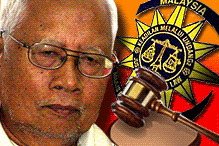
There is definitely merit in the call for an independent inquiry into why, how and who were responsible for the 1988 judicial crisis, said former United Nations special rapporteur on the independence of judges and lawyers Param Cumaraswamy.
There is definitely merit in the call for an independent inquiry into why, how and who were responsible for the 1988 judicial crisis, said former United Nations special rapporteur on the independence of judges and lawyers Param Cumaraswamy.
 In a statement over the weekend, he said any inquiry must be seen to be independent, credible with powers to compel to appear and be examined.
Under our present system only a royal commission of inquiry is available provided there is political will to trigger this mechanism, he added.
"Even then could such a commission be able to compel the high dignitaries involved in the affair?" he asked in reference to the then Yang diPertuan Agong, former premier Dr Mahathir Mohamad, then chief judge of Malaya Hamid Omar and former attorney-general Abu Talib Othman.
"Practically all of them would claim immunity for their conduct under the existing protection available for such dignitaries holding public office," Param said.
"Without these four personalities being able to be examined for their conduct and actions in the whole affair we may not be able to establish the truth and culpability," he added.
Recently, Bar Council president Yeo Yang Poh called for a re-examination of the judicial crisis, which saw the sacking of then Lord President Salleh Abas.
Numerous quarters, including Salleh, who broke his protracted silence over the incident, supported the call.
However, the government dismissed it, saying there were no solid reasons for it to re-examine the crisis and that it cannot indulge the 'whims and fancies' of certain individuals.
In 1988, Mahathir had Salleh tried by a special tribunal on charges of misconduct for questioning constitutional amendments that seriously eroded the powers of the judiciary.
Two of five Supreme Court judges - George Seah and Wan Sulaiman - who ruled that the tribunal was convened unconstitutionally were sacked along with Salleh, after being found guilty of misconduct by a tribunal of six judges, including one each from Singapore and Sri Lanka.
'Most shocking event'
Commenting further on the crisis, Param said it was seen both domestically and within the international legal fraternity as the "most shocking event in the constitutional history of Malaysia".
 "The dismissals of Salleh Abas, Wan Sulaiman and George Seah on charges that would not be sufficient to even upbraid a low-functionary in the public service left the chilling effect demonstrating not only to the judiciary but to all Malaysians where the balance of power lay in our system government then.
"The report of the tribunal which recommended the dismissal of Salleh Abas was aptly described by an eminent foreign commentator 'as one of the most despicable document in legal history'," he added.
He also quoted former Lord President Suffian Hashim as saying that it would take another generation to restore the independence of our judiciary.
Soon after this 'sordid event', Param said regional organisation LawAsia (Law Association for Asia and Pacific) considered setting up an Asian Commission on Justice and invite five retired eminent senior judges in the region to examine the reports of the two tribunals and advise whether the process and findings of the tribunals were in accordance with internationally accepted standards of justice.
"No doubt the findings of the commission would not be binding on Malaysia. However, it would have had a moral effect," he added.
According to Param, due to difficulties in raising sufficient funds the proposal for such a commission was not pursued.
"However an examination of the records and findings of the two tribunals would not establish those responsible and who should be made accountable for those events. Hence, the Malaysian public will have to leave it to the conscience of those responsible.
"They will be made accountable sooner or later to the Almighty for the desecration of the temple of justice then," he said.


