




Proposed gender bill to comply with syariah law
A women's group which is pressing for a gender equality bill said that the new legislation will be made compatible with the country's Islamic laws.
A women's group which is pressing for a gender equality bill said that the new legislation will be made compatible with the country's Islamic laws.
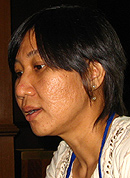 Penang-based Women's Centre for Change (WCC) vice-president Zarizana Abdul Aziz (
photo
) said today that the suggested bill will be drafted to suit Malaysia's unique social context, where 60 percent of the population are Muslims.
Penang-based Women's Centre for Change (WCC) vice-president Zarizana Abdul Aziz (
photo
) said today that the suggested bill will be drafted to suit Malaysia's unique social context, where 60 percent of the population are Muslims.
WCC is mooting the proposed bill to, among others, wipe out discrimination against women in the workplace.
"The Federal Constitution says that there shall be no discrimination on the grounds of gender," Zarizana told reporters after the presenting ideas on the proposed bill at the International Conference on Mechanisms and Legislation to Promote and Protect Gender Equality held in Petaling Jaya.
However, the courts have interpreted the constitution's Article 8 as only requiring the government not to practise discrimination against women. Private individuals and companies are exempted.
.
Zarizana was referring to the high-profile case of Beatrice Fernandez , a stewardess who was sacked in 1991 by national carrier Malaysia Airlines for refusing to resign when she became pregnant.
Fernandez eventually lost a 14-year battle in March last year when the Federal Court - the country's highest court - rejected a petition to review employment terms deemed restrictive towards female employees.
Zarizana argued that Malaysian courts have understood gender discrimination differently from those in other countries.
"Some countries don't need legislation because equality comes out from the law naturally and is a part of justice."
The suggested bill will also include the establishment of a commission, similar to the Human Right Commission, or Suhakam. Among the tasks of the commission is to help bring reconciliation informally between conflicting parties.
It will also set up a tribunal, or a mini-court, to adjudicate cases of gender discrimination. The tribunal could however refer its cases to the High Court.
Consult syariah courts
Asked on whether the bill would encroach on the country's syariah law, Zarizana replied: "The syariah law, as far as I can see, only pertains to personal laws. If a case is brought before commission that pertains to the syariah, the commission can consult the syariah courts or choose not to take on the case."
She explained that the draft bill will be further refined at the three-day conference which kicked off yesterday.
In drafting the bill, women activists seek to draw on existing gender equality mechanisms in 20 countries.
"We will looked at common law countries and European ones simply because they have very developed law on equality and discrimination."
Some of the proposed clauses include:
- Discrimination of women is defined as 'treating women differently for reasons of pregnancy, childbirth or breastfeeding'.
Zarizana later added that they would consult the Joint Action Group - a coalition of women's groups - further before presenting a memorandum on the proposed bill to the government, which was estimated to take place next year.


