




Gov't concedes mistake, says Husam
An opposition leader who had earlier criticised the sale of medical services giant Pantai Holdings Bhd to a Singaporean company said the government has now conceded its mistake to giving the green light for the controversial deal.
An opposition leader who had earlier criticised the sale of medical services giant Pantai Holdings Bhd to a Singaporean company said the government has now conceded its mistake to giving the green light for the controversial deal.
The government's investment arm Khazanah Nasional Bhd announced on Monday that it would "buy back" the shares which was sold to Singaporean company Parkway Holdings Ltd late last year.
Parkway last November became the controlling shareholder in the Malaysian company when it bought the stake from a group of local businessmen for RM311.6 million.
Khazanah is paying RM394.9 million for the shares to ensure that the healthcare company remain in local hands.
PAS vice-president Husam Musa however claimed that while the announcement was the government's admission of error, those responsible should not be allowed to get away scot-free.
He said the shares 'buy back' was an "open confession" by the Finance Ministry of its mistake in approving the sale of a majority stake of 31 percent of Pantai to Parkway last year.
 "If not, why the need to buy back the shares?" said Husam, who has written
an open letter
to Prime Minister Abdullah Ahmad Badawi on the matter two weeks ago.
"If not, why the need to buy back the shares?" said Husam, who has written
an open letter
to Prime Minister Abdullah Ahmad Badawi on the matter two weeks ago.
"The deal was a mistake because, among others, two of Pantai's subsidiaries are involved in privatisation programmes and under current government regulations, a company given a privatisation concession cannot fall into the hands of foreigners," he added in a statement today.
New deal flawed
Husam pointed out that the sale of the controlling stake of a local company to a foreign entity requires the approval from the Finance Ministry.
"Since the mistake has been admitted, someone in the ministry must accept responsibility for it," he said.
Husam however believed that the mistake was deliberate and it is only now that steps are taken to rectify it after the deal became a controversy.
 Nevertheless, the opposition leader argued that the 'buy back' deal was flawed and nothing more than a "cosmetic exercise to save the government's face".
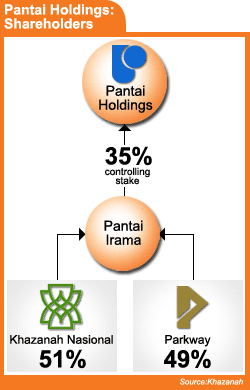
According to him, Parkway in addition to getting RM357 million from the sale of its recently acquired shares, the Singaporean company has been given the opportunity to own 49% in Khazanah subsidiary Pantai Irama Ventures, which now controls Pantai.
Husam said the company has also been given the management right in Pantai for 15 years.
"This means, Parkway controls the management of Pantai and at the same time continues to own shares in the company," he added.
He said Prime Minister Abdullah Ahmad Badawi, who is also finance minister, must take responsibility for the fiasco and provide a full explanation on the matter.
Minister: Not a bailout
Parkway's controlling stake in Pantai, which operates seven hospitals in Malaysia, had raised eyebrows since the latter is the sole concessionaire for supervising health checks on foreign workers and for providing support services to government hospitals.
Two days ago, Khazanah announced that its subsidiary Pantai Irama had entered into an agreement to buy Parkway's stake in Pantai.
The government's investment arm will then sell a 49% stake in Pantai Irama to Parkway and enter into a shareholders' agreement that would see it (Khazanah) maintain majority equity ownership of Pantai Irama and for Parkway to manage and operate the hospitals under Pantai at a later date.
Yesterday, Second Finance Minister Nor Mohamed Yakcop defended Khazanah's move to acquire a 30.68% stake in Pantai. He said the transaction was purely market driven and not a bailout.
He stressed that the question of bailout did not arise as Pantai was already a profitable company.
The company reported a higher turnover of RM833.42 million for the year ended June 30, 2006 from RM691.159 million previously.
Pre-tax profit totalled RM57.393 million for the year under review from RM67.549 million in the previous year.
"From the outset, the purchase (by Khazanah) will solve the issue that had cropped up," Nor Mohamed was quoted as saying by Bernama .
The second finance minister was referring to the concerns that foreigners should not hold a controlling stake in strategic sectors like hospitals and medical care.


