




G'ovt boosts spending with expansionary budget
 The government tabled an expansionary 2007 budget today, giving a hefty boost to development spending to defy a looming slowdown and secure its goal of achieving developed status by 2020.
 The government tabled an expansionary 2007 budget today, giving a hefty boost to development spending to defy a looming slowdown and secure its goal of achieving developed status by 2020.
Prime Minister Abdullah Ahmad Badawi said the country was now at the midway point in its campaign to become the world's first Muslim developed nation.
 "The journey ahead is full of challenges. We must be determined, dedicated and act with a sense of urgency to ensure we achieve the national objectives within the stipulated timeframe," he told Parliament.
However, Malaysia said it had been forced to scale back its 2006 economic growth forecast to 5.8 percent from 6.0 percent, citing challenges including high oil prices and competition from China and India.
Abdullah said the new forecast was a "credible performance, given the uncertainties in the global environment".
"This encouraging economic performance has been accompanied by an improved balance of payments position, high levels of savings and liquidity, as well as a stronger ringgit," he said.
Economists hailed the budget as a "pump-priming" initiative and welcomed decisions to cut the corporate tax rate from 28 percent to 26 percent by 2008, and to streamline the processing of expatriate visa applications.
Abdullah said the corporate tax cut was aimed at enhancing the competitiveness of Malaysian firms and to spur the private sector which is "the engine of economic development" in the country.
"I think it has hit some right notes in a number of areas, particularly in lowering corporate taxes to spur private sector activities," RAM consultancy services chief economist Yeah Kim Leng said of the budget.
"It is important for Malaysia to try to alleviate the human capital constraints that have been limiting our growth so far," he said.
"In conjunction with the lowering of the corporate taxes, it will be one of the measures that will be welcomed by the private sector... and foreign investors."
Development spending
The Finance Ministry said the government will increase total spending by 16.6 percent to RM159.4 billion for 2007.
For the 2006 Budget, the government has allocated RM136.8 billion, an increase of 5% compared to 2005.
"The increased expenditure is aimed at sustaining the growth momentum given the more challenging external environment," it said.
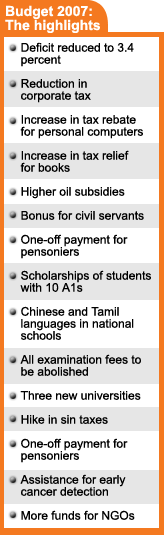 Development spending for 2007 - including the areas of transportation infrastructure, education, health and defence - saw a significant rise, increasing by 24.3 percent to RM44.51 billion.
The Finance Ministry forecast Gross Domestic Product (GDP) to grow by 6.0 percent in 2007, saying that despite the threat of geopolitical tensions, Malaysia will profit from higher crude oil prices next year.
The ministry said it also expected to cut the budget deficit to 3.4 percent of GDP next year from an estimated 3.5 percent in 2006.
The inflation rate as measured by the consumer price index (CPI) is projected at 3.7 percent for 2006 against 3.0 percent in 2005 due to higher crude oil prices.
For the first seven months of 2006, Malaysia's CPI rate rose by 3.9 percent following higher energy costs.
Other notable expenditure included RM4 billion for programmes to eradicate poverty and to narrow the gap between the country's urban population and rural poor.
One billion ringgit has been set aside for research and development activities, especially in the biotechnology and information technology industries.
Tourism is Malaysia's second-largest foreign exchange earner and the government said RM400 million would be spent to promote tourism in 2007, which has been designated "Visit Malaysia Year".


Are you sure you want to delete this comment?
This action cannot be undone.