


'Pendatang' Kian Tan uses ancient works to explore history, identity
MALAYSIANSKINI | When you step into the terrace house, the first thing you will see is a big Buddha statue before you enter the living room with rows of wooden bookshelves. There are two desks with a computer, books and painting sets. The smell of incense is in the air.
It’s hard to imagine this is the studio of a young artist. Thirty-year-old Kian Tan has just returned from the Taiwan Art Biennale two months ago and is now settling in Kluang, Johor - the small town where he grew up.
Over the past five years, he has completed a series of rubbing project works with various ancient tombstones and war monuments that delve into personal and collective memories; probing postcolonial conditions, immigration and the ambiguous position of the Chinese diaspora.
Rubbing, a modern revival of ancient art is the technique of transferring an engraved design from an existing textured surface onto a sheet of paper pressed tightly against a textured surface.
While others may use wax or crayon to transfer the engravings, Kian uses aluminium foil for his rubbing work.
A vision of the afterlife
His work has been exhibited in several art galleries in both Taiwan and the United Kingdom and in the 2020 Taiwan Art Bienniale themed "Sub Zoology", Kian "transported" a series of Chinese tombstones which had been erected during the British-Malayan era to the gallery in a series he calls "Paradise".
In it, he aims to capture the traditional funeral customs related to the social status of Chinese overseas leaders who came to Malaya during the Qing Dynasty (1644 to 1912) and what their imaginations of an afterlife might be.
Kian’s showroom was like an indoor cemetery with dark-blue light in the night. Shining silver...
MALAYSIANSKINI | When you step into the terrace house, the first thing you will see is a big Buddha statue before you enter the living room with rows of wooden bookshelves. There are two desks with a computer, books and painting sets. The smell of incense is in the air.
It’s hard to imagine this is the studio of a young artist. Thirty-year-old Kian Tan has just returned from the Taiwan Art Biennale two months ago and is now settling in Kluang, Johor - the small town where he grew up.
Over the past five years, he has completed a series of rubbing project works with various ancient tombstones and war monuments that delve into personal and collective memories; probing postcolonial conditions, immigration and the ambiguous position of the Chinese diaspora.
Rubbing, a modern revival of ancient art is the technique of transferring an engraved design from an existing textured surface onto a sheet of paper pressed tightly against a textured surface.
While others may use wax or crayon to transfer the engravings, Kian uses aluminium foil for his rubbing work.
A vision of the afterlife
His work has been exhibited in several art galleries in both Taiwan and the United Kingdom and in the 2020 Taiwan Art Bienniale themed "Sub Zoology", Kian "transported" a series of Chinese tombstones which had been erected during the British-Malayan era to the gallery in a series he calls "Paradise".
In it, he aims to capture the traditional funeral customs related to the social status of Chinese overseas leaders who came to Malaya during the Qing Dynasty (1644 to 1912) and what their imaginations of an afterlife might be.

Kian’s showroom was like an indoor cemetery with dark-blue light in the night. Shining silver tombstones and animal replicas were hung around or scattered on the floor.
In ancestral Chinese cemeteries, stone statues usually stand guard on both sides of the tomb's front with the types of animal that indicate the deceased’s rank. This custom was practised by wealthy and influential families and officials who were conferred rank from the Qing governor at that time.
Words engraved on a tombstone usually convey the historical background of that era. For example, the late Kuala Lumpur Kapitan Yap Ah Loy has two titles on his tombstone - one of them was Kapitan China, a government position during the European colonial period in Malaya; the other a title conferred by the Qing governor.
After almost a hundred years, these statues are still guarding the graves as well as the social status of the dead.
The foil - which Kian is using to rub the tombstones or memorials across Malaysia - is widely seen in daily life but is a rare material in the museum. And art.
A fragmented history
Kian sees the fragile material as reflecting the fragmented nature of history.
“I had been living in several places these past years and was curious about the diaspora context of the Chinese. And I found that the context is fragmented, fluid and not comprehensive.
“It’s similar to the process of creating my works, wrapping the real tombstone or statue with a few pieces of foil paper, rubbing it, trimming the extra parts and collaging them into an installation before sending them abroad.
“Thus, I think this material could be linked with identity and death and express my doubt over a history that is constructed and fragile.”

He said his chosen medium does pose difficulties in transportation and storage but its impermanence fascinates him. It has a lot to do with Buddhism which Kian studied for almost 16 years.
“Yes, it is hard to maintain but this is what I want. I get inspiration from paper offerings, it is made to be burnt or destroyed. My other inspiration is from the sand mandala (a Tibetan Buddhist tradition involving the creation and destruction process and made into ornate shapes from coloured sand).
“The Tibetan monk must be extremely attentive while drawing a sand mandala but it will be ritualistically dismantled once it has been completed.”
The ritual is said to symbolise the Buddhist doctrinal belief in the transitory nature of material life.
“It’s the process that matters. My artwork is deeply influenced by Buddhism, including the discussion of impermanence and the transitory nature of material life," Kian added.
An awkward boy and poor student
Kian was born into a Buddhist family and grew up in a temple but had little practice in rituals like burning incense and worshipping.
During his first two years in secondary school, Kian was an unpopular figure among peers and did poorly in academic performance.

Interestingly, things changed after he attended a one week Buddhism camp in Taiwan and realised that Buddhism was not just about religious rituals but provided explanations for life, psychology and the relationship between human beings and the world.
“I had reached a breaking point during that period, my family was giving up on me due to my poor academic performance and my relationship with my schoolmates was really bad. I believed there was an absolute right or wrong for everything and I would fight with my friends if they didn't accept my opinions.
“Buddhism helped to get rid of my binary mindset and become more well-rounded. (After the camp) I was wondering what would happen if I lived such a disciplined life. So I tried and that changed me a lot,” he said.
Kian began putting more effort into his work and became one of the top students for the arts stream in his high school.
Dreams of being a painter
While Kian is now more of a contemporary artist, he once dreamt of being a painter. He was good at oil painting and pursued studies in fine arts at the National Taiwan Normal University (NTNU) in 2011.
However, his perceptions changed after he took courses in another school - the Taipei National University of the Arts (TNUA) which is a leading contemporary arts institution.
In his first class at TNUA, one of his award-winning oil paintings was questioned by the teacher which stimulated him to think about the purpose of making art.
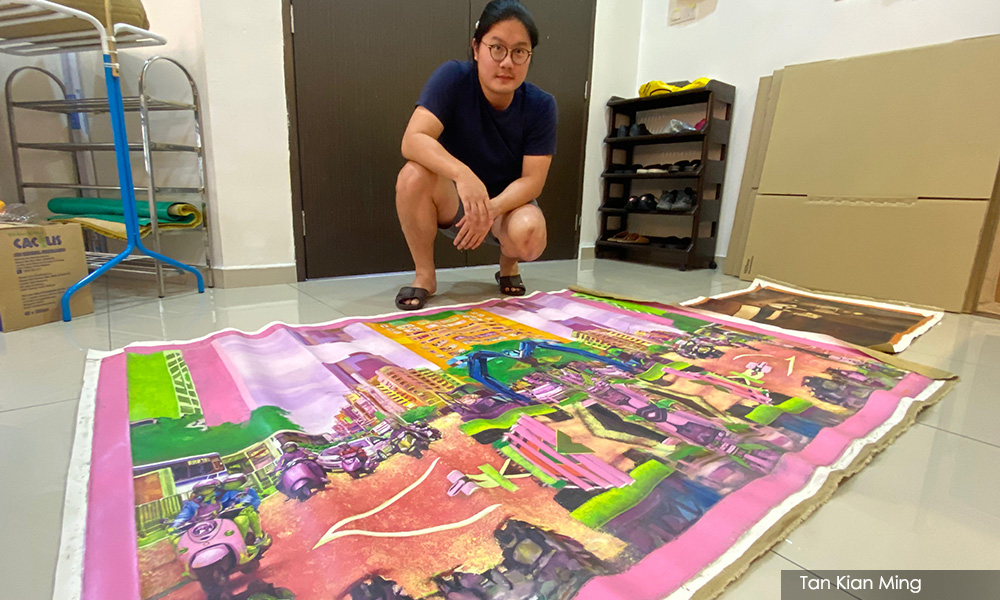
"That was a big shock for me when I realised my works were still very ‘formalised’. For one of my oil paintings that won third prize in my school, I painted a Taipei street scene in a kaleidoscope way to express a sense of being lost in a foreign land.
“My teacher’s questions made me think about the importance of mixed media art and why I chose oil painting to express myself. Before that, I just wanted to show the skill of oil painting. But skill is not art. It’s just a form of expression,” he added.
Pendatang – issues of history and identity
His current work revolves around the topics of history and identity.
“The traditional mediums, including Western or Chinese painting, have been linked strongly to their culture, history and nation. There would be some contradiction if I use them to discuss these critical issues.
“And foil paper was only introduced after the Industrial Revolution. Instead of using a material that has been interpreted, I chose to use a material that I could interpret,” he said.
The first artworks he did, using foil paper for tombstone rubbings, were for his college graduation solo exhibition in 2015. The name of this exhibition was "Pendatang", a Malay word meaning traveller or outsider.
The inspirations for this theme were many, including the "Chinese pendatang" issue in Malaysia, being rejected from some of the competitions and exhibitions due to his foreigner status and his difficulties in fitting into the community while studying abroad.
But the most important trigger was Taiwan's "Overseas Chinese Student (Qiao Sheng) Policy". In 2014, when Kian was filling out a form, he noticed a required column of "overseas residence address", for which he wrote Malaysia.
The definition of "overseas Chinese" (hua qiao) should be those who have a nationality of China (PRC) or Taiwan but reside in other countries while those who hold another country’s passport like Malaysia should be "Ethnic Chinese".
However, in the 1950s when the Chinese Civil War ended with the defeated Kuomintang retreating to Taiwan and the Chinese Communist Party controlling mainland China, both sides implemented this policy to gain support from overseas ethnic Chinese who were working abroad especially in South East Asia.

The US allegedly funded the policy in Taiwan to prevent students from going back to communist-controlled mainland China. This policy continues to be implemented today in Taiwan. A Malaysian Chinese student who wants to study in Taiwan can apply as an overseas Chinese student or international student but the latter’s tuition fees are much higher.
“I started to think about national identity and nationalism and had some new inspiration. It was new to me since we all considered ourselves as ethnic Chinese in Malaysia. And I went to Taiwan as an international student.
“Out of curiosity, I read a lot of history about Chinese immigrants and attended various related classes in NTNU.”
The turning point
Kian admitted that he knew little about identity, democracy, or public affairs before he went to Taiwan.
The turning point came in 2013 to 2014 when he returned to his hometown to vote in the 13th general election with a group of Malaysian students.
He also witnessed the "Sunflower Movement" - mass students’ protests in Taiwan the following year.
“That was when I realised the people could talk or act on issues like legislation, justice and democracy and not just remain frustrated.”
Upon his return to Malaysia, he travelled across the country to "collect" the ‘Overseas Chinese Anti-Japanese War Memorial’ and related monuments with foil paper rubbing.
Many monuments were inscribed with the words "overseas Chinese" and used the Republic of China (RoC) calendar which was launched by the Kuomintang - reflecting the complicated relationship among the Chinese community in Malaya during the Cold War period.
"I believe Malaysia has been independent and we should be ‘overseas Malaysians'," said Kian.
"Pendatang" was the third exhibition that Kian curated in Taiwan. Before that, he had organised an exhibition with the GE13 theme together with several Malaysians in Taiwan as well as a group exhibition called "Transit" with a bunch of Malaysian art students.
His art journey did not stop there but has taken him further and kept him constantly on the move.
He pursued his master's degree in arts at the London Goldsmith University after studying English courses in Kuala Lumpur. He later completed his thesis in his home country after the Covid-19 outbreak in the UK last year.
Kian has now expanded the theme of “Pendatang” to a series of foil paper tombstone installations called “The exploration of immigrants”.
Among them are the "Homeland Déjà Vu" collected tombstones from Bukit China Malacca, one of the oldest cemeteries for Chinese immigrants which can be traced back to the late Ming dynasty that preceded the Qing dynasty.

In "The Ancestor", Kian explored the fragmented aspects of his Chinese identity by tracking down the ancestral tombstone of his great grandfather. As a fourth-generation Chinese in Malaysia, Kian has kept the surname and the place-name of his ancestral residence (Fujian/Hokkien).
'Who am I?'
However, he does not have blood relation to him since his great grandfather adopted his grandfather who in turn adopted his father. From Kluang to Taipei to London, Kian has been a pendatang for more than 10 years in different places and does not rule out the possibility of leaving again.
“I kept moving around and was deemed as a pendatang while living in different places. I tried to fit myself into those communities, knowing that I would leave in a certain period of time.
“I was pessimistic about these situations initially but afterwards I think it is what ‘life’ means. I found that I don’t really like to stay in one place forever. When I returned to Kluang, the place that I grew up in, sometimes people consider me as an outsider too. But I really enjoy it, especially when I try to adapt to the different pace of life and ways of communication.
“It’s important for an artist to rethink ‘who am I’ while moving around. When you’re very sure of who you are, it’s kind of boring. Art is not to solve problems but to probe more possibilities, ask questions and provide a platform to discuss issues,” he said.
Nonetheless, Kian admitted that it might be challenging to promote his works in a multiracial country like Malaysia since they seem to be more of a Chinese issue. So far, his works have not been exhibited here.

“There might be a communication gap between the different races when promoting my works. Although I hope to get it out on the common ground, I wish to have a more in-depth discussion as well.
“Fortunately, artworks are usually a medium for communication. I could transform the content into visuals so that they could reach a very different group of people. When I release my works in a gallery, the audience could be from different races.”
For Kian, art is not only a tool to express personal feelings but also a medium to rethink and question historical and current affairs.
“If I release my works in a place like the UK which is not familiar with the issue, the people would not have much sensitivity towards it. If I release it in Malaysia, where the issue comes from, I would receive more interaction and even criticism, which could improve me.
“I’m looking forward to the discussion that could happen in Malaysia. I am also very active in making new friends in the local art and cultural fields.
“(But) if there comes a time when I think it's time to leave, whether it’s because of a survival issue or I’m in a pessimistic mood, it wouldn’t be a bad thing. At the moment I’m full of energy,” says Kian with laughter.
MALAYSIANSKINI is a series on Malaysians you should know about.
Previously featured:
'No uterus, no vagina' - Wani Ardy's mission to normalise sexual health
Ili Nadiah just can’t stay silent in the face of climate crisis
How teacher Dinnie makes award-winning films in rural Sarawak
Space programme finalist Vanajah still reaching for the stars
Fighting for justice is in her blood
Bake with dignity - Empowering adults with disabilities through baking



Report this comment
Are you sure you want to delete this comment?
This action cannot be undone.