




Don't write off Dr M just yet
Dr Mahathir Mohamad failed in his bid to be elected as a candidate in the Kubang Pasu division which he had led for more than three decades. And his opponents are celebrating.
Dr Mahathir Mohamad failed in his bid to be elected as a candidate in the Kubang Pasu division which he had led for more than three decades. And his opponents are celebrating.
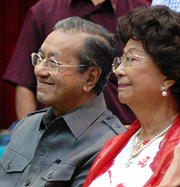 However, the real cause or causes for what is popularly perceived to be a 'humiliation' has yet to be public discoursed with length and depth.
First and foremost, it showed that any concrete attempt to have him return to power, whether real or merely speculative, had been decisively defeated. Bluntly, there is no hope whatsoever for Mahathir to become Umno president or prime minister again.
More likely than not, it is this perception that has caused his latest nemesis, Prime Minister Abdullah Ahmad Badawi, to appear confident and magnanimous enough to extend an invitation to his predecessor to be a VIP at this November's Umno general assembly without the right to speak or participate in the debates.
However, the question of whether Mahathir's failure to become a delegate is a tactical or strategic setback remains to be answered.
True survivor
From the long history of his ups and downs in political involvement and participation, it is clear that Mahathir suffered even more humiliating or ignominious setbacks. This included the alienation and isolation from the mainstream of the old Umno under the leadership of the late Tunku Abdul Rahman until 1964 as the result of his opposition to the Tunku's pro-British and right-wing foreign and defence policies.
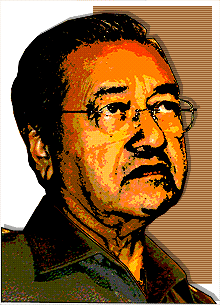 Not to forget, his 1969 electoral defeat by PAS in the Kota Setar parliamentary constituency which he served for one term after being elected in 1964 as well as his expulsion from the old party from 1969 to 1972.
Yet, he bounced back to become Malaysia's longest serving Umno president and prime minester. His 22-year tenure was longer than that of Tunku who served for 13 years from 1957 to 1970.
Even during his tenure as Umno president and prime minister, Mahathir had to confront situations and alignments of forces that were extremely adverse to his power and position. For example, he was nearly toppled by another nemesis, Tengku Razaleigh Hamzah in the 1987 party elections.
During the 1997 Asian Financial Crisis and subsequent Anwar Ibrahim saga, many prophets of doom, both local and foreign, also 'predicted' Mahathir's downfall, but, like it or not, he survived.
Even in the current round of confrontation with his chosen successor Abdullah, Mahathir made many breakthroughs catapulting himself from political obscurity or marginalisation to the front pages and sparking off popular and passionate debates on a wide range of issues.
His determination to fight amid adversities as well as his survivalist and killer instincts, leads to one reasonable conclusion: while Mahathir is 'politically dead' as far as returning to power is concerned, his ability to be a kingmaker or one capable of dethroning a king should not be dismissed.
The pattern of his political behaviour suggests that he fights best strategically after suffering from tactical setbacks, especially personally humiliating ones.
Don't forget Mukhriz
Another factor that should not be ignored is that his son Mukhriz did make it as a delegate in Kubang Pasu. Therefore, at the very least, Mahathir now has a trusted spokesman or mouthpiece to represent his views and opinions to the Umno general assembly.
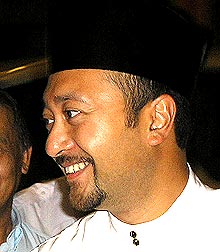 The election of Mukhriz is also significant for a larger and more strategic reason: he could become a focal point of loyalty and dedication among Mahathir's hardcore loyalists and pro-Mahathir forces in the country, providing a real as well as symbolic sense of continuity of their struggle.
In other words, as far as Mahathir's camp is concerned, Mukhriz's election as a delegate has offset the negative implication of the old man's defeat.
Therefore, for those who see Mahathir's personal defeat last Saturday as the end to factionalism within Umno or that the pro-Mahathir forces would disintegrated, they could be disappointed.
Of course, it could also be argued that the younger and politically less experienced Mukhriz is no Mahathir although they are tied in blood. But what cannot be denied is that while the pro-Mahathir forces, which have already been supplied or animated with ideas by Mahathir and organised or networked by means like blogs and websites, need only a symbol of continuity and renewal, not so much of real leadership.
Another larger and more strategic question that has been obscured by the triumphalist mood and propaganda of Mahathir's opponents is the number of pro-Mahathir delegates elected in Umno divisions other than Kubang Pasu.
What is the nationwide balance of forces among the elected delegates who are pro-Mahathir and those who are pro-Abdullah?
Psychologically, the personal defeat of Mahathir might even paradoxically strengthen the collective resolve of his younger supporters and loyalists to claim 'revenge' for their paramount leader's loss of face.


