




Computer analysis reveals poll irregularities
Computer analysis conducted by opposition party PKR's central elections committee has allegedly detected irregularities in the 2004 electoral roll.
Computer analysis conducted by opposition party PKR's central elections committee has allegedly detected irregularities in the 2004 electoral roll.
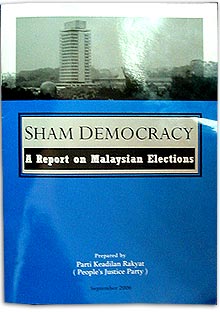
Among them, said the committee in their report entitled 'Sham Democracy: A report on Malaysian elections', two identical polling stations were said to have existed in the Selangor parliamentary constituency of Gombak.
 The two polling stations of Kemensah recorded, however, different results.
The computer programme, according to the committee's deputy chair Dr Mansor Othman was called SISMEP12 - (Sistem Menang Pilihanraya Ke-12), was also able to detect voters without polling booths.
"In Selangor alone, this amounted to 223,950 voters - and the confusion which arose from it in the 2004 elections caused ugly commotions," said the report.
The report also said that computer analysis of the electoral rolls in Selangor, Kuala Lumpur, Penang, Perak, Pahang and Kedah uncovered 20,048 cases of voters aged between 90 and 122 years.
While the new MyKad identity cards were introduced more than 15 years ago, the report said 57,068 voters had been identified without the new identity card numbers.
Revealing the method behind the analysis, Mansor said the electoral roll - an electronic copy of which the Elections Commission (EC) has made available to the public - was arranged according to locality.
"We then conducted on-the-ground field work to verify the addresses on the electoral roll," he said when contacted.
According to Mansor, a PKR supreme council member who also heads the party's research bureau, such efforts resulted in being able to significantly 'cleanse' the electoral roll of 'fraud and other dirt'.
30-page report
Mansor said one example of an irregularity in the electoral roll was the identification of a fictitious address in Kampung Kelang Gate in Hulu Kelang, Selangor, that purportedly housed six voters living in a high-rise apartment.
 "But when we got there, we found that the house in question was in the middle of a squatter settlement and there was no high-rise building to be found anywhere," he added.
The 30-page report, which also addresses other forms of abuses and irregularities pertaining to the elections and other democratic processes and instruments, contained recommendations towards achieving free and fair elections.
These include reforms to develop a more independent EC unbeholden to the ruling parties, the more 'substantial' participation of international observers, and the improvement of the mechanisms and tools normally vital for genuine democracy, such as a free press.
Legislative reforms also need to be put in place for the electoral process itself, including to address the prime minister's 'unbridled power' to determine when Parliament is to be dissolved.
There also needs to be a change to bring about a more reasonable period between the dissolution of Parliament and nomination day, and between nomination day and election day, said the report.
Postal voting, it said further, should be established in favour of more transparent methods of voting available with the advances in information and communication technology, and the practice of indelible ink introduced to prevent multiple voting or dubious individuals from voting.


