
Private sector will be roped in to partially fund MRT3 project
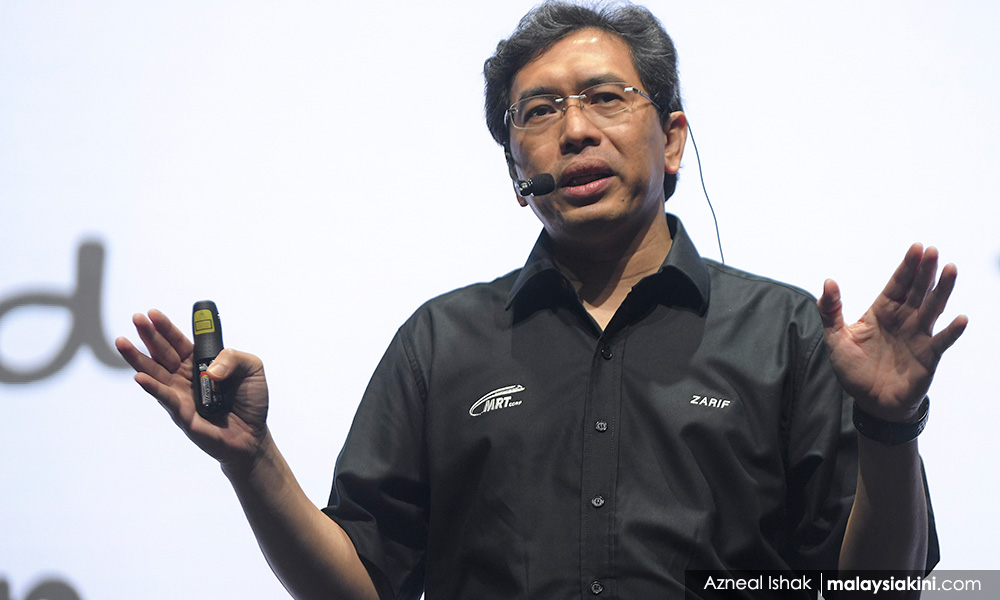
The MRT3 project will be partially funded by the private sector, according to Mass Rapid Transit Corporation Sdn Bhd (MRT Corp) chief executive officer Mohd Zarif Hashim.
Zarif (above) said between 10 and 30 percent of the project cost may involve private funding.
"We are looking at a hybrid model and we are taking the initiative to invite private companies," he told journalists during a briefing on the revived project in Kuala Lumpur today.
The model is a variation from the previous MRT1 and MRT2...
The MRT3 project will be partially funded by the private sector, according to Mass Rapid Transit Corporation Sdn Bhd (MRT Corp) chief executive officer Mohd Zarif Hashim.
Zarif (above) said between 10 and 30 percent of the project cost may involve private funding.
"We are looking at a hybrid model and we are taking the initiative to invite private companies," he told journalists during a briefing on the revived project in Kuala Lumpur today.
The model is a variation from the previous MRT1 and MRT2 projects which were fully funded by Putrajaya through DanaInfra Nasional Bhd which raised government bonds.
However, Zarif said between 70 and 90 percent of the MRT3 project cost will still be funded by the government.
He said the route of the MRT3 line will be finalised by August.
"The construction work will start by early next year," Zarif said adding that MRT Corp was in the midst of collecting feedback and suggestions from different parties on the alignment.
“Hopefully, in three months time we will be able to share the final alignment with the public after approval from the government,” said Zarif.
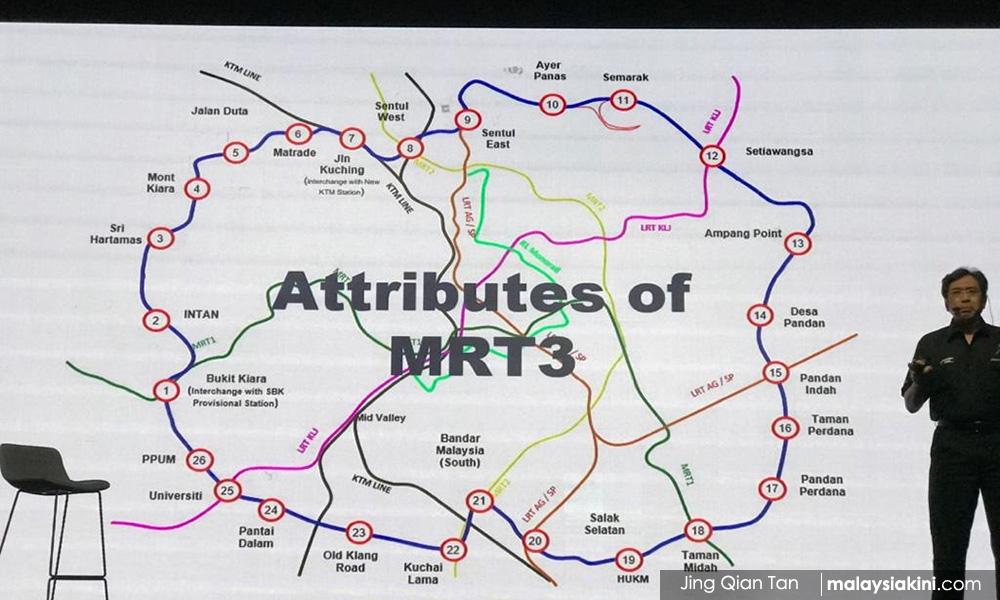
Based on the presentation, the circle line will start at Bukit Kiara on the west, passing through Sentul at the north and then going to the east through Ampang before going to the south around Old Klang Road and the Pantai Dalam areas.
Zarif added that MRT Corp is expecting to call tenders in August and complete the awarding process by the end of the year.
Five phases
According to Zarif, MRT3 will include about 30 stations, with 10 interchange stations. The total length of the line will be about 50km, 40 percent of which will be underground.
He said although the overall project could take up to 10 years to build, he said they will become operational in phases. There are a total of five phases.
Asked about the total cost of MRT3, Zarif said he could not reveal the figures yet but said figures reported in the news were "not that far off".
Business portal The Edge Markets quoted analysts as estimating the project cost to be between RM20 billion and RM30 billion.
The MRT3 project, also known as the circle line, is intended to link up the various rail lines in the Klang Valley.
It was initiated by the Najib Abdul Razak administration in 2017and then featured 26 stations within 40km at an estimated cost of between RM40 billion and RM50 billion. It was expected to be completed by 2025.
However, the project was cancelled by the Pakatan Harapan government in 2018 as part of efforts to reduce the nation's debt.
The MRT 1 project linking Sungai Buloh to Kajang became fully operational in 2017.
The MRT2 project, also known as the Putrajaya line, links Sungai Buloh to Serdang and on to Putrajaya. The first phase is expected to begin operation later this year while the full operation is expected by 2023.
Multiplier effect
Describing the mega-project as a ‘large transformation’, Zarif said the MRT 3 project was not just a construction project but a 'Transit-Oriented Development' (TOD) which would deliver a series of social and economic programmes.

For example, he said, affordable housing could be built along the circle line which connected to the existing radial line so that the residents could enter the city centre easily. They also need not go through the city centre anymore in order to go to the other side of the city.
Zarif anticipated that the project would have a 3.5 times multiplier effect on the Malaysian economy.
“From our own calculations, we are going to get about 3.5 times higher in terms of a multiplier. If we spend a ringgit today, we have to get about 3.5 ringgit back to the economy,” said Zarif, adding that MRT Corp was looking to cooperate with several parties such as government agencies and also property developers.
Apart from that, Zarif said the rail project would reduce reliance on foreign workers with construction methods changed to attract more local youth.
Thus, the project sought to emphasise construction manufacturing such as industrialised building systems (IBS) as this method would be more conducive for employees, said Zarif.