


Malaysian dream of foreign workers remains just that
For foreign workers like 'Amin' and 'Shamin', Malaysia is where they hoped to find their proverbial pot of gold - this was what they were promised.
Tales spun by agents of high-paying jobs and a life of luxury have lured thousands like them to our shores.
They forked out large sums of money, often selling family heirlooms or mortgaging property, in the hope that they would return home in a few years with bags full of money.
Almost all ended up disappointed working in sweatshops and factories for menial salaries and are subjected to exploitation at every turn. In most cases, entire families are trapped in debt bondage.
Amin is the only son of a small businessperson. His father ...
For foreign workers like 'Amin' and 'Shamin', Malaysia is where they hoped to find their proverbial pot of gold - this was what they were promised.
Tales spun by agents of high-paying jobs and a life of luxury have lured thousands like them to our shores.
They forked out large sums of money, often selling family heirlooms or mortgaging property, in the hope that they would return home in a few years with bags full of money.
Almost all ended up disappointed working in sweatshops and factories for menial salaries and are subjected to exploitation at every turn. In most cases, entire families are trapped in debt bondage.
Amin is the only son of a small businessperson. His father emptied his life savings to pay for the recruitment agent's fees and a student visa application to enable him to enter the country.
Some foreign labourers enter the country on student visas as they have not yet secured a job. After arrival, they seek out employment and are again subject to exploitation by Shylock-type agents.
“That’s why I worked very hard for the first few years in Malaysia, I want to pay him back, I want to make my father proud.”

Shamin, on the other hand, was a poor kid in his hometown. He and his family had to borrow money from relatives and friends to ensure he got to Malaysia.
“My relatives and friends are not rich either. I want to return their money quickly but my salary is not much.”
Shamin is also hoping to get his passport back from the local agent and make efforts to legalise his stay. Then, he says, he can seek full-time employment and earn more.
Many local agents retain the passports of these workers to gain an extra hold over them. Being in a foreign land, many of the workers are unaware of their rights.
Lack of enforcement
But money is not the only trouble as many have to live in cramped accommodations, which Human Resources Minister M Saravanan once described as “not suitable for human habitation”.
The ministry has been harping on the Workers' Minimum Standards of Housing and Amenities Act 1990 or Act 446, but its implementation (which has been postponed several times) lacks the bite.
Although big companies seem to have been targeted, small and medium enterprises (SMEs) appear to have escaped any detection.
In one case, 14 foreign security guards were said to be sharing a three-bedroom flat but their 12-hour roster was done in such a way that only seven would be at home at any given time.
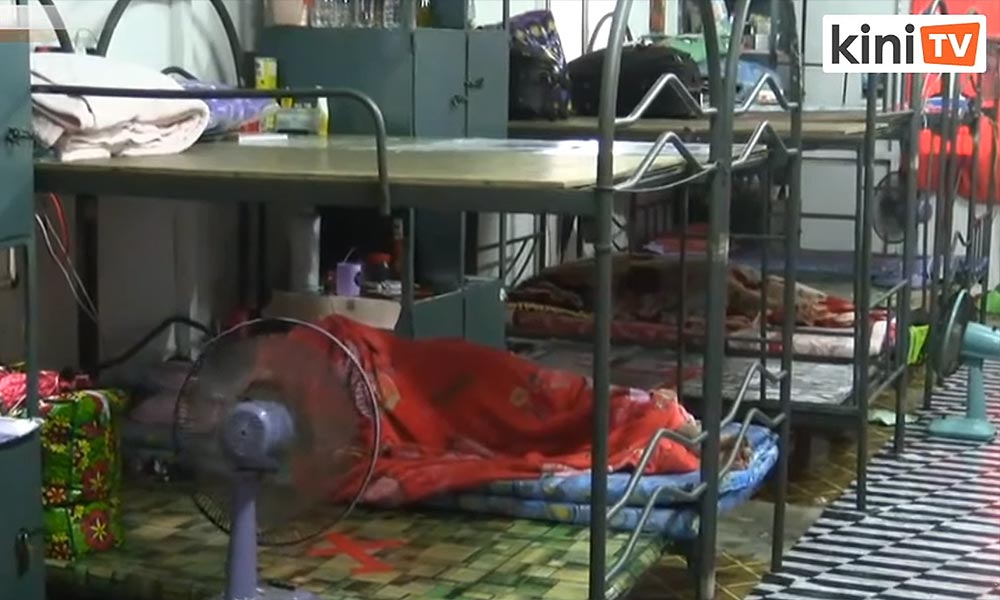
Although the penalties are stiff - an RM50,000 fine, as well as potential jail time for the bosses - to date, only a handful of prosecutions have been made.
According to Saravanan, 91.1 percent or 1.4 million foreign workers in Malaysia are not provided with accommodation that complies with provisions in the act.
The government, he added, only received applications for a certificate of accommodation for 143,587 (8.83 percent) foreign workers in Malaysia as of October 2020.
Meanwhile, Malaysian glove manufacturer, Top Glove, was on March 15 charged with 10 counts of failing to provide workers’ hostels that meet the requirements of Act 446.
According to the charges, 10 of their foreign worker accommodations in Perak had not received certification from the Labour Department.
Related reports:
Debt bondage still a bane for foreign workers
Foreign workers - govt to protect their rights, says minister
This report was produced as part of a course organised by the Kini Academy. It is co-published by Malaysiakini, The Sun and Sinar Harian. Please send feedback and comments to - kiniacademy@malaysiakini.com
The views expressed here are those of the authors/contributors and do not necessarily represent the views of Malaysiakini.





Are you sure you want to delete this comment?
This action cannot be undone.