




Peugeot tie-up a lifeline for Proton
An alliance plan between carmaker Proton and France's PSA Peugeot-Citroen may help turn around the troubled Malaysian automaker, but analysts warn the issue of control remains sensitive.
An alliance plan between carmaker Proton and France's PSA Peugeot-Citroen may help turn around the troubled Malaysian automaker, but analysts warn the issue of control remains sensitive.
The two auto manufacturers recently signed a letter of intent to evaluate and study possible co-operation, with the first round of talks to start next week.
PSA Peugeot is the second largest European car manufacturer, posting a market share of 14.5 percent in 2005.
 The three-month study will focus on product development, manufacturing, distribution, contract assembly, vendor development and quality improvement, Proton said.
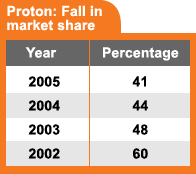
Aishah Ahmad, president of the Malaysian Automotive Association (MAA), told AFP that the partnership will bring many gains to Proton, whose market share has eroded in recent years.
"It will help sales of Proton cars and indirectly the auto industry in the country," she said.
Analysts have attributed the fall in Proton sales to the whittling away of import duties and a persistent reputation for poor quality and unimaginative models.
Declining market share
Aishah also said technology expertise from the alliance would spur Proton's vendors to manufacture quality parts and make Malaysia a hub for the supply of auto parts.
"The industry as a whole will gain with world-class technology from Peugeot. It will boost employment," she said.
 The MAA said vehicle sales fell by 6.4 percent year-on-year in August, posting the seventh month of decline due to low resale value of motor vehicles and rising interest rates.
In May, Deputy Premier Najib Razak said Malaysia's auto industry cannot survive on its own and manufacturers must join forces with strong foreign partners able to open up export markets.
"What is clear, however, is that to continue indefinitely with a policy of shielding our domestic market ... is not a viable long-term strategy," he said.
"The solution is to have a powerful foreign partner (who) will open the door for Malaysian-made vehicles to its own larger markets."
His comments apparently referred to struggling Proton which has had difficulties striking a deal with a foreign partner.
Previous negotiations with Germany's Volkswagen collapsed after Proton was unwilling to share control of the company with Volkswagen.
Hardeep Singh, senior assistant vice-president and economist of Bank of Tokyo-Mitsubishi UFJ (Malaysia) Bhd. said that it was in the interest of Proton to seal a partnership with a foreign player quickly.
"It is crucial for its own survival. If not it will be gobbled up in the ever growing competitive marker," he told AFP.
Hardeep said key to Proton's survival was producing cars with economics of scale and access to state-of-the-art technology.
"To survive they have to have production of scale and technical expertise to produce good models. An alliance with a global player will help in its exports and address falling domestic market share," he said.
Image boost
Hardeep said a partnership with a foreign player would also boost its image.
"Proton is now nobody's choice even in Malaysia. People only buy it because it is cheap," he said.
But Hardeep said Proton must be willing to share control of the company for Peugeot to provide technical know-how in exchange.
"Proton has to allow some form of control to the other partner. They have to be fair in their negotiations," he said.
An auto analyst with a local said equity control was a "sticky" issue and would derail the alliance plan if Peugeot insist on equity control.
"The issue of control could derail any plans by the two automakers to work together. Proton will have to confront it later," she told AFP on condition of anonymity.
First round of talks will begin next week but will not include the question of equity sharing, Proton managing director, Syed Zainal Abidin, told reporters Friday.
"We will talk about it when the time is right. We are prepared to talk," he said.


