




Dont be cowed by US: economist
It is imperative that we approach the on-going Free Trade Agreement (FTA) talks with economic powerhouse United States in a firm manner so as to extract a fair deal for Malaysia.
It is imperative that we approach the on-going Free Trade Agreement (FTA) talks with economic powerhouse United States in a firm manner so as to extract a fair deal for Malaysia.
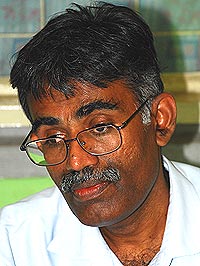 Universiti Malaya professor Rajah Rasiah said that the overwhelming disparities between the US and Malaysian economy would put us at a disadvantage in the negotiations.
As a result, Malaysia has to approach the FTA negotiations in a drastically different way from the US in order to get as fair a deal as possible.
"You can go to the negotiating table and firmly make a case, and say that you're unwilling to include certain items in the bilateral agreements," said Rajah in an interview in Petaling Jaya today.
"It's easy to have long-drawn negotiations and (still) not agree on anything. We may not sign (the deal) if the other party doesn't agree with us. Miti (Ministry of International Trade and Industry) has delayed (the talks) and it was because of these issues," he added.
There have been two rounds of talks so far - the first in Washington and the second in Penang. The third round, which was to be held last week, has been put off to October .
Rajah explained that the US, unlike Malaysia, has a huge "inward-oriented" market.
"Something that happens outside the world will have a bearing on us much more than what it will mean to the US," he said.
Disastrous consequences
Rajah warned that the failure on our part to be clear about our unequal position could bring disastrous consequences.
"We are not the US, where it can afford to be in deficit for three decades. We will end up like Thailand and Korea during the 1997 Asian financial crisis. We will lose our resources. Domestic entrepreneurs and domestic capabilities will not be developed. We must make sure this doesn't happen," said Rajah.
National carmaker Proton, for example, will be hard-put to survive unless it establishes a strategic alliance with a European manufacturer such as Peugeot, said Rajah.
The Asian financial crisis, said Rajah, also illustrates the need to formulate regulations that would ensure a stable capital market.
According to him, the liberalisation of the capital market would also lend to greater instability as capital can easily be transferred out of the country.
Rajah conceded that post-FTA Malaysia may experience higher unemployment rate, with some businesses going bust and more expensive medicines.
But he stressed that the worst-case scenario as Malaysian business leaders and civil society groups have warned concerning the FTA will not necessarily be the reality.
Intellectual property rights
The entry of US firms, especially into the services sector, would also mean that Malaysian companies have to be prepared to face stiff competition from US businesses that have better technology, skilled labour and access to capital resources, said Rajah.
"Foreigners find that if the option is there, they will go for capital equipment (instead of investing on labour) because they can have greater control over it.
"So there is a high likelihood that firms would like to use capital investment techniques, and so on, because they may be interested in having fewer legal problems. The consequence of it may be that they retrench workers. These are all possibilities, but not necessarily realities," he said.
On the issue of intellectual property rights, Rajah said based on the record of other FTAs between the US and developing countries, there is a very real possibility that such essentials as medicine would become more expensive.
Even this, however, does not have to be the case if the Malaysian government can negotiate as the South African government did in order to reach an equitable solution for makers of generic drugs.
"Unless you include that in the FTA and you negotiate the way the South African agreement was negotiated, there may be additional expenditures (for Malaysia)," said Rajah.


