




Yes, we believe in academic freedom but...
Fresh from its latest slide in the world university rankings, Universiti Malaya attempted to put at least something right by saying that it still believed in academic freedom.
Fresh from its latest slide in the world university rankings, Universiti Malaya attempted to put at least something right by saying that it still believed in academic freedom.
But that came with caveat - that such freedom would not directly help in enhancing academic excellence.
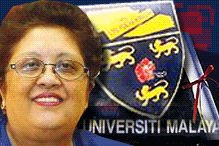 UM vice-chancellor Rafiah Salim said this while responding to questions whether allowing an independent thinking academia - such as letting academicians to air views without fear or favour in public or by writing articles in newspapers - will help in promoting academic excellence.
"(Academic excellence means) more publications in cited journals and there is no law that forbids any professors to publish in these journals," she said at a press conference today.
However, Rafiah said that this did not include writing for newspapers.
She said that the survey undertaken by the UK-Times Higher Education Supplement never considered matters such as newspaper articles written by the teaching staff of a university.
"Writing in newspapers is not taken into account in the Times ranking (but) writing in the academic journals does matter. That is the only thing that counts. I don't see how writing in newspapers help to get you published in cited journals.
"(But) if you are talking about academic freedom, yes, we believe in it and that's why everybody is talking about some amendments to the Universities and University Colleges Act. But let's not talk about the Act, it has nothing to do with the ranking, let's keep it to the ranking," she said, turning to other questions.
Continuous slide
The press conference was called by the university to explain its falling in the latest ranking - from 169 last year to 192. In 2004, UM stood at 89.
Its continuous slide saw Universiti Kebangsaan Malaysia overtaking UM as the country's top university. UKM rose to 185 from last year's 289.
The state of academic freedom in the nation's oldest university was hotly debated last year after a debacle involving UM economics associate professor Dr Edmund Terence Gomez, who later spoke up about several alleged irregularities within the university's administration.
On another matter, Rafiah remained cynical on the question of whether a greater campus democracy will produce more critical thinking students, and that in turn will help enhancing the university's world ranking.
"NUS (National University of Singapore) has done so well, do you think Singapore is going to allow any 'student riot'? So is Beijing," she rebutted.


Are you sure you want to delete this comment?
This action cannot be undone.