




Southern Thai peace plan sent to new gov't
The southern Thailand draft peace plan, brokered by former Malaysian premier Dr Mahathir Mohamad, was presented to the military government last month after the ouster of Thai prime minister Thaksin Shinawatra.
The southern Thailand draft peace plan, brokered by former Malaysian premier Dr Mahathir Mohamad, was presented to the military government last month after the ouster of Thai prime minister Thaksin Shinawatra.
It had previously been submitted in August to the Thai government to settle its decades-long conflict with Muslim insurgency movements in the southern provinces.
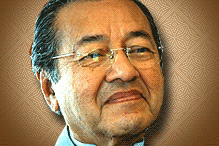
 Mahathir's son Mukhriz (
photo
), co-ordinator of the Peace Malaysia Foundation, was among several Malaysian leaders - including former police chief Norian Mai - who were involved in secret year-long negotiations between the two sides on the terms of a peace plan.
Mahathir's son Mukhriz (
photo
), co-ordinator of the Peace Malaysia Foundation, was among several Malaysian leaders - including former police chief Norian Mai - who were involved in secret year-long negotiations between the two sides on the terms of a peace plan.
"We submitted the plan to the military government (last month), right after Thaksin's removal (in the Sept 19 coup), and we are waiting for them to indicate whether they want us assist further in any way," he said when contacted.
Although the Malaysian team of peace-brokers is ready to raise any further issues of concern between the Thai government and insurgency leaders, and amend the proposals if it gets consensus from both parties, much of the work has been completed, he said.
 The ball now lies on the side of the military government to indicate its approval to continue with more formal negotiations.
"We are just waiting for them to sign on the dotted line and make these things a reality. We may or may not be further involved in the process, but as far as we're concerned, we've done our part up to this point," he noted.
Asked how he felt about the plan, Mukhriz said: "Based on what I've been hearing from the present government, I'm very optimistic. There seems to be the motivation and drive to see something good coming out from the peace process.
"I have had the opportunity to see their commitment to the peace talks and towards achieving peace."
Socio-economic justice
Mukhriz stressed that the Muslim leaders' demands in the proposed Joint Development and Peace Plan for Southern Thailand, does not include a call for a separate or independent Muslim state.
 Straightforward demands have been included for the socio-economic development of southern Thailand, simultaneous with respect for the Muslims' cultural identity, practices and aspirations, he said.
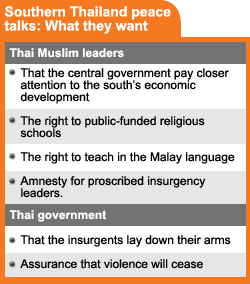
Among other aspects, the insurgency leaders want the central government to pay closer attention to economic development in the south, the right to public-funded religious schools, to teach in the Malay language, and amnesty for proscribed separatist leaders.
"During the Thaksin years, there was such a thing as a blacklist of purported 'terrorists'. Unfortunately, many who were on the list are not at all terrorists," Mukhriz said.
"Every time there was violence in the south, there were no real investigations. (Instead) many accusations were made against these leaders without any proof. Many of them are still in hiding. They demand an amnesty so that they can go back to their families without being taken into custody."
The success of the peace plan now hinges on whether or not the military junta gives its backing to the demands, he said.
The government, meanwhile, has demanded that the insurgents lay down arms and provide the assurance that much of the violence at least will cease.
"We don't expect that, with the signing of the peace agreement, all violence will stop, but we would like to think that some violence that has been purportedly (committed) by the insurgents would decrease," said Mukhriz.
"The thing that makes the conflict convoluted is that there are elements of smugglers, criminal activities, drug trafficking and political vendettas. Each time violence occurs, it's not easy to determine who the perpetrators are, so it's easy to believe the Muslim separatists are always behind these, when actually, that's not how it is."
 Confirming Mukhriz's statements, a Thai diplomat said the peace talks were kick-started in June last year when Mahathir's assistance was sought by several of the insurgency leaders.
Following that, he said, Mahathir received the backing of Thai king Bhumibol Adulyadej during a meeting arranged late last year by one-time premier Anand Panyarachun.
"Mahathir has delivered his part of the work... If ultimately they don't implement the peace plan, it would not be his fault," he said.
Since January 2004, about 1,700 people have been killed in violence stemming from a combination of separatist conflict and criminal activities.


