




Adopt liberal approach, Pak Lah told
Vernacular educationists have urged Prime Minister Abdullah Ahmad Badawi to support a liberal policy in education, to resolve controversies surrounding Chinese and Tamil primary schools.
Vernacular educationists have urged Prime Minister Abdullah Ahmad Badawi to support a liberal policy in education, to resolve controversies surrounding Chinese and Tamil primary schools.
"If our premier wants to be different from his predecessor, then he should adopt a more open, liberal and multicultural policy to end marginalisation of the minorities," said Chinese educationist Goh Kean Seng.
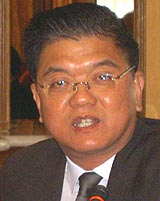 Goh, a leader in the influential United Chinese School Committees
Association of Malaysia (Dong Zong), said this at a roundtable conference, held
at Parliament House this morning, to discuss recent controversy over the issue.
Goh, a leader in the influential United Chinese School Committees
Association of Malaysia (Dong Zong), said this at a roundtable conference, held
at Parliament House this morning, to discuss recent controversy over the issue.
He asked the government to act fairly in terms of building the schools according to needs. He cited official statistics to back his claim that the government has not taken needs into account in building new schools.
"In Petaling Jaya, there are 43.14 percent of Chinese Malaysians and, based on this, there should be 24 Chinese primary schools instead of the current seven," said Goh, who is also the principal of a Chinese independent secondary school.
Last month, Deputy Education Minister Noh Omar revealed in Parliament that there would be no more new vernacular schools under the five-year Ninth Malaysia Plan (9MP) which ends in 2010.
His statement did not go down well with vernacular education movements, which argued that the government had broken its promise because the prime minister had previously promised to build more vernacular schools.
The status of vernacular schools in Malaysia is a contentious issue. While the government allows the existence of these schools, they do not receive full financial aid because the official policy is strengthen national schools.
The government hopes that, by grouping students of all races under one roof in national schools, national unity would be enhanced. However, vernacular educationists reject the argument, saying this should not be done at the expense of the students' rights to mother-tongue education.
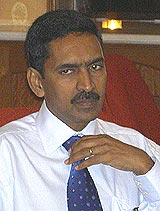 Tamil educationist K Arumugam reiterated the right
to mother-tongue education as guaranteed under several articles of the Federal
Constitution and the Universal Declaration of Human Rights.
Tamil educationist K Arumugam reiterated the right
to mother-tongue education as guaranteed under several articles of the Federal
Constitution and the Universal Declaration of Human Rights.
"If it is a basic human right, it becomes an obligation for the government to fulfill rights. Otherwise, the government could be considered as violating fundamental rights," said the secretary-general for the Malaysian Tamil Educational Research and Development Foundation.
As for the state of Tamil schools, Arumugam said the Malaysian Indian Congress - a component of the ruling Barisan Nasional coalition - is not capable of addressing the community's needs because its elected representatives rely on Malay votes.
Salary-cut motion
The two-hour roundtable conference was organised by Parliamentary Opposition Leader Lim Kit Siang, who has threatened to move a RM10 salary-cut motion against Education Minister Hishamuddin Hussein and his two deputies, as well as the ministry's parliamentary secretary.
"Unless there is a change to the Ninth Malaysia Plan and Budget 2007 to state there will be new Chinese and Tamil schools, the censure motion will be moved in the House when sitting resumes (next month)," he said.
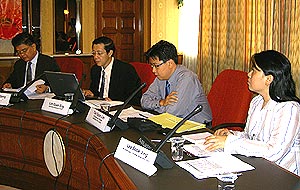 DAP secretary-general Lim Guan Eng, Ipoh Barat MP
Kula Segaran, and Kuala Lumpur and Selangor Chinese Assembly Hall Youth leader
Tan Soon Lim spoke at the conference. The session was moderated by Bukit
Mertajam MP Chong Eng.
DAP secretary-general Lim Guan Eng, Ipoh Barat MP
Kula Segaran, and Kuala Lumpur and Selangor Chinese Assembly Hall Youth leader
Tan Soon Lim spoke at the conference. The session was moderated by Bukit
Mertajam MP Chong Eng.
The 15 participants adopted a five-point resolution:
- To demand fair treatment for Chinese and Tamil primary schools to be built based on needs as mother-tongue education is a fundamental right


Are you sure you want to delete this comment?
This action cannot be undone.