




UKMs secret recipe in trashing UM
Last week, the nation was stunned by the latest world university ranking which saw Malaysia's premier university - Universiti Malaya (UM) - being overtaken by Universiti Kebangsaan Malaysia (UKM).
Last week, the nation was stunned by the latest world university ranking which saw Malaysia's premier university - Universiti Malaya (UM) - being overtaken by Universiti Kebangsaan Malaysia (UKM).
Many were curious to know how UKM managed to jump from the 289th spot to 185, an advancement of 104 places, whereas UM dropped to 192 from 169.
Well, here now is the answer. It is all down to the recruiter or employer review - one of the six criteria adopted by the UK-Times Higher Education Supplement (THES) in compiling this year's ranking.
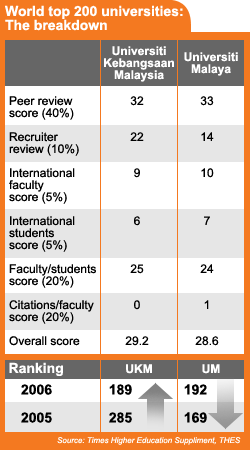 According to the grading detail released by THES recently, out of a total of 100 points, UKM scored 22 in this category, eight points higher than UM.
However, the seven-spot distance between the two universities is due to a 0.6 difference in their overall score. UKM possessed an overall score of 29.2 out of 100.
UKM had surpassed UM in only two criteria - recruiter review and ratio of faculty to student, which made up 10 and 20 percent of the overall score respectively.
UKM scored 25 points in the ratio of faculty to student, one point ahead of UM.
Meanwhile, UM beat UKM in other four criteria, but also by a mere single point. They are peer review (33), international faculty (10), international student (7) and citations per faculty (1).
Many features overlooked
According to the methodology released by THES, which is similar to last year, every criteria carries a full score of 100. The summation of each criteria's score is then benchmarked against the top university, which is Harvard University, with a score of 100.
Peer review is constructed after collecting data from 3,703 academics around the world by asking them to name 30 universities they regarded as the top institutions in their expert area.
Whereas recruiter review involved feedback from 736 graduate recruiters who worked internationally or on a substantial national scale.
Meanwhile, citations per faculty, is based on the citations of academic papers of each university in Thomson's Essential Science Indicators, a database that concentrates on the world's most highly cited and influential research. This criteria indicates how much intellectual power a university has relative to its size.
The number of citations is then divided by staff numbers of a particular institution.
International faculty and students are measured by the percentage of foreign academics and students in a particular institution.
However, THES admitted that many features were overlooked including the under-representation of papers in languages other than English in citations data.
"There are many measures we do not attempt to capture in these pages. We gather data on universities that teach undergraduates only. It is impossible to devise a universal measure for entry standards," said THES in its official website .
USM, UPM also improve
Universiti Sains Malaysia (USM) and Universiti Putra Malaysia (UPM) also improved in this year's standings with UPM rising from 394 last year to 292, while USM climbed from 326 to 277.
However, their grading detail is not revealed as THES only released information on the top 200 universities.
The ranking is co-ordinated by Martin Ince, contributing editor of The Times Higher Education with the assistance of two survey companies, QS Quacquarelli Symonds and Evidence Ltd.
Since its introduction in 2003, the ranking has been criticised by some academics.
Last November, Nunzio Quacquarelli, the managing director of QS Quacquarelli Symonds was invited to a UM's seminar and he conceded there was an error in the 2003 data collection which placed UM in the 89th place, a higher standing than warranted.
Some academics worried that campus administrators are caught up in "a beauty contest of universities" and change policies according to the ranking, rather than objective criteria.


