




Msians not mature enough, says OCPD
Police moved in on participants of the Bloody Sunday May 28 peaceful demo against the petrol price hike at KLCC to protect other members of the Malaysian public who 'were not mature enough' to handle the situation, Dang Wangi OCPD Kamal Pasha Jamal said today.
Police moved in on participants of the Bloody Sunday May 28 peaceful demo against the petrol price hike at KLCC to protect other members of the Malaysian public who 'were not mature enough' to handle the situation, Dang Wangi OCPD Kamal Pasha Jamal said today.
Testifying before the Human Rights Commission (Suhakam) public inquiry into the demonstration which was violently broken up by armed anti-riot police, Kamal said bystanders that day could have 'been easily influenced'.
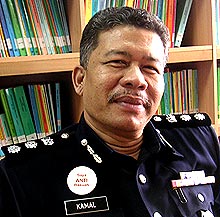 "The Malaysian public is not mature enough. Bystanders passing by will be easily influenced and get dissatisfied and irritated with the speakers uttering scathing words about the government.
"These words will provoke them to join in the rally blindly without thinking rationally," Kamal told the Suhakam panel comprising chair KC Vohrah, Choo Siew Kioh, Zaitoon Othman and Michael Yeoh Onn Kheng at the Suhakam headquarters in Kuala Lumpur.
He further said bystanders and pedestrians would have eventually reacted towards the speeches being delivered by the speakers and their reactions would have most likely resulted in a full-blown riot.
Kamal said that as Malaysia was a multiracial country, an incident such as that would have probably developed into a racial issue if 'the necessary action' had not been carried out by the police to stop the crowd.
'Shouting had occurred'
The police chief also testified that the peaceful demo was 'an unruly rally' due to the fact that shouting had occurred and this, too, could have possibly led to a riot.
He said because the crowd was shouting, their emotions and gestures could easily have turned into an 'aggressive and irrational manner' which could endanger the public.
"Shouting, chanting and holding placards and banners were gestures of losing temper and these kinds of emotional appearances can affect their judgement," Kamal told the panel adding that although the gestures were not hurting members of public or were aimed at the police, the actions could be classified as 'violent and unruly'.
Zaitoon Othman: Only with these gestures (shouting, holding placards and banners), you consider it as violent?
Kamal: Yes, the gestures were violent although they were not hurting anybody.
KC Vohrah: Why do you describe the demonstration as unruly?
 Kamal:
This is because they were shouting and the way they shouted will easily have resulted in them losing their rationality to think whether their actions were right.
Kamal:
This is because they were shouting and the way they shouted will easily have resulted in them losing their rationality to think whether their actions were right.
Kamal claimed that if the 'unruly actions' of the peaceful demonstrators were allowed to continue, the situation would have turned out to be uncontrollable and developed into a riot.
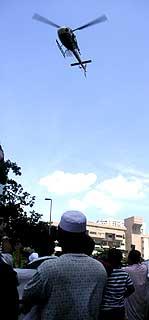
Asked by the Suhakam commissioners as to the presence of a police helicopter hovering just above the demonstrators, Kamal revealed the aircraft was to "disrupt the noise of the crowd and to frighten them into dispersing".
He said police hoped the low-flying helicopter would intimidate the crowd but admitted this tactic turned out to be ineffective.
Four areas
The public inquiry is to determine whether any human rights violations occurred during Bloody Sunday and if so:
- which person or agency was responsible for the violations;
It will be the fifth held by the human rights watchdog since its formation in 1999.
Previous inquiries were on the the Kesas Highway incident (2001); conditions faced by Internal Security Act detainees (2002); alleged mistreatment of native villagers in Sabah by the police (2004); and the death of S Hendry while in police custody (2006).
The inquiry resumes tomorrow where more witnesses from the police force.


Are you sure you want to delete this comment?
This action cannot be undone.