




Avoid Airbus slipstream, MAS told
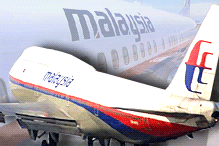
Despite a three-year turnaround plan initiated this year, loss-making national carrier Malaysia Airlines (MAS) may not see profits within the decade if it proceeds with its purchase of the world's largest commercial aircraft.
Despite a three-year turnaround plan initiated this year, loss-making national carrier Malaysia Airlines (MAS) may not see profits within the decade if it proceeds with its purchase of the world's largest commercial aircraft.
 MAS Employees' Union (Maseu) executive secretary Mustafar Maarof said the airline should cancel its order for six Airbus A380s, following reports of delayed delivery.
Instead, he said, MAS should focus on improving cash flow, and retaining the remaining in-flight crew and maintenance personnel after the recent 'mutual separation scheme' (MSS).
Airbus, a partnership between EADS and BAE Systems, has announced that the aircraft will not enter service on schedule due to complex electrical wiring problems. It has pushed the first delivery to October next year, in meeting orders for 168 aircraft by 16 airlines.
Last year, MAS signed up for six A380s while Singapore Airlines (SIA) bought 12. Depending on configuration, each 555-seater A380 is priced at about US$290 million, or just over RM1 billion.
MAS is slated to receive the first aircraft in 2009. The purchases will be made by Penerbangan Nasional Bhd, which will lease the aircraft to the national carrier.
 Mustafar said MAS should not have followed SIA's lead in the first place.
"The problem is that MAS has mirrored SIA. Cathay Pacific and JAL (Japan Airlines) did not buy any A380. What Singapore does, we follow. They (MAS) said it was a matter of competition. It's not," he told malaysiakini .
"Airbus has the potential of turning into another Enron. I give it two years. When I saw the CEO step down last week, I knew something was not right. That's why Boeing is so quiet. There will be retrenchment in Airbus after the French elections (in February next year). (Airbus) promised 49 planes in 2009, but I don't believe this."
Airbus is currently facing a management crisis, with its chief executive Christian Streiff having resigned last week, the second top official to leave in 10 months.
It is also US$2 billion in debt. Analysts have said that any pullout by airlines that have placed orders would result in catastrophe for the company.
'Cut losses'
Mustafar said the government would have to contend with the prohibitive cost of preparing the Kuala Lumpur International Airport for use by the super-jumbo aircraft.
MAS is likely to foot the bill for training the crew, while Malaysia Airports Bhd will likely pay the cost of readying any new hangars, parking bays, possible runway extensions or doubled-decked aerobridges.
"You have to send your boys (staff) for training - your cabin crew, your engineers, your technicians. This will involve billions (of ringgit) even before the first aircraft touches down. We would spend all that money three years before you can see the plane," said Mustafar.
"If the delay persists, the orders should be cancelled. A penalty will be levied, but this would be offset by penalties for delays on their part. We should cut our losses. The bottom line is that we don't want the staff to get the blame years from now. We'll picket if that happens."
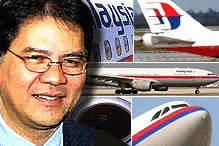 MAS, which reported a loss of some RM10 billion over the past two years, has blamed this on fuel price hikes and changing flying trends.
Since taking over management early this year, chief executive Idris Jala has sold the MAS headquarters and given up over 100 routes to budget carrier AirAsia, as part of a turnaround plan the bring the airline into the black in three years.
The plan also includes retrenching 6,000 of the 18,000 employees. To date, some 2,400 have left via the MSS.
The airline's prestige has apparently dropped. A Bernama report over the weekend described MAS as no longer being the primary choice of airlines among Malaysians.
Quoting the Bumiputera Travel and Tour Operators Association, the report said Malaysians now prefer low-cost carriers.
Campaign toward union
Meanwhile, the UK-based International Transport Workers' Federation (ITF) will launch a campaign at year's end against any restrictions imposed by AirAsia that prevents employees from forming a union.
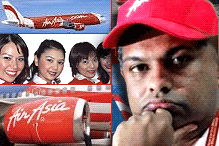 Mustafar, who is on the ITF civil aviation steering committee, said any action by the AirAsia management to hamper the formation of a union would be against the law.
Section 5 of the Industrial Relations Act 1967 forbids employers from restricting the rights of workers to organise and join a union.
"It's legally wrong for management to issue warnings to staff, for example, or to intimidate them if they want to form a union," said Mustafar.
He added that ITF's goal is to get in-house unions formed in AirAsia and UK's low-cost carrier Ryanair.


