




Division in the Bar is 'natural'
The internal division in the Malaysian Bar between Syariah lawyers and those who champion the constitution has been described as 'natural' by its president.
The internal division in the Malaysian Bar between Syariah lawyers and those who champion the constitution has been described as 'natural' by its president.
Earlier, Bar Council chairperson Yeo Yang Poh asserted his support for apostate Lina Joy's case in the Federal Court on the grounds of constitutional supremacy.
This then led to various quarters questioning Yeo's leadership style in representing the Bar as a whole.
In this final part of an interview with malaysiakini , Yeo addresses this issue and speaks of the need to revamp the judicial system and about his future plans.
It appears the Bar Council is divided over the Lina Joy apostasy case with Syariah lawyers feeling discontented. How do you feel about this?
(Earlier, the Bar Council made a stand supporting Joy on the grounds of constitutional supremacy for which lawyer Malik Imtiaz Sarwar received death threats. Peguam Pembela Islam (PPI) or Lawyers in Defence of Islam was then set up to counter what they termed as concerted efforts to attack Islam. Top on the PPI agenda is to tackle the 'partisan stand' taken by the Bar Council on cases of apostasy and to counter moves by certain quarters to 'liberalise' the Federal Constitution.)
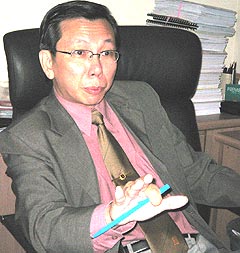 Yeo:
Firstly, the Bar Council has not and does not take a partisan stand in the sense of being partisan to a particular race or belief or profession etc. The stand that we take is always based on our belief in fundamental rights and liberties. So if at all, we are pro-rights but we are not partisan to any groups of person demarcated by place, gender, race, religion etc. That has to be clarified.
Yeo:
Firstly, the Bar Council has not and does not take a partisan stand in the sense of being partisan to a particular race or belief or profession etc. The stand that we take is always based on our belief in fundamental rights and liberties. So if at all, we are pro-rights but we are not partisan to any groups of person demarcated by place, gender, race, religion etc. That has to be clarified.
Secondly the divergence of views. The Malaysian Bar is a very unique body in this sense. If you take most other bodies their members comprise people who are like minded about core subjects. For example a person who thinks he is pro-conservation of nature or who loves nature would join the nature society. People who think animals should be treated well would join the SPCA (Society for the Prevention of Cruelty to Animals). So in all these associations, you have very like minded persons though they may differ in a lot of issues but in the core issues of their organisations, there is no divergence of views.
The Bar is not like that. The Bar is not comprised of people who believe in something, therefore we come together. You have to be a member of the Malaysian Bar because you are practising law. Due of that, we have a wide divergence of views in a lot of issues because not all lawyers gather because they are pro-freedom of speech, there are some that are still conservative and believe that freedom of speech may lead to chaos and must be curtailed by a lot of things such as defamation, sensitivity to beliefs and so on.
So in the Bar we must start by realising that divergence of views is natural which is to a much larger extent than any other organisation that you will find. So in this case (on apostasy), yes there are divergence of views but it's not unique. There are divergence of views with regards to death penalties also. There are members of the Bar who support death penalties and think the ISA (Internal Security Act) is justified in certain circumstances.
What happens in this issue is that it is a very sensitive issue so it becomes more apparent. So when a person says the Bar Council may not be representative of the entire Malaysian Bar, that can be said for a lot of issues.
The next question to ask is the extent of the divergence. The Bar Council always takes into account members' views because we believe in engagements and dialogues. So for a group of lawyers who say that what the Bar Council has said does not represent (their) views, that is nothing unusual. If they want to discuss what (their) positions are in the Malaysian Bar, we welcome that.
PPI has also questioned your leadership style. Any comments on that?
Anybody is free to question my leadership style. This is the style adopted by all the presidents before me that I know of and it is the only workable style which is, you have a council and you put forward views. Whatever the views are, it must be supported by all or the majority of the council. This is the only workable way.
In June, the Bar Council called for a judicial commission. Have you gotten any feedback on it? How is that going?
Well, we have not had positive response for that but like many other things we will keep pushing because we also believe that a judicial commission is something the country needs.
Why is the Bar Council involved with Suhakam's public inquiry into the demonstrations in front of KLCC on May 28?
(The Bar Council currently has observers attending the on-going public inquiry into the 'Bloody Sunday' protest)
It relates to a lot of issues which the Bar Council has been very actively involved in like freedom of assembly, proper use of police powers and the abuse of police powers. These are issues of fundamental rights and we always believe that there should be freedom of peaceful assembly. So it is quite natural that we take an active part in it.
We always hear that we have an excess number of lawyers in Kuala Lumpur. Any comments or statistics on this?
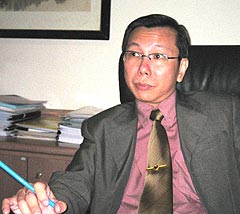 I don't think anybody has done any studies on comparative study in terms of population ratio perhaps compared with other cities. I am not aware of this. There are many, many more lawyers now than10 or 20 years ago but whether you have reached that optimum point or saturation point as compared with other cities in similar stages of development, that I'm afraid I don't have the comparison.
What do you think can be done with the backlog of cases in our judicial system?
This a question that involves a holistic solution. There is a serious shortage of manpower. It will not be resolved unless the government realises that the justice system is very important and is no less important than putting money into defence or education and to start allocating sufficient funds to resolve our problem of shortage of manpower.
Of course shortage of manpower has two parts. One is the absolute number. Too few, so you have to increase the number. But the second part, you must increase it with appropriate and suitable persons. It doesn't mean to say we need 100 more judges so we will appoint them all tomorrow, it depends on who you appoint. Not all lawyers are good at being judges, some can be excellent in advocacy but a judge's role is different because they may not be suited in being open minded, fair and patient. So manpower has to be tackled in both quality and quantity. And manpower does not mean judges only but support staff like interpreters and research personnel which means more money needs to be pumped into the judicial system.
So do you think you will be a good judge?
For me? No, I'm not patient enough (smiles).
What do you think of the appointment of fresh graduates as magistrates to help with the backlog?
A lot of jurisdictions don't allow that. Even though magistrates are subordinate court officers, a lot of jurisdictions require them to have say three or seven years experience. There are good reasons for that. Apart from the technical knowledge, there is also experience in life because people appear before you and describe certain things that happen and if you don't have sufficient experiences in life, you will not be able to discern the situation. Plus, magistrates although subordinate, they deal with very important things such as remand. Remand means depriving someone of liberty. Liberty is far more important than money. Magistrates for example deal with somebody's liberty, you cannot say it is not important. In order to deal with important issues, it is good that if the system is as such that you have to have a certain experience in practice and life in general.
There is a regulation that foreign lawyers are not allowed to practice here. Will that provision ever be removed?
We are talking about globalisation. Let's start with something which a lot of people even those in the government misunderstand. They always think the only reason why lawyers ( here) feel that foreign lawyers should not be easily allowed to practice here is because of protectionism. That is a misunderstanding. Of course one of the work of the Bar Council is to take care of the welfare of our own members.
But there are other reasons. Law is not like other disciplines where it is either 100 percent or 90 percent universal. Every country has different laws and because of that, globalisation and law cannot go at the same pace as other disciplines for this reason.
 Would you like to be a politician some day?
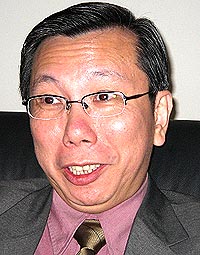
I've never been involved in politics in my entire working life. And do I want to become a politician? I have zero interest there.
How about activism and being involved in politics somehow?
Every citizen should be concerned with politics because we are all governed by politicians so if we don't care about political issues, then it means we don't care about our own society. So yes, I take a keen interest in that but I have zero interest in being a politician.
What do you think are your greatest achievements so far as Bar Council chairperson?
That's for other people to judge, not for me to say. My own thinking is that - I try to do an honest day's work and do my best, that's it.
Your presidential tenure ends in 2007. What's next in store for you?
It ends next March, I believe. We will have elections and a new council will come in. I'll go back to my legal practice which I've put on hold for two years.
Do you miss practising?
Oh yes, because of the work, we have to devote a lot of time to this (position as president) so it is almost a full time job.
Where did you grow up and where did you read law?
I was born and bred in Malacca and I did my law in University of Canterbury in Christchurch, New Zealand.
What is your one wish for Malaysia?
So many things (laughs). Can I cheat a bit and say something that contains more than one thing? Ever increasing freedoms of all kinds - freedom of expression, belief, from corruption. If you start giving people more space to speak, those who are oppressed would slowly find their voice. Even if you're not tackling their immediate problems, but because you give an environment of increasing freedom, they would become better as well.
It's like corruption. It leads to a lot of things. But since you have freedom, corruption doesn't just go away. But if you have freedom, people can then expose the corruption and it would build up to a stage where people would say enough is enough something has to be done.
Yesterday: IPCMC - urgently needed


Are you sure you want to delete this comment?
This action cannot be undone.