




Ramin saga: Timber council hits back
'Mischievous and unreasonable!' The Malaysian Timber Council (MTC) hits back at an United Nations conversationist body for grilling Malaysia over its management and harvesting of ramin timber.
'Mischievous and unreasonable!' The Malaysian Timber Council (MTC) hits back at an United Nations conversationist body for grilling Malaysia over its management and harvesting of ramin timber.
MTC director (public and corporate affairs) Aimi Lee Abdullah said the Convention on International Trade in Endangered Species of Wild Fauna and Flora's (Cites) secretariat had acted wrongly.
She was responding to UN body's concerns contained in a document based on a study on peat swamp forests in Sarawak.
Calling it 'mischievous and unreasonable', she said Cites had confused the aims of the study - which started six years ago - as its conclusions.
The joint Malaysia-Dutch study, which started in November 2000, published its findings in a report last year entitled 'Sustainable Management of Peat Swamp Forests of Sarawak with Special Reference to Ramin.'
The Cites' 54th standing committee meeting held in Geneva, Switzerland, from Oct 2-6 saw the secretariat reporting on its concerns and recommendations for Malaysia to control its trade in ramin, a highly-coveted species of timber.
Cites imposes strict regulations and conditions for the legal and sustainable trade of species - including ramin - listed under Appendix II.
Efforts have been made to upgrade ramin to Appendix I, which carries a full ban on trade except for research or conservation purposes
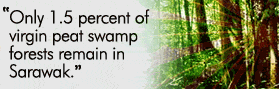 Citing the secretariat document, environmental groups Environmental Investigation Agency (EIA) and Telapak had described Malaysia's management of its peat swamp forests as 'poor'.
It also termed the rapidly depleting ramin and the only 1.5 percent remaining original peat swamp forests in Sarawak as 'disturbing'.
No information
Aimi, however, said these were the problems that led Malaysia and Netherlands to embark on the study to tackle the almost total absence of information on the status and distribution of ramin - not its conclusions.
"At the start of the study, there was no information and plans to put in motion in Sarawak to set aside representative areas of virgin peat swamp forest, and so on. This is why the study was needed...," she said in an e-mail to malaysiakini .
"It is unreasonable for the persons writing (the secretariat document) to quote these (problems) as the present state of management of peat swamps in Sarawak," she said
The project was Sarawak's recognition five to six years ago that they had to undertake research and to improve, she added.
Since then, Aimi said, three protected areas had been established in Sarawak for the regeneration of ramin, while logging in peat swamp forests had been reduced.
Aimi also responded to the questions raised by the secretariat, EIA and Telapak on the basis for Malaysia's 45,000 cubic meter 2006 quota of ramin.
According to them, Malaysia had yet to provide for non-detriment findings (NDF) for ramin - the quantity that can be harvested and exported without harming survival of the species or its role in the ecosystem.
In the absence of specific scientific methodology and Cites guidelines to determine NDF, even developed countries have found it difficult to provide for such data, said Aimi.
This has led to the acceptance of such 'interim measures' as the use of 'preliminary' and 'cautious' quotes based on the scientific and trade data available, she added.
Unsubstantiated allegations
However, Aimi said Malaysia has conceded that the 2006 quotas for Sarawak, at least, were derived from partial NDFs done in December 2004 before ramin's Cites listing and assurance 'had been given that the 2007 quotas would be lower.'
She dismissed claims that Malaysia was instrumental in the trade of illegal ramin, mostly from Indonesia, and was not doing enough to clamp down on the global trade.
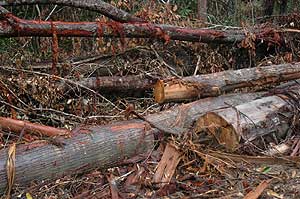 "The Malaysian Timber Industry Board (MITB) has done its utmost in monitoring and enforcing Ramin export procedures - it is not Malaysia's role to clamp down on illegal Indonesian ramin exports as Indonesia has to do it at their end.
"The allegations of ramin smuggling into Malaysia are unsubstantiated and figures quoted are plucked out of the air. MTIB, with the help of the customs department, is making sure Indon ramin is not smuggled in," she added.
Aimi also said EIA and Telapak were referring to 'old cases' when they accused Malaysia of allowing large consignments of smuggled Indonesian ramin to go through and leave its ports for the European and US markets.
On attempts to 'upgrade' ramin to Cites Appendix I, she said this was up to the scientific community to deliberate and call upon.
Aimi said Malaysia, in face of calls for Cites parties to suspend trade with nations that do not fulfill their obligations, had urged the standing committee to regard and use Cites as a 'facilitative body' for the conservation of species, not a 'punitative one'.


Are you sure you want to delete this comment?
This action cannot be undone.