




Pak Lah-Dr M meeting - a happy ending?
The reported peace or reconciliation meeting between Prime Minister Abdullah Ahmad Badawi and his predecessor Dr Mahathir Mohamad, which is said to have been agreed to by both sides, comes as a surprise to observers of Malaysian politics.
The reported peace or reconciliation meeting between Prime Minister Abdullah Ahmad Badawi and his predecessor Dr Mahathir Mohamad, which is said to have been agreed to by both sides, comes as a surprise to observers of Malaysian politics.
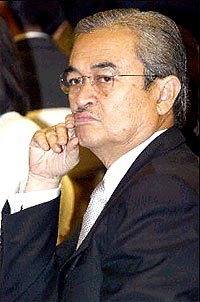 Did not Malaysians and the whole world hear just last Saturday how Abdullah openly and uncharacteristically expressed his critical opinions regarding Mahathir during a
CNN
interview?
Did not Malaysians and the whole world hear just last Saturday how Abdullah openly and uncharacteristically expressed his critical opinions regarding Mahathir during a
CNN
interview?
And what about Mahathir characteristically " firing another salvo " at Abdullah on Bloomberg ?
How did their relationship change from being hopelessly negative to blissfully positive in such a short period?
One technical reason offered by some commentators and private observers is that both the CNN and Bloomberg interviews were pre-recorded much earlier and that much had changed since then, especially after Mahathir's humiliating defeat in Kubang Pasu.
Logically, the explanation seems plausible but it presupposes that Mahathir has conceded defeat wholeheartedly and has to pursue peace now as a loser.
However, an empirical question arises as to whether Mahathir showed any signs of surrendering even after the Kubang Pasu debacle.
As a matter of fact, he has not publicly retracted his allegation that money politics had caused his defeat in the Umno divisional contest.
Mahathir has never withdrawn or shown any signs of withdrawing all the allegations he has fired in the direction of Abdullah and the new administration.
How can a peace or reconciliation meeting be seen as serious and promising when harsh allegations such as Abdullah "selling out" the country and being "a liar" still linger, without being retracted by Mahathir to establish a minimum level of trust and respect?
Moral high ground
This is why there is an observation that the reported agreement on the part of Mahathir to the peace talk is a tactic to either buy time for another round of confrontation or an attempt to turn a political defeat into winning the moral high ground.
As a matter of fact, Mahathir has never outrightly rejected any proposal for peace or reconciliation with Abdullah since Day 1 of the fallout.
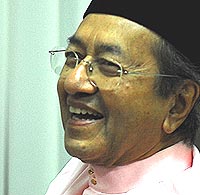 As an experienced and seasoned politician, Mahathir certainly knows very well that in Umno as well as Malaysian politics in general, being seen occupying the moral high ground is critical because there is always a need to win the hearts and minds of the bystanders when the diehards have been consolidated.
It is the same for Abdullah. It would be politically suicidal for him to reject any offer for peace talks with his predecessor-turned-nemesis for this would alienate the non-hardcore in the party and country.
In other words, whether or not Abdullah sees Mahathir's agreement to the peace talks to be genuine, he has to respond to it positively in order not to be perceived or accused of being arrogant and disregardful of the call for "unity".
Seen in this light, it may still be too early to conclude that the peace talk would necessarily lead to a happy ending.
More likely than not, the supporters of both Abdullah and Mahathir would continue to strengthen their ground behind the scene for any eventual or continuing slug-out even though their top commanders are now publicly engaging in diplomatic moves to win hearts and minds.
This probably explains why, despite the media hype, the expressions used by both sides are still vague and not concrete.


Are you sure you want to delete this comment?
This action cannot be undone.