




Women most vulnerable under US-Msia FTA
Women will be the worst affected by the US-Malaysia Free Trade Agreement (FTA), said activists who co-organised a protest against the ongoing talks in Kuala Lumpur this morning.
Women will be the worst affected by the US-Malaysia Free Trade Agreement (FTA), said activists who co-organised a protest against the ongoing talks in Kuala Lumpur this morning.
Based on the experience of other developing countries that have signed a FTA with the US, women are among the first to be laid off or otherwise made to suffer deteriorating work conditions, they said.
Talks are currently in progress between the US Trade Representative and Malaysia's Ministry of International Trade and Industry (Miti).
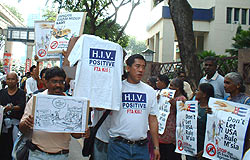
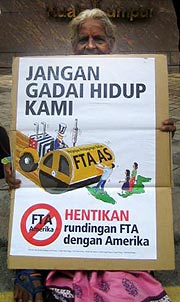 A coalition of opposition political parties and NGOs demonstrated outside the hotel being used as a venue in Jalan Sultan Ismail. Some 100 protestors chanted "Stop! Stop! FTA!" and "Out! Out! USA!".
As the protest went on, activists marched carrying a mock coffin. They wore tee-shirts with the dire warning: 'FTAs kill'.
A senior Miti official later accepted the anti-FTA coalition's memorandum and agreed to convey its demand for a meeting with the ministry within two weeks.
US businesses and factories will benefit from operating in Malaysia and will be subject to fewer regulations under the FTA.
Women's Development Cooperative director Cecilia Ng told malaysiakini women make up 80 percent of workers in such industries as electronics and textiles and garments.
"In countries like Mexico (that fall within) under Nafta (North America Free Trade Area), women workers figure predominantly among the most neglected and exploited," said Ng.
"What kind of (labour) laws will we have to amend under the terms and conditions (stipulated by) the FTA? What rights will women have to give up?"
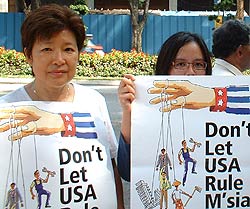 Increased competition could lead to greater unemployment and the closure of small and medium Malaysian industries and enterprises. Those still employed could face a downward spiralling of wages and work conditions, while those in business may see diminished profits.
Women are also usually the first to be made to go when downsizing or closures occur.
All Women's Action Society executive director Honey Tan noted that the cost of medicines generally will be out of reach of ordinary people under the FTA.
The cost of treatment for HIV/Aids in other countries has increased many times due to patenting regulations under their FTA.
"The rate of HIV/Aids infection is higher among women. They will be disproportionately affected by the higher costs of medicine and treatment," said Tan.
Not against trade
Parti Keadilan Rakyat Youth information chief Latheefa Koya said women are the first to be dismissed or made to settle for lower wages and other benefits, because they are perceived to be the least economically-productive workers.
 She also noted that those advocating the FTA may seek public support by claiming it will dismantle the New Economic Policy's bumiputera affirmative-action programmes and achieve greater transparency and accountability.
They will also portray the anti-FTA coalition as being opposed to trade and against the increased transparency and accountability in governance that the FTA will bring about, she said.
"In reality, the FTA will merely create another class of privileged Malaysians revolving around US-business interests and their local partners," she added.
"We are not against trade in itself. We are just calling for 'fair' trade as opposed to the so-called 'free' trade."
Other coalition leaders said they would continue protesting against the FTA until the government heeds their call to end the talks, conduct a detailed cost-benefit analysis of the agreement, and involve the public .
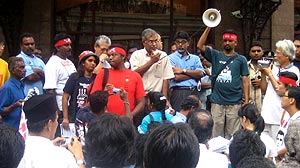 Parti Sosialis Malaysia pro-tem president Dr Nasir Hashim said there is a great need for the public to see the unjust economic and power structures and relations contained in the US-Malaysia FTA.
"Issues of race and religion are affected by certain economic and power relationships, especially in Malaysia where race and religion is the crux of development," said Nasir.
"These protests are part of the conscientisation, politicisation and education of workers towards influencing policy decisions that affect them. We're going to protest until the government stops what it is doing and addresses in detail the effects of the FTA on the people."


