




Supp crisis: Time for Chan to bow out?
Sarawak United People's Party (Supp) president Dr George Chan was probably very lucky he was able to find a reason to prevent voting on a no-confidence motion against him at the party's central working committee (CWC) meeting in Kuching on Oct 26.
The motion, the first of its nature in the history of the 47-year-old Supp, was proposed by his deputy Law Hieng Ding and seconded by CWC member Daniel Ngieng.
Sarawak United People's Party (Supp) president Dr George Chan was probably very lucky he was able to find a reason to prevent voting on a no-confidence motion against him at the party's central working committee (CWC) meeting in Kuching on Oct 26.
The motion, the first of its nature in the history of the 47-year-old Supp, was proposed by his deputy Law Hieng Ding and seconded by CWC member Daniel Ngieng.
 It is widely believed that if a vote had gone through to carry the motion, Chan (
left
) would have to reconsider his position as party president, a post he has been holding since 1997 after taking over from Dr Wong Soon Kai, or even compelled to relinquish his position immediately.
It is widely believed that if a vote had gone through to carry the motion, Chan (
left
) would have to reconsider his position as party president, a post he has been holding since 1997 after taking over from Dr Wong Soon Kai, or even compelled to relinquish his position immediately.
Law, the most vocal critic in the party of Chan's leadership, had said "George must go to clear up the big mess he has created in the party."
Law who has blamed Chan for playing 'dirty' with him in the appointment of the Supp candidate to the federal cabinet after the 2004 general election is certainly not alone in clamouring for the party president to step down.
But that the call has now become public, not only with Law tabling of the no-confidence motion but also strong attack on the party president's personal character, goes to show the temporary respite is not going to bring any comfort to anybody at all.
It could be just the lull before the storm.
The storm is already brewing, and unless there is a last-minute compromise to avoid an open showdown, the faction supporting the deputy president is going ahead to table the no-confidence at the 110-member central committee (CC) meeting scheduled on Dec 9 or the special delegates conference the following day.
At the Oct 26 CWC meeting, what emerged after a long and heated argument was some agreement of sort to leave the motion to another day and to another committee. But the tensed CWC meeting broke off discussion on the motion only after a disappointed Law had stormed out of the meeting following Chan's veto of any vote related to the motion.
"I want to exercise my democratic rights (to vote on the motion). But the president dare not face the voting," Law told malaysiakini during a meeting break.
Lack of collective leadership
According to him, even if the constitution is silent on the question of whether such a motion can be tabled, the ordinary rules of meeting should apply and members can agree either by a show of hand or by secret ballot whether to allow such a motion and to debate it.
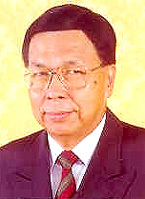 Law (
right
) said he told the meeting if the majority of the CWC members rejected the motion then the party president should continue to lead the party, and if the majority were in favour then he (Chan) should step down.
Law (
right
) said he told the meeting if the majority of the CWC members rejected the motion then the party president should continue to lead the party, and if the majority were in favour then he (Chan) should step down.
The party performed poorly in the May 20 state elections, losing eight seats, mostly in key Chinese areas out of the 19 it contested. Now its 100,000-strong membership throughout Sarawak want to know whether the party has lost its effectiveness in the government as a spokesman and watchdog to protect and promote the interests of the Chinese community.
Opponents blame Chan, who is one of Sarawak's two deputy chief ministers with responsibility over industrial development matters, for what they call his indecisivesness and lack of collective leadership. Law also said Chan made too many empty promises to other party leaders.
Others say Chan is too close to Chief Minister Abdul Taib Mahmud (one of his daughters is married to Taib's son Sulaiman) and many in the party have become wary of this.
During last year's CC meeting, words like chin kay (relation) and Pek Moh (White Hair, in referring to Taib) were used in less than endearing terms by some delegates when referring to Chan's ties with Taib.
Many are unhappy with some of Taib's policies, such as the uncertainties facing many urban home-owners over the renewal of the 60-year-old land leases and the seemingly high premiums payable for renewals, the future of Chinese education in the state, corruption and state-funded projects going nearly only to certain companies with strong political connections.
Not surprisingly, Taib himself has privately complained to some close associates that "Chan has lost control of his boys (in the party)". But in recent times, he (Taib) was also alluding to the noise raised against the top leadership by Supp Youth leader Alan Sim after the party lost the Kuching City South mayorship.
The state government ignored Supp's recommendation, and appointed a senior Chinese civil servant Chong Ted Tsiung, 50, the former controller of the Sarawak Natural Resources and Environment Board (NREB), the new mayor, breaking Supp's 43-year hold on the mayor post. Many of the president's party colleagues said he gave in too easily by not fighting hard enough to protect party interests.
To many party leaders and members, they saw this as a further humiliation for the party and an indication the party was being marginalised within the government as it was no longer being listened to.
It is learnt, however, the real reason for the government's decision not to appoint a Supp member had more to do with the party's defeat in the last state elections - its four incumbents contesting in Kuching constituencies were rejected by the largely Chinese electorate.
Post-mortem report
Nonetheless, Alan Sim confronted the top leadership and demanded an explanation and this forced the party president at a recent CWC meeting to accept a proposal calling for a special delegates conference in December.
According to many political observers, almost any issue is being highlighted by Chan's opponent to justify the call for the party president to step down. One such issue is over the post-mortem report on the party's defeat in the state polls.
Initially, media reports said the party, quoting certain sources in the party, had submitted the report to Prime Minister Abdullah Ahmad Badawi. Now Chan said the report has not even been tabled at the CWC meeting, let alone submitted to the PM. Chan had apparently commissioned a private company to study the factors for the party's loss of eight seats.
"The report blames everybody accept Chan's leadership," one source said. "Even Taib was not spared."
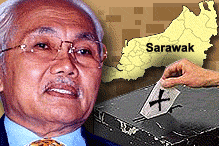 It is reliably learnt that Taib (
left
) got wind of it and made his views known at a recent meeting with a delegation of CWC members led by Chan at Taib's private residence.
It is reliably learnt that Taib (
left
) got wind of it and made his views known at a recent meeting with a delegation of CWC members led by Chan at Taib's private residence.
When asked where the report was now, party organising secretary and federal Minister of Plantation Industries and Commodities Peter Chin replied, "Ask the party president." Other party leaders, including secretary-general Sim Kheng Hui and deputy secretary-general Wong Soon Koh, replied in similar fashion.
There are more woes facing Chan come the special delegates conference which Chan had no way of avoiding after Alan Sim lobbied for it to be held in order to give delegates an opportunity to speak out their mind and to tell the leadership in the face what they think.
According to political observers, the leadership crisis has 'forced' the largely Sibu-based Foochow group, including Sibu branch chairperson and state Second Minister of Finance and Minister of Tourism, Wong Soon Koh, and branch deputy chairperson and federal Deputy Minister of Local Government and Housing Robert Law Hoi Chiew, to take up the gauntlet to win back Chinese confidence and support for the party, and they clearly see some changes in leadership may now be necessary.
Within nearly five decades of its existence, Supp has transformed from a party once infiltrated by leftist elements with socialist ideology to a party that is described as more of a 'towkay party' with strong connections to some of the large Chinese-owned timber conglomerates. Its CWC meetings are now conducted mostly in English.
Some quarters within Supp have openly expressed concerns that the party could end up like the now-defunct Sarawak Chinese Association (SCA), often described in those days as nothing more than a 'towkay party' (it was controlled by the family of the late timber tycoon and banker Ling Beng Siew and his business associates). SCA was dissolved in the 1970s and its three assembly representatives all joined Supp.
Political power game
Hence, the current challenge to the party president's leadership is seen increasingly as a political power game within the largely Chinese party between the Sibu group, led by Soon Koh, and the Miri group, led by Chan.
A political analyst told malaysiakini , "As of now, if a vote is taken on a no-confidence motion in the CC, it could go five per cent either way."
This explains why when one of Chan's staunch supporters Dr Soon Choon Teck, a state assistant minister and state assemblyperson for Dudong, went it alone to announce his proposal to set up the Dudong branch without even informing the four units (sub-branches or service centres) operating in the Dudong state constituency, the Sibu branch publicly condemned Soon and called for an explanation while, at the same time, contemplating disciplinary action against him.
The setting up of any new branch within Sibu requires the Sibu branch's approval in line with a CWC's resolution. Soon had obtained 15 out of the 26 signatures among the CWC members recently to support his proposal to set up the Dudong branch. The move is seen as clearly to shore up support for the beleaguered president in anticipation of a move to oust the party president either at the CC meeting or the special delegates conference.
Chan has made it clear that he has no intention to step down as president. Only the delegates can decide on his position, he told reporters. The votes from Kuching members will be crucial. They probably hold the balance. The heads of the Pending, Padungan, Batu Lintang and Batu Kawah branches in Kuching are said to be behind the party president.
"But their support is a qualified one - they want George to state a time-table for stepping down as party president, preferably in a year's time, and his position as deputy chief minister is the chief minister's prerogative," a source said. However, Chan has told his Kuching supporters he is not interested in such a deal as he intends to fight to keep his position.
Given such a scenario, come Dec 9-10, unless there is a last-minute compromise, the party's leadership crisis could further deepen and may lead to irreparable damage. Taib, as state BN leader, who has so far declared a hands-off policy, may be forced to step in because a break-up of the party could have serious implications not only for the state BN but also for him personally.
A close associate of the chief minister commented, "As long as Supp is still there and is still intact, it doesn't matter who leads the party."
Does this mean then that the writing is already on the wall for Chan?
In the event circumstances change forcing Chan to relinquish his position in the party before his term ends in 2008, the general expectation is that Soon Koh, an Australian-trained teacher turned politician and a cousin of former party president Soon Kai, will take over the presidency, with the deputy president post likely to go to Peter Chin. Law has announced that when the party president agrees to step down or is ousted as president, he too will step down voluntarily to give way to younger blood.
"The party needs a new image, it needs to re-build its credibility in the eyes of the Chinese community," he said.
For the party, the next parliamentary election is crucial. Will it be able to retain all its six seats and do better by winning Bandar Kuching which it lost to the DAP in 2004?
A Kuching-based political analyst said Supp's troubles at the core is "a crisis of the lack of democracy within the party and thus, an inability to undertake dynamic renewal within the party."
This is exacerbated by the fact that as a towkay party, it is now riddled with patronage which is also bad for renewal since those with access to the top refuse to let go and thus bend the party to suit their purse-strings, whims and fancies.
What is happening is Supp is nothing unusual, he said, adding that it has already happened with Parti Bansa Dayak Sarawak (PBDS), Sarawak National Party (Snap) and now Parti Rakyat Sarawak (PRS). He thinks it is a matter of time before the rest of the BN component parties are similarly affected.
The political analyst, however, said that the only way to overcome what he called this phenomenon is to ensure that political parties are subject to dynamic leadership contests annually.
"That way, party leaders can get their mandate renewed and thus display that they are truly serving the party needs and not their own," he added.
TONY THIEN is malaysiakini's Sarawak-based correspondent.


Are you sure you want to delete this comment?
This action cannot be undone.