




M'sia drops further in world corruption index
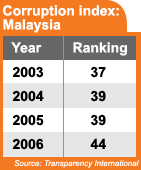
The country's ranking for perceived corruption by Transparency International (TI) has worsened, dropping five positions from last year to now rank 44 out of the 163 countries surveyed.
The country's ranking for perceived corruption by Transparency International (TI) has worsened, dropping five positions from last year to now rank 44 out of the 163 countries surveyed.
The country's position last year was 39 out of 158 countries. Malaysia only achieved five points out of a maximum of 10 this year, from 5.1 points from last year.
The nation's position in 2004 was also 39, a drop of two places from 37 in 2003.
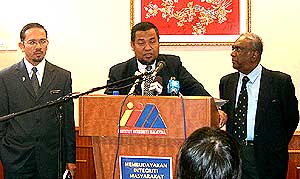 "Malaysia's weakened ranking is quite disappointing considering the many new initiatives taken by Prime Minister Abdullah Ahmad Badawi's government to combat corruption and enhance transparency and efficiency in the public delivery system," said TI (Malaysia) president Ramon Navaratnam.
He was speaking to reporters after opening an anti-corruption forum held at the Malaysian Institute of Integrity (IIM) in Kuala Lumpur today. Present was Anti-Corruption Agency (ACA) deputy director Zakaria Jaffar.
 Navaratnam said the perception of corruption in Malaysia by TI had increased slightly despite the establishment of the IIM, the formulation of the National Integrity Plan and the government's push for greater transparency and efficiency in the public services delivery system.
TI's Corruption Perception Index, which draws from multiple expert opinion surveys, provides scores on a scale from zero to 10. Countries are ranked in terms of the degree to which corruption is perceived to exist among public officials and politicians.
Worldwide, Finland, Iceland and New Zealand share the top rank with scores of 9.6. Denmark is placed fourth followed by Singapore, Sweden, Switzerland and Norway.
Political will
In the region, Malaysia comes behind Australia (9), Hong Kong (15), Japan (17), Macao (26), Taiwan (34) and South Korea (42). The full list can be seen here .
The Berlin-based monitoring body said there is a perceived lag between the formulation of new policies in Malaysia and the actual implementation of these policies on the ground.
Their report for Malaysia this year also concluded that the complexity involved in the approving and licensing procedures by statutory and local authorities needed improvement.
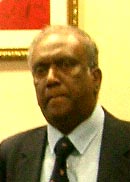 "TI-Malaysia calls on the government to act firmly without fear or favour against all parties that abuse their power and take part in corrupt practices. There should be stronger political will on the part of the leadership. They should say 'no more' and mean it," said Navaratnam.
"Corruption is a debilitating and a scourge on that keeps a nation from achieving its fullest potential and inhibits growth and equitable income and wealth distribution," he added.
Asked on TI's stand on Minister in the Prime Minister's Department Nazri Abdul Aziz's recent statement that Umno members are immune to graft laws, Navaratnam said he disagreed.
"Nobody should be above the law. Not politicians, not TI, not anybody. As long as we can prove it (corruption), then nobody is immune," he said.
"If there is some law that exempts political party members from prosecution, then it should be made public," he said.
Attention span
Nazri, who is the country's de facto law minister said last week that the ACA had no powers to initiate investigations on reports of money politics and bribery within Umno.
"Political parties are associations for members only, hence positions in such organisations are not public posts. ACA can't come in because this (money politics) has nothing to do with the public. It does not affect public in the sense that it does not involve public projects," he had said.
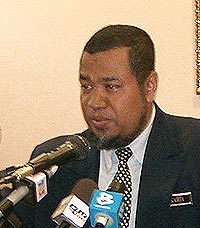 Zakaria (
pix
), meanwhile, told reporters that a closer working relationship between the media and the ACA was needed.
Zakaria (
pix
), meanwhile, told reporters that a closer working relationship between the media and the ACA was needed.
"We commend their (the media's) attitude on anti-corruption cases and hope to see more cooperation in the future," he said adding however, that the media had 'a relatively short attention span'.
"Cases that are 'hot' are pursued but reporters tend to not focus on cases that are not so 'hot'," he said.
Zakaria refused to comment on Nazri statement when pressed by reporters on the matter.


