




Sin Chew 'shall remain independent'
Media baron Tiong Hiew Khing's acquisition of two more Chinese newspapers will not affect the editorial independence of Sin Chew Daily , said its group editor Liew Chen Chuan.
Media baron Tiong Hiew Khing's acquisition of two more Chinese newspapers will not affect the editorial independence of Sin Chew Daily , said its group editor Liew Chen Chuan.
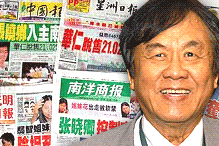
Tiong who owns Sin Chew and its sister publication Guang Ming Daily , recently took over Nanyang Siang Pau and its sister publication China Press from MCA.
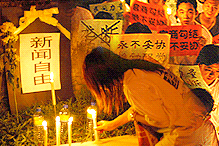
Over the weekend, students mounted a nationwide protest against what they described as a monopoly of the Chinese media. The protest forced Sin Chew to block the entrances of its headquarters in Petaling Jaya and Penang with lorries.
 Responding to the protest, Liew penned a lengthy commentary which was published by the MCA-owned English daily,
the Star
, today.
Responding to the protest, Liew penned a lengthy commentary which was published by the MCA-owned English daily,
the Star
, today.
Liew did not criticise or defend Tiong's acquisition of Nanyang and China Press but absolved Sin Chew from any role in the deal.
"It should be clearly established that it was Tiong and not Sin Chew Media Corporation that acquired Nanyang Press," he said in the commentary titled 'We don't believe in monopolies'.
"Both companies are listed on Bursa Malaysia. They are required to comply with the various regulations of the bourse and come under the supervision of the regulator in terms of fulfilling their responsibilities towards their shareholders and stakeholders, large and small," he added
Liew said Tiong's ownership of the four newspapers would not get in the way of Sin Chew 's independent news coverage.
"... with the recent acquisition of Nanyang , Sin Chew Daily has been labelled as a "monopolist" by certain parties.
"It has been accused of monopolising the Chinese newspaper market in Malaysia and the space for expression of opinions," he added.
Liew said all four newspapers are being managed by separate groups.
"In other words, even though Tiong is the major shareholder of both (publishing) companies, Sin Chew Daily , Guang Ming Daily , Nanyang Siang Pau and China Press remain separate corporate entities. In the past, they were run independently, in competition with each other," he added.
Tiong's pormise
Liew said Tiong promised that the newspapers will continue to compete in terms of pricing, quality, technology, product innovation and marketing.
"Tiong has made a personal promise that this current state of competition will go on. The management and staff of all four newspapers as well as the consumers, namely their readers, all share this desire.
 "Similarly, Tiong, as the owner, would want this competition between the newspapers to go on. Any loss of reader support will have a direct impact on the returns from his investment," he said.
"Tiong has never been identified as being highly political. He has mainly been seen as someone involved in business and culture. He is not a political figure nor does he have any political agenda. As a businessman, his concerns are the survival and growth of his businesses.
"As a man of culture, he wants to ensure that the newspapers live up to their responsibility to society and the elevation of culture," he added.
Liew said the operations of all four newspapers will continue to be dictated by market forces.
MCA bought Nanyang shares for RM5.50 per share in 2001 but sold part of the stake to Tiong at RM4.20 per share, making a loss of RM3.07 million.
Nanyang's financial situation has not been healthy in recent years. It suffered RM6.3 million losses in its last financial year ending on June 30, 2006. It was also the first time Nanyang suffered losses after being taken over by MCA.
It was said a takeover by Tiong's corporate group, through Ezywood, would help inject finances into Nanyang and China Press .
However, numerous quarters, including 100 columnists from Chinese dailies, have opposed the takeover.


