




Gov't caught napping in economy drive
The nation's economic trend has been spiraling downwards in the past 10 to 15 years as a result of the government's inefficient policies, charged former director of the Centre for Public Policy Studies Dr Lim Teck Ghee.
The nation's economic trend has been spiraling downwards in the past 10 to 15 years as a result of the government's inefficient policies, charged former director of the Centre for Public Policy Studies Dr Lim Teck Ghee.
 "Our leaders have been building up a structure of inefficiency through several kinds of policies like privatisation, industrial master plan, the national automotive policy and many more," he said at a forum on Saturday.
"All these giant projects have contained serious design and implementation flaws as well as the massive costs of bailouts which are still continuing," he added.
Lim was one of the panel speakers at the 'What is the future of Malaysian Economy' forum organised by Parti Keadilan Rakyat in Penang on Nov 25. The other panelists were academician P Ramasamy and Keadilan treasurer Khalid Ibrahim.
Lim said that the country's economy was now at crossroads with the government making one forward step while moving back two steps simultaneously.
"With all the advantages that we have, actually we should be surging ahead but in fact we are sleeping and being left behind," he lamented.
"What is of concern is that the dismal socio-economic outlook is coming at a time when the country should be taking advantage of its diversified economy, surging energy and commodity prices and the booming global economy to make a big leap forward. Instead, the country appears to be going backwards," he added.
Revise the NEP
He added there were few reasons that were holding back the country's economy, one of them being the 'feel good' syndrome ( Malaysia Boleh ) among the locals.
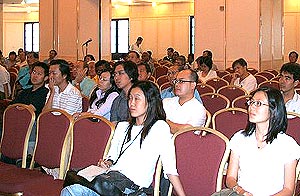 "From 1970 till 1990, basically Malaysians felt that the poverty rate in the country was dropping. The civil service was not that politicised and the health service was not too bad. Everything sounded reasonably well," he said.
He added that the slide in this 'feel good' factor among the people and the leaders made the economic condition worse.
He also said that although the New Economy Policy (NEP) has its advantages in maintaining an economic stability, the government must revise or reform the 36-year-old affirmative action policy.
Lim said that the country could have a brighter future if the leadership could rise above narrow parochial interests and jettison past policies that had only enriched vested interest groups.
The NEP's purpose was to elevate the economic status of the bumiputeras to achieve a 30 percent stake in the nation's economy pie. It was to have achieved its target in 1990 but as of now their equity share is only 18.9 percent.
Lim was recently involved in a controversy after a report which he had helped prepare at the Asian Strategy and Leadership Institute claimed that the bumiputera equity could already be as high as 45 percent.
Visiting senior research fellow of the Institute for Southeast Asian Studies P Ramasamy said that the bad quality of the leaders was a contributory factor in the shape of our economy.
"There is no space for us to discuss the NEP freely as it'll become highly racial as our politicians claimed in the media," he said.
"How is the country going to improve if NEP continues to exist without addressing problems of capital acquisition among Malays and poverty, but to enhance the interests of Malay elites, especially those with close links to Umno?" he asked.
High cost of doing business
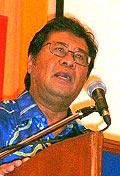 The other speaker, Khalid Ibrahim urged the government to create an 'open economy' because the recent economy trend does not cater to the market demand.
Rather it only serves to the interest of certain groups, he said.
He also claimed that the cost of doing business in Malaysia was getting higher as foreign investors needed to pay 'introduction fee' to get themselves introduced to the government.
Instead of direct business relationship, foreign investors had to go through a system of "selected lobbies".
"Let say if our prime minister is sitting at the main business table. If you want to get a seat at the side table, you need certain help from certain channels and this means money," he said.
"And if you have a land here, to make your file moving faster among the staff, you need to pay certain advisory fees," he added.
Photos by Ngu Ik Ying


