




MILF peace talks: M'sia may need to shift role
Malaysia may have to shift from its role as facilitator in the peace talks between the Philippine government and Moro Islamic Liberation Front (MILF) should the current stalemate remain and recede back to a larger conflict, said an analyst.
Malaysia may have to shift from its role as facilitator in the peace talks between the Philippine government and Moro Islamic Liberation Front (MILF) should the current stalemate remain and recede back to a larger conflict, said an analyst.
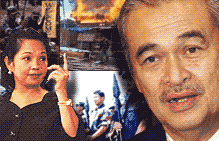 Prof Dr Aruna Gopinath, a history lecturer with Universiti Malaya, said Malaysia may have to become more involved as an 'arbitrator' if the MILF does not come up with a viable counter-proposal on ancestral domain that reflects the consensus of all the stake-holders in the Moro community.
Aruna said this would occur only at Manila's request in accordance with the Asean principle of 'non-interference' in the internal affairs of member nations.
Aruna, who specialises in Philippine history and politics, returned to Kuala Lumpur on Monday after presenting a paper on the peace talks at the 19th International Association of Historians of Asia Conference in Manila.
The 13th exploratory talks between the Philippine government and MILF that took place in Kuala Lumpur on Sept 6-7 broke down after the MILF rejected the proposal on 'territory'.
The Philippine government proposed 613 villages to be added to the Autonomous Region of Muslim Mindanao (ARMM).
However, the MILF argued that there should be about 1,000 villages in order to provide for a contiguous are of governance for the proposed Bangsamoro Juridicial Entity (BJE).
Last Sunday, Philippine soldiers were involved in a shootout with MILF rebels and this worsened the already tensed stand-off between the warring parties.
Many factions
Meanwhile, Aruna said MILF has to figure in the many factions in the volatile South who could otherwise be a source of instability if left unaddressed.
These include the numerous clans and Muslim and non-Muslim ethno-linguistic tribes whose conflicts in the past have wrought considerable destruction and loss of property.
Aruna said Malaysia had thus far underestimated the importance of such factors and the complexity of Mindanao.
The authorities have also had to deal with the scourge of piracy that has preyed on the shipping routes in the South China Sea as well as the criminal gangs loosely grouped under the 'Abu Sayyaf' network.
"If things get any worse, especially if they threaten the economic development and stability of Asean, Malaysia may have to consider the option of changing the role it has played up until now," said Aruna.
She said Malaysia has two things going for it in terms of models to offer the Muslims in the Philippines.
On the one hand is its model of Islam as a uniting factor for what is an otherwise extremely divided South, she said.
On the other hand, Malaysia offers a model of modernisation that can prove attractive to the Muslims of Mindanao and hopefully contribute to lasting peace, she added.
The 12,000-strong MILF has been waging a separatist rebellion in Mindanao since it split from the larger Moro National Liberation Front (MNLF).
The MNLF signed a peace deal with Manila in 1996, dropping its separatist ideology for limited self-rule.
President Gloria Arroyo Macapagal signed a truce with the MILF in 2001 and later engaged the rebels in negotiations with an aim of signing a final accord this year.


