




Media giants merger put off
A press conference scheduled later today, which is expected to announce the proposed merger between two media giants, has been put off until further notice.
A press conference scheduled later today, which is expected to announce the proposed merger between two media giants, has been put off until further notice.
This eleventh-hour postponement immediately raises questions on possible hitches in the merger between the Utusan Melayu and New Straits Times Press (NSTP).
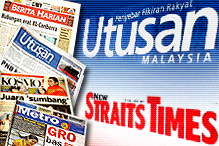 In a statement released to Bursa Malaysia later in the day, both Utusan and NSTP said they have not reached a "definitive agreement in relation to the terms of such merger."
"Utusan and NSTP intend to continue to explore and discuss this matter further and have entered into a non-disclosure agreement to govern the period of discussion," it said.
"An immediate annoucement shall be made to Bursa should a final agreement materialise."
Trading resumes tomorrow
Another statement from Bursa Malaysia said that trading of the two companies will resume tomorrow morning.
The merger looked all set to proceed with the suspension of trading of the two companies at Bursa Malaysia last Friday.
A press conference was slated for this evening where the details of the merger was expected to be made public.
However, this morning a joint press release by the two companies said that the press conference was called off. No other details were provided.
In their joint statement to the Bursa Malaysia today, both the companies admitted publicly for the first time that they were exploring the possibilities of a merger.
Both companies said that they will continue to explore and discuss this matter further.
Umno supreme council scuppers deal?
It is believed that the merger was put off after Umno politicians expressed concern over the identity and status of Utusan - which is directly owned by the party - at its supreme council meeting on Friday.
At the post-council press conference, Prime Minister and Umno president Abdullah Ahmad Badawi nevertheless gave his green light for the merger.
Abdullah, however, warned that the two media powerhouses should not lose their identities, tradition and history following the merger.
"It is not about the financial aspect of the merger. It is about the image, history and tradition of each of the newspapers. It is not easy to forget the pride of newspapers that had survived through time," he said.
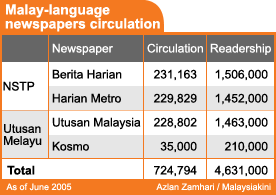 News of the merger surfaced earlier last week when it was reported that the two public-listed organisations will be grouped under a yet-to-be named entity.
The merger will also see the new entity coming under the direct control of the ruling party which will now have a complete monopoly of Malay-language newspapers.
Together, this new company will have a total daily Malay-language newspaper circulation of 724,794, with a readership of 4.6 million.
Umno in control
Umno fully controls Utusan - which published Utusan Malaysia and Kosmo - while has an indirect control of NSTP stable of newspapers and television stations.
The Star on Saturday reported that several party supreme council members voiced their concern over the deal and also the long connection between the party and Utusan Malaysia newspaper.
They told the meeting they feared that any merger which could affect the identity of the Malay daily would backfire on the party, although Umno would continue to control it.
The Star quoted a source as saying that following this concerns raised by several Umno council members, the negotiators decided to re-look at the deal.
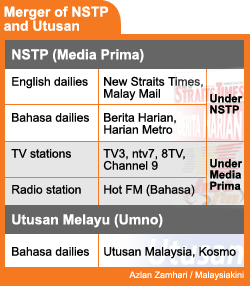 At present, Umno controls about 50 percent equity interest in Utusan Melayu, which the party took over after an acrimonious battle with the then newspaper's editors and journalists in 1961.
However, the party's control over NSTP has always been through nominee business groups such as Media Prima, which has a 43 percent stake in NSTP.
NSTP publishes the English dailies New Straits Times and Malay Mail as well as Malay newspapers Berita Harian and Harian Metro .
The merger could also pave the way for the ruling party to directly control all the private free-to-air TV stations - TV3, ntv7, 8TV and Channel 9 - which are currently under Media Prima.


