




Utusan-NSTP merger affects both
Veteran Malay-language journalist Said Zahari said that the proposed merger between media giants Utusan Melayu and the New Straits Times Press (NSTP) would affect the identities of newspapers published by them.
Veteran Malay-language journalist Said Zahari said that the proposed merger between media giants Utusan Melayu and the New Straits Times Press (NSTP) would affect the identities of newspapers published by them.
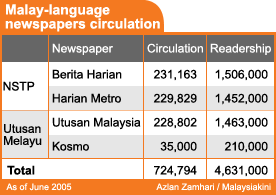
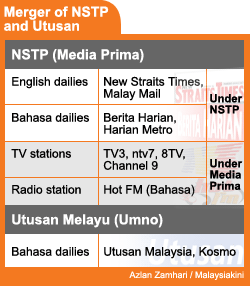
Utusan Melayu publishes the popular Utusan Malaysia and Kosmo while NSTP's flagship is the New Straits Times and Berita Harian , which competes directly with Utusan Malaysia for the Malay market.
 According to Said,
Utusan Malaysia
and the
New Straits Times
were founded with different historical backgrounds to cater for different interests and values of different communities in Malaysia.
According to Said,
Utusan Malaysia
and the
New Straits Times
were founded with different historical backgrounds to cater for different interests and values of different communities in Malaysia.
"Their unique identities should be preserved to reflect the diversity and plurality of the country," he told malaysiakini in a telephone interview today.
" Utusan Malaysia is, for example, meant for the Malay-educated Malaysians, a large proportion of which resides in the rural area."
" New Straits Times , on the other hand, is for the more urban-centric Malaysians who are English-educated," elaborated Said.
Unique products
So, Said added, the proposed merger between Utusan Malaysia and the New Straits Times is actually different from the consolidation of Nanyang Siang Pau , Sin Chew Jit Pau , China Press and Guangming Daily under a single ownership because the Utusan Malaysia and the New Straits Times are two unique products.
"The loss of the unique identities of Utusan Malaysia and the New Straits Times consequent on the merger would affect the product loyalty of the exiting readers of the both the newspapers.
He added that if the readers feel that the merger is an attempt to stifle press freedom and manipulate public opinion, then the dailies will suffer a greater drop of readership and revenue.
 "If there should be any merger for business reason, it would be more meaningful if it is between
Utusan Malaysia
and
Berita Harian
," he added.
"If there should be any merger for business reason, it would be more meaningful if it is between
Utusan Malaysia
and
Berita Harian
," he added.
Said, 78, was the editor-in-chief of the independent Utusan Melayu from 1956 to 1961 before the newspaper's ownership was taken over by Umno.
In the turmoil which followed, Said was detained in Singapore without trial for 17 years from 1963 to 1979. He is also a former guest writer of the University Kebangsaan Malaysia (UKM).
"While I do not know the real reason for the proposed merger, I do know that both Utusan Malaysia and the New Straits Times are not doing well in recent years because the market competition posed by The Star and the mushrooming online media like malaysiakini and Malaysia Today ," Said observed.
"The more proper and appropriate response to the challenge is not merger but for Utusan Malaysia and the New Straits Times to be freer, more liberal and open-minded in providing space for different voices in our pluralistic society.
"This include giving space to the voices of the opposition parties and NGOs and not to continue to restrict their roles to being mouthpieces of Umno and the government."
 "We must not forget that members and supporters of opposition parties also have purchasing power in th media market and their number in the country is not negligible," Said said.
The new reality
" Utusan Malaysia and the New Straits Times must face up to the new reality that Malaysians nowadays are more educated and critical people who cannot be satisfied with reading reported speeches and pronouncements of ministers like in the 1960s or 1970s...
"Now we want other sides of the story and also commentaries and analyses from various perspectives," he added.
The proposed merger in expected to be sewn up soon despite reservations shown by several Umno leaders and grassroots members. Senators too have expressed their concerns with the proposed merger.
On Sunday, Umno Youth chief Khairy Jamaluddin said it was important to get the opinion of the grassroots because the two mainstream newspapers have their own history and identity.
However the Umno Supreme Council, which had had lengthy discussions on the matter have left it to the party top leadership to decide on the merger.
 Prime Minister Abdullah Ahmad Badawi has given his green light for the merger but urged the media houses to retain their respective identities if the merger goes ahead.
He added that the merger was being discussed solely for financial reasons.
At present, Umno controls about 50 percent equity interest in Utusan Melayu. However, the party's control over NSTP has always been through nominee business groups such as Media Prima, which has a 43 percent stake in NSTP.
NSTP also publishes Malay Mail as well Harian Metro .
The merger could also pave the way for the ruling party to directly control all the private free-to-air TV stations - TV3, ntv7, 8TV and Channel 9 - which are currently under Media Prima.


Are you sure you want to delete this comment?
This action cannot be undone.