


M'sia falls in corruption perception index for second year in a row
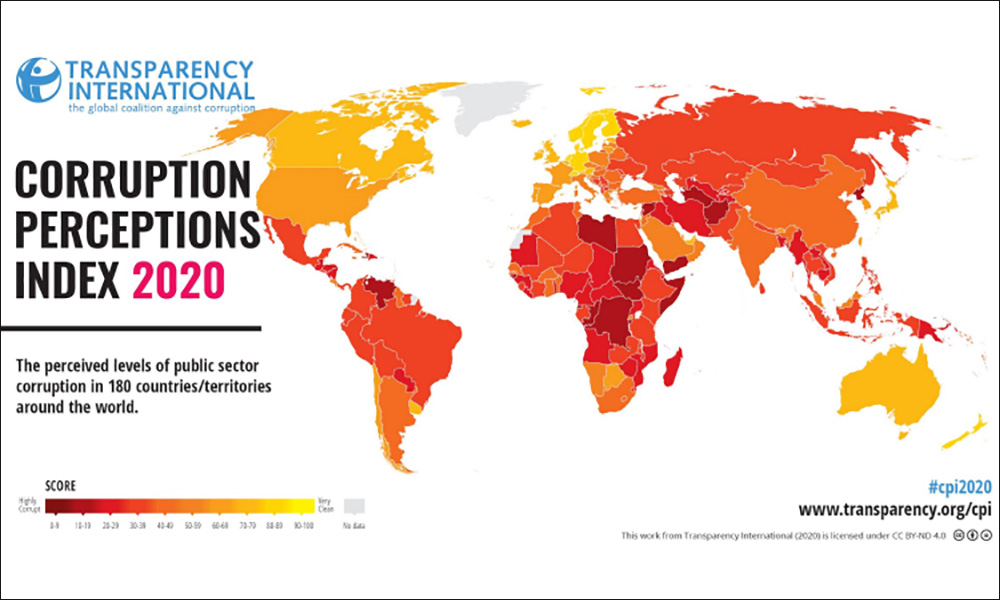
Malaysia's score in the annual Corruption Perception Index (CPI) has fallen for the second time in a row, dropping three points from last year’s report and pushing the score below the 50-point mark.
The 2021 CPI was released by Transparency International-Malaysia (TI-M) today, showing the country's score is now 48, compared to 51 in the previous year and 53 points in 2019.
The deterioration of the score is reflected in Malaysia’s ranking which dropped to the 62nd spot from...
Malaysia's score in the annual Corruption Perception Index (CPI) has fallen for the second time in a row, dropping three points from last year’s report and pushing the score below the 50-point mark.
The 2021 CPI was released by Transparency International-Malaysia (TI-M) today, showing the country's score is now 48, compared to 51 in the previous year and 53 points in 2019.
The deterioration of the score is reflected in Malaysia’s ranking which dropped to the 62nd spot from 57th in 2020.
“This is our score for 2021, so you can see it has dropped further.
“From 53 (in 2019) to 51 (in 2020) and we have dropped another three points, so it is a very worrying trend that we are seeing.
“We have dropped five points in three years since 2019. Some may say it is only five points, but no, actually the five points are very serious and very significant,” said TI-M president Muhammad Mohan during the release of the 2021 CPI report, which was conducted over video conferencing today.

In 2019, Malaysia saw a marked improvement in the CPI, increasing six points from the previous year to 53 points. This had been Malaysia’s highest score on the CPI since 2012.
Muhammad said the score is the more important indicator as the rankings can be affected by new countries being included in the list and other external factors.
Among the region, Malaysia appears to be doing well, falling behind only Singapore this year. While Brunei had outdone Malaysia in 2020, their results were unavailable for 2021 due to a lack of data sources.
This year, Singapore had a score of 85 points, placing it at fourth place where it tied with Norway and Sweden. Singapore is also the only Asian country to make it onto the top 10 on the CPI.
Those three countries are behind only Denmark, Finland and New Zealand, which tied for first place with 88 points.

Still doing well in Asean
Muhammad noted that while it seems Malaysia is still doing well in comparison to other countries in Asean, Indonesia has been improving slowly over the past few years.
“We need to be careful with our situation, especially with Indonesia… they are slowly improving. If we are not careful, one day Indonesia may overtake us,” he said.
He also compared Malaysia’s results with selected Islamic countries, saying that the United Arab Emirates (UAE) and Qatar are among the best-performing Islamic countries on the CPI, with 69 points and 63 points respectively.
“As an Islamic country, we should be aiming to be at the level of the UAE or Qatar, and of course, we can continue to improve after that,” he said.
Correlation between healthcare spending and CPI score
In TI-M’s analysis of the results, they found a correlation between the average percentage of government spending on healthcare and their average score on the CPI.
Countries that allocated more funding for the public healthcare system tended to score higher on the CPI, Muhammad noted.
“Malaysia’s spending is only 3.8 percent on healthcare, which is relatively low.
“This comment had also come from some of the health experts during the peak of the Covid-19 pandemic when we saw how our healthcare system was overwhelmed during that difficult period,” he said.
He said it is “common sense” that countries that handle corruption well can have more funds to be put to good use, such as in the education or healthcare system.

Meanwhile, Muhammad noted that Malaysia launched the National Anti-Corruption Plan (NACP) in 2019, making it one of the few countries to have an action plan to fight against corruption.
This is commendable, he said, but good planning must be accompanied by good implementation, which is where Malaysia has fallen behind.
Other reasons
Other possible reasons why the country's score had regressed include the stalling of institutional reforms, with the last four governments lacking the political will to table the Political Financing Bill, he added.
The proposed Independent Police Complaints and Misconduct Commission (IPCMC) Bill had also been watered down to an “ineffective” Independent Police Conduct Commission (IPCC) Bill, while recommended reforms to MACC have not progressed since 2015.
There have also been acquittals with no clear clarifications in high-profile corruption cases as well as a lack of closure in the SRC International Bhd and 1MDB cases.
The suspension of Parliament during the movement control order (MCO), the appointment of politicians without experience to head government-linked companies (GLCs), limited progress or public updates on high-profile cases, lack of action against public officials found to have abused their positions and so on, were among the other reasons for a lower score.
READ MORE: MACC vows 'serious attention' after poor corruption index score
Recommendations
As such, TI-M has once again come up with a list of recommendations for the government to look into, as below:
- Narrow the scope of the Official Secrets Act so that matters of public interest can be disclosed.
- Share information transparently including on all public contracts and regular updates on the status of pending high-profile cases.
- Monitor implementation of the NACP and disclose its progress to the public.
- Empower the chief secretary to the government to be responsible for the public service’s role in the implementation of the NACP.
- Adopt the International Standards on Integrity Pact in government procurement.
- Improve the power and independence of the Enforcement Agency Integrity Commission (EAIC).
- Reform MACC to make it truly independent and place it under the purview of Parliament.
- Amend the Whistleblower Protection Act 2010.
- Enactment of an asset declaration law to compel all politicians and high-ranking public officials to declare their assets publicly.
- Reduce large off-budget projects that use public funds. Mandate the public disclosure of cost-benefit reports and require parliamentary approval before commencing.
- Amend the election Offences Act 1954 to include sanctions against corruption.
- Compel public officials found guilty of corruption to vacate their official positions, even while they exhaust the appeal process.
- Include misconduct in public office as a provision in the MACC Act to hold public officials accountable for their decisions.
- Enact a new ombudsman law to investigate complaints involving public interest.
On top of their recommendations, TI-M has urgently called for the full implementation of the NACP, accelerate the tabling of the Political Financing Act, the independence and transparency of key institutions such as the MACC and Attorney-General’s Chambers, the enactment of an anti-hopping law or recall elections, implementation and empowerment of Undi18 as well as the implementation of parliamentary reforms.





Report this comment
Are you sure you want to delete this comment?
This action cannot be undone.