




A weary Orang Asli hero
How has the native land rights case changed your life? A simple enough question, but Sagong Tasi of the Temuan tribe instantly goes from chatty to sombre in searching for an answer.
How has the native land rights case changed your life? A simple enough question, but Sagong Tasi of the Temuan tribe instantly goes from chatty to sombre in searching for an answer.
Nobody would believe that he is one of the most recognisable of the Orang Asli community in Malaysia.
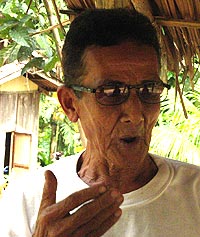 Now 77, he won 'celebrity status' when he and six others took the government and developers to court for building a highway on land to which the Temuan tribe claims customary rights to. They represented 26 families in Kampung Bukit Tampoi in Dengkil, Selangor.
He was 68 when more than two hectares of his land were taken over to build the Kuala Lumpur-Nilai highway in 1996. This was part of a tract of 15.32 hectares that was acquired.
The legal battle, which started in 2001 in the Shah Alam High Court has moved right up to the Federal Court, where it is awaiting an appellate hearing.
Dressed casually in a t-shirt and shorts, he began animatedly by describing his experiences in court.
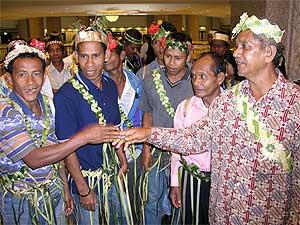 "We didn't even know the procedures, but we got help from people like Colin Nicholas (director of the Centre for Orang Asli Concerns, a non-governmental organisation)," Sagong said.
"But by the time the case went up to the Court of Appeal, it had attracted much attention - about 300 other Orang Asli turned up to show support."
On Sept 19, 2005, the Court of Appeal upheld the Shah Alam High Court's landmark decision to declare Sagong Tasi and six others as customary owners of the plot of land in dispute.
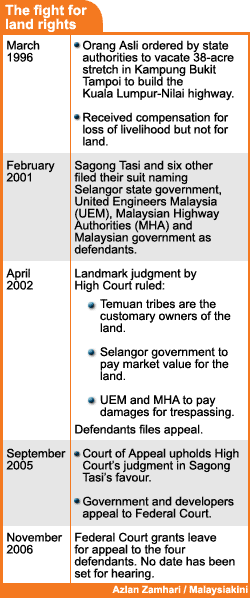 The court ordered that they be paid the market value under the Land Acquisition Act 1960 since their constitutional rights to adequate compensation had been violated. It further ruled that the government was wrong in (merely) paying compensation for loss of livelihood and damage to property.
The developer, United Engineers Malaysia (UEM) and the Malaysian Highway Authority (MHA) were ordered to pay damages for trespassing on the land.
Swift recognition
Recognition was swift in coming - human rights group Suaram gave its 2005 Human Rights award to this Temuan community for its "hard-earned victory".
Sagong was invited to an Orang Asli convention in Sabah at the end of last year as a guest of honour.
Chipped in Nicholas: "I was with him for two days and left him there for the rest of the week. I didn't have to worry - he was well taken care of. Everyone treated him as a celebrity."
Listening to this, Sagong quipped: "In my village, no one visits me. But outsiders want to come, to see what I look like - whether I'm attractive or not...."
Asked to compare the changes to his lifestyle resulting from the loss of land, he looked dispirited.
 "I cannot enjoy my life anymore. My farm is gone. I used to have oil palm and rubber trees, go fishing for fish and prawns in boats that I made myself ... but they are all gone," he sighed.
Three of the plaintiffs, who were his friends, have since died.
"Now I am alone, all my friends have passed on. I spend most of my time thinking about the past and then I start crying. They have all left me and I've lost my fighting spirit," he said.
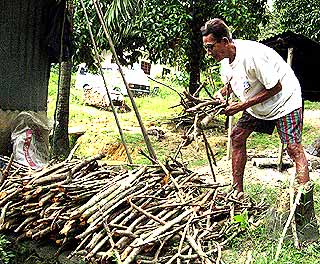
Sagong now chops firewood for a living and spend most of his days listening to the radio in his house.
 There is still much at stake, as the case has yet to conclude.
The federal and Selangor governments, UEM and MHA were granted leave to appeal six questions of law, including the issue of proprietary rights, compensation and damages.
The Federal Court is expected to hear submissions this year, but the date has yet to be fixed.
While he misses his friends, Sagong draws consolation from this thought: "Before the case started, nobody would believe we could take on the government but now, we have enough support to carry on the fight."


