
More than a decade after it was first completed, the film adaptation of late playwright Jit Murad’s theatrical masterpiece ‘Spilt Gravy on Rice’ is finally set to premiere in cinemas on June 9.

The story revolves around a character known as Bapak (which means father in Malay), a British-educated retired journalist and patriarch, who realises that he does not have much time left on Earth.

Bapak decides to invite his five children over for dinner to discuss unresolved family matters, including who will inherit his house - an old mansion in the centre of the rapidly developing Kuala Lumpur.

The movie stars legendary actor Rahim Razali taking on the role of Bapak, Zahim Albakri, Jit, Na’a Murad, Junji Delfino, Sean Ghazi and Bernice Chauly.

Directed by Zahim, the film began production way back in 2011 and was scheduled to premiere in local cinemas in 2013. However, several issues cropped up that delayed its release, and tragically, Jit passed away suddenly in February this year.

In an interview, Zahim shed some light on the delay and how he feels now that the film will finally hit the cinemas.

He said that the idea to turn ‘Spilt Gravy on Rice’ into a film came to them in 2003 during the last run of the play at the now-defunct Actors Studio Bangsar. The cast and crew were joking about turning it into a film and which Hollywood actor they would cast in the lead roles.

“By 2010, Jit’s description of Bapak’s house in the play became very similar to that of my family’s home for over 40 years on Jalan Kia Peng.

"That house stood on a large piece of land in a once leafy neighbourhood of Kuala Lumpur but is now dwarfed by tall skyscrapers.

“My family had been reluctant to sell the leasehold property which was originally built in 1921 but had been extensively renovated and extended by my late father, Hisham Albakri, a renowned architect, in his signature style of tropical architecture," Zahim told Malaysiakini.

A hope to preserve an old house…

He said that given the knowledge that the house would inevitably have to make way for development, he thought that making a film with the house as a backdrop would be a way of preserving it.

"My bapak’s legacy and the desire to one day put Jit’s story of Bapak and his offspring on screen seemed to be a perfect fit," Zahim said.

With Jit's blessings, Zahim and writer June Tan began the task of adapting the play for the screen. It took 10 drafts to finally come up with an adaptation they were happy with.

Many changes were made with Jit adding a few new scenes for the angels, reprising the role he had played in the stage production.

Zahim said: “I would say the structure has changed, putting more focus on Bapak that may have been influenced by the knowledge of what a great screen actor Rahim is.

"There is the welcome addition of the character of Concepcion, played by Delfino, who plays Bapak’s grumpy Filipina housekeeper to perfection.

"Bapak’s wives who were only spoken about in the play are now personified by five stellar female actresses, Nanu Baharuddin, Ida Nerina, Melissa Saila, Sabrina Hassan and Diana Danielle.”

A scene from ‘Spilt Gravy on Rice’ starring Rahim Razali and Junji Delfino

Zahim said he feels films are more about showing than telling and that some things take on a much larger significance in the film than they did in the play.

"Being my first film, I was not expecting the impact of that but I now believe it only highlights the richness and importance of Jit’s writing. Beneath the laughter and giggles, there was real gravitas and profundity to his words.

"I consider myself so fortunate that he trusted me enough to allow me to play around with the product of his undoubted genius, his writings. For that, I will be forever grateful. Thank you, Jit.”

The familiar censorship battle

According to Zahim, the director’s cut of the film was finished in 2012 and it was first submitted to the Film Censorship Board at the beginning of 2012.

In February of the same year, they received the first report stating that the film, as it is, was not suitable for screening in Malaysian cinemas.

“The report included recommendations for cuts, the muting of dialogue, the blurring of a vulgar hand gesture, and suggestions on how to make the film suitable for viewing.”

Zahim Albakri in a bloody scene of the movie

Zahim was then invited to meet with the then Censorship Board chairperson to discuss the report and recommendations.

“The meeting was attended by several Censorship Board panel members and the discussion that followed was done in a very open, frank and at times lively manner, with the chairperson and various panel members explaining the issues they had with the film, particularly from a religious standpoint.

“I must admit that I had expected them to have objections to the content of the film.

“But I was surprised when some of what I had expected them to object to was not a problem at all whereas other parts which I didn’t expect them to have a problem with, they did.”

Zahim (centre) directing the film along with cast members

He was given two alternative suggestions that could be made to the film that would make it possible to pass for public viewing. Zahim gave them a third option which they considered and were open to.

“I left the meeting feeling humbled, grateful and believed they genuinely felt the film deserved the time, effort and consideration given to it and they wanted it to be released, but not in the form it was in then.”

However, what followed was an eight-year period in which several different versions of the film were resubmitted. Each version had something in it that did not satisfy the Censorship Board requirements.

“The last submission was done in 2020 and in March of that year, we received a report saying the film was passed by the Censorship Board with one minor condition - which was to blur a vulgar hand gesture made by the character Zak - which I played, so it could get a PG13 rating rather than an 18 rating.”

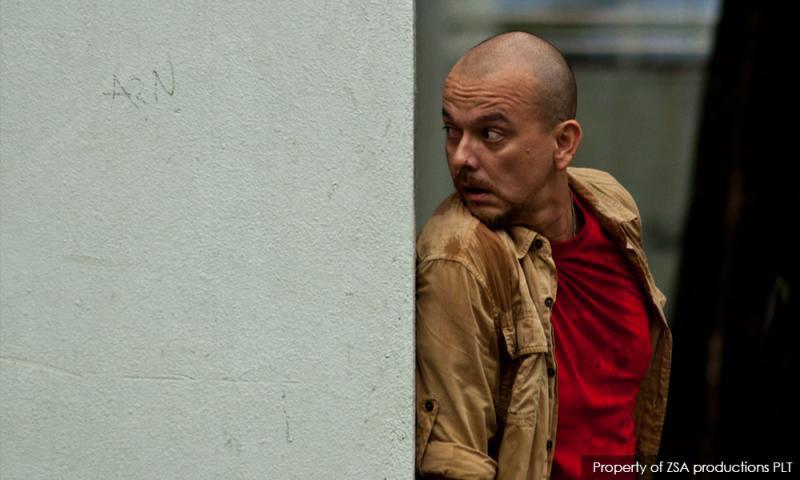
Zahim’s character Zak on the run

They went ahead with the changes so more young people could see it. Although it took so long, Zahim said that he learned to give and take, and have patience along with hope.

“What could be more Malaysian than that? What makes the release of this film so meaningful right now is the fact that Jit is no longer with us. He never got to see the fruits of his labour on the big screen.

“Jit told me he loved the original version. I believe he was proud of it and, of course, he was disappointed.

"But being the empath that he was, he was not as disappointed for himself, as he was for everyone else, for me, for my brother who produced it and for all the people who had worked so hard and put their effort into making this film who might never get a chance to see it released."

Zahim said that those who knew Jit and his work will feel a sense of nostalgia that will, no doubt, draw them to watch ‘Spilt Gravy on Rice’.

A scene featuring (from left) Harith Iskander, Na’a Murad and Jit Murad

"I hope they won’t be disappointed as most of the characters, the way they speak and what they say, came from him.

"What I am hoping for is that those who don’t know him or his work will have a sense of curiosity to come and find out what exactly was so special about the man and his work. I don’t think they will be disappointed either," he added.

Having invested so much time and energy into this project, it was interesting to know what Zahim felt, now that the film is ready to hit the big screen.

“I’m nervous of course. I can’t help but feel overwhelmed by all that needs to be done to get the word out.

"Not mastering how to navigate through the multiverse of social media is one thing I am hugely regretting now," he mused.

Right for the present time

He added that although the Covid-19 pandemic did further delay the release of the film by over two years, he was able to fix a few things that he wasn’t too happy about.

This included the colour grading and sound design. So this version looks, sounds fresh and feels like a new film, he said.

Zahim and Sean Ghazi (second left) in a scene from the movie

“But above all, I do feel with all that has gone on in Malaysia over the past two years, the core message that was and still is at the heart of Jit’s story about Bapak and his dysfunctional offspring is one of unconditional love and compassion and that is what Malaysia needs now, more than ever.

"So, even though it has been 11 years since we started making this film, I feel like this might be the right time for it to be released.”

Zahim described ‘Spilt Gravy on Rice’ as a film about a family, particularly a Malaysian family.

“It’s about us, all of us, all Malaysians.

"It was made for Malaysians to enjoy and we’ve been waiting a long time to share it with all of you, all Malaysians, whatever shape, size, age, sex, gender, sexuality, race, ethnicity, religion or political persuasion you are, it’s for you. So please come and watch it!”

Zahim is the vice-president of Badan Warisan Malaysia, an NGO that advocates, lobbies and creates awareness for the conservation and preservation of all aspects of Malaysia’s heritage.

Immediately after the release of the film, he will start work on directing the performance for the official opening of the PJ Performing Arts Centre at 1Utama.

“There’s also a play that Jit wrote before ‘Spilt Gravy on Rice’ that has never been staged… I am thinking about directing it, maybe towards the end of this year,” Zahim added.