




Be less racist, MP tells all political parties
Umno backbencher Zaid Ibrahim, fresh out of a 18-month party suspension, said the ruling party must undergo reforms for the country's race relations to improve.
Umno backbencher Zaid Ibrahim, fresh out of a 18-month party suspension, said the ruling party must undergo reforms for the country's race relations to improve.
Addressing a forum in Kuala Lumpur yesterday, he said certain parts of the New Economic Policy (NEP) needs reviewing.
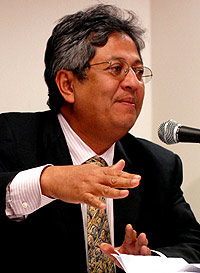 The outspoken Kota Baru MP, who had last year described Prime Minister Abdullah Ahmad Badawi's reform agenda as a
failure
, said the relations between ethnic groups is at a new low and Barisan Nasional (BN) components must be 'less racist'.
The outspoken Kota Baru MP, who had last year described Prime Minister Abdullah Ahmad Badawi's reform agenda as a
failure
, said the relations between ethnic groups is at a new low and Barisan Nasional (BN) components must be 'less racist'.
Zaid said the ruling government, in particular Umno, should effect change within its ranks. "The government has to do a lot more to reject racial dominance and racism," he added.
Describing the NEP as a response to a serious disequilibrium in a 'very dysfunctional country', he said: "There was general acceptance by most people then ... now something has gone wrong ... race relations has gone bad."
The other speaker at the forum - entitled 'NEP: Improving ethnic relations or otherwise'- was Parti Sosialis Malaysia (PSM) leader Dr Jeyakumar Devaraj
The NEP was created in 1970 to eradicate poverty amongst rural Malays in response to race riots the year before.
Instrument of dominance
Zaid, who is a prominent lawyer, however did not blame the NEP for deteriorating race relations.
"It's (NEP) meant to be temporary. There was general acceptance by most people, even the Chinese, Indians back then ... not the impression of the opposition that we see today," he said.
"Of course something has gone wrong since then, and I agree with you (Jeyakumar) that our race relations today is very bad. The problem with NEP is because it gives advantage to some group, there is a tendency to flaunt that as an instrument of dominance.
 "That is where it has gone wrong. I see that as not good for the country. I remember when there was a non-Malay headmaster or the education minister was Chinese. But you don't see that now," he said.
Attributing his foray into the law profession to a government funded scholarship, Zaid said it is acceptable to help a particular race if the criteria is clear.
"If the justification is made, then people can accept that. The problem today is that it has become something else.
"So if there a policy that is racist, that is not acceptable. But a policy that supports a particular race for a particular reason for a particular period in a particular way I would accept that as necessary," he explained.
In 2005, Zaid was let off with a warning after being found guilty of money politics by the party disciplinary board, but was suspended after declaring he had lost confidence with the board.
Winning formula
Previously, he had urged BN component parties to merge into a single entity because "the coalition parties have their own agenda in dealing with issues."
Last night, however, he said that disbanding race-based parties would take time.
"Maybe we could disband all these political parties based on race, but we still need to work together in a multi racial context. Of course ideally one day, we have two or three political parties.
"I hope one day we will get there. I don't think just because we (race-based parties) disband, that the people are ready for that," he told an audience of about 100.
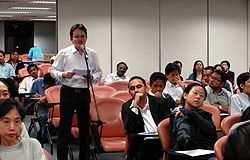 To a question from the floor, Zaid reiterated that he would not leave Umno.
"I remain in Umno because I believe that this country is not ready for a non-race based system. I think the transformation has to be through racial based parties, but at the same time we don't have to make those race-based parties racist.
"Therefore I still think you have to do it progressively through the existing framework channel, and that's why I still remain in Umno, though I don't know if they still want me (laughs). I believe that Umno must change, so that the country can change.
"It's not what you and I decide, it's what the ordinary people on the street decide. Since independence, the BN concept has worked. We got the support of the people. I think it is a bit unrealistic to disband a winning formula. If you are a BN man, why would you want to disband a policy that is working well in elections. We win two-thirds of the vote," he said.
Time to act
Earlier, Jeyakumar said civil societies have to act and not depend on the ruling parties.
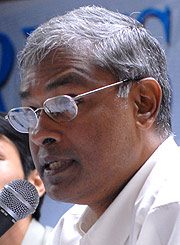 "We need to speak out. I think we cannot rely on component parties to speak out on these issues, they probably won't. They are in a comfort zone, so why should they?"
"We cannot sit quiet, I think we need to do things ourselves, as students, as social activists as workers. We got to organise civil societies, there are campaigns going on to get people educated. And then BN would take notice because some issues have become important issues, ideas," he added.
Jeyakumar also blamed the NEP for creating a new 'political species' - the Umno elites. He said this species depended on the policy to maintain political power.
He singled out Umno Youth leaders, whom he claimed deliberately create racial tension between ethnic groups as a means to maintain control.
"In the end it is a struggle among BN leaders and their cronies for the contracts and projects, with everybody else as pawns," he said.
The forum was organised by Youth For Change (Y4C), University Sains Malaysia's Humanity Library Tionghua Association Alumni and the Bar Council's National Young Lawyers Committee. It was held at the Bar Council headquarters.


Are you sure you want to delete this comment?
This action cannot be undone.