




Gov't Aids shelters lacking in modern M'sia
In a cluster of simple wooden houses where he has cared for hundreds of Aids patients who had nowhere else to go, Alex Arokiam is puzzled.
How is it, he wonders, that Malaysia can afford to construct the world's tallest buildings, but there is not one government shelter for HIV-infected people.
In a cluster of simple wooden houses where he has cared for hundreds of Aids patients who had nowhere else to go, Alex Arokiam is puzzled.
How is it, he wonders, that Malaysia can afford to construct the world's tallest buildings, but there is not one government shelter for HIV-infected people.
The government has admitted that Malaysia faces a widespread HIV/Aids epidemic, and that half a century of development could be reversed if it fails to act aggressively against the virus.
 There are now 73,427 people living with HIV among a population of almost 27 million, and the government warns that if the virus is not checked, up to 300,000 people could be infected by 2015.
But Arokiam, a tall and charismatic 57-year-old, says that although more Malaysian Aids patients will receive free treatment with modern anti-retroviral drugs from this year, they will still need to be cared for.
"You can't give free medicine and hope the Aids problem will disappear. They need a place to stay and be monitored until they are strong enough," he said.
"The government has to fund similar centres nationwide. We have a long list of people hoping to come here but space here is limited."
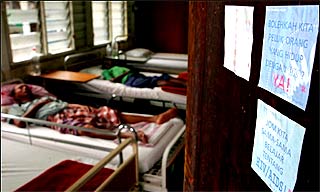
At his Welcome Community Home in a quiet village outside the capital Kuala Lumpur, Arokiam is caring for some 50 male Aids patients who he says get little public sympathy in the race to address the needs of women and children.
In an open courtyard, those who are able do their daily exercises, while one sickly man in a wheelchair is massaged and has his limbs stretched by a fellow inmate.
"To keep costs down, those who are healthy nurse the weak. Food is prepared by themselves," says Arokiam who established the centre with funds from the Catholic Church a decade ago and is helped by his wife and daughter.
Nowhere to go
Aids shelters for men are rare in Malaysia and this home is one of the biggest in the country - a country, Arokiam points out, that in 1998 constructed what were then the world's tallest buildings, the Petronas Towers, at a cost of US$1.5 billion.
The Malaysian Aids Council says the government provides it with RM4 million annually, and just RM300,000 ringgit of that is set aside for shelters.
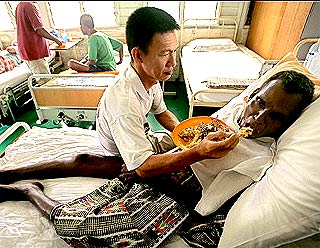 At least 640 people have passed through Arokiam's doors, 100 of whom have died. Many more regained their strength thanks to good diet and nursing, and were able to return to their families or fend for themselves.
Arokiam says the Aids crisis first caught his attention in 1997, when he joined a local church group to provide food and medical treatment for drug addicts in Kuala Lumpur.
"Addicts with the disease were begging me for a home. We did not have a single shelter. But we had the Twin Towers. I was shocked and disturbed," he says.
"These were people with full-blown Aids and with nowhere to go. There were ample shelters for the blind, cancer but none for the Aids persons."
Determined to solve the problem, he obtained funding from the church to buy a piece of land, and some 15 Aids patients cleared the land to build a sick bay, kitchen, hostel and an office.
'Giving me hope'
The residents are mostly intravenous drug addicts who contracted HIV through needle sharing, while others caught it from sex workers.
Manaf Sain, 50, was a labourer in Singapore who had been an addict for some 25 years.
"I got HIV through sharing needles. Seven years ago I was confirmed with the disease. I have been here for the past five years. I have regained strength and now I help maintain the home," he says.
S Shanmugam, 33, was an executive with a freight-forwarding firm until his life collapsed.
"I was married five years ago but I visited prostitutes. I was confirmed with HIV two years ago," he said. "I have not seen my two children and wife since then.
"But I like this place. It gives me some hope to live. I want to recover and return to my family," he adds, his face brightening as he shows off his new watch, a present from his mother.
"My mother and sister came to see me for the first time. They hugged me. I want to live and I want to go home."


