




The crushing of Fallujah and its people
American troops 'murdered' 16 children and this marked the beginning of the horrors in Fallujah, claimed a former resident of the strife-torn city in Iraq.
American troops 'murdered' 16 children and this marked the beginning of the horrors in Fallujah, claimed a former resident of the strife-torn city in Iraq.
Testifying before the Kuala Lumpur War Crimes Commission yesterday, Abbas Z Abid said the children perished when the troops opened fire on a group of demonstrators in front of a school.
Abbas, who lost his nephew in the incident, said this sparked off the war in Fallujah.
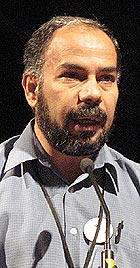 "After the shooting, some of the relatives of the murdered children decided to fight the American troops. This response occurred at the time when resistence fighters throughout Iraq began their resistence against US occupation," he added.
Abbas' testimony was one of several victims and witnesses to war crimes in Iraq, Lebanon, Palestine, and Afghanistan made to the six-member commission.
Their testimonies serve as grounds for the commission to decide whether to forward their petition to the pro-tem Kuala Lumpur War Crimes Tribunal.
The Perdana Global Peace Foundation, led by former premier Dr Mahathir Mohamad, has mooted the setting up of the tribunal in order to try and punish 'warmongering' leaders and governments of aggressor nations guilty of war crimes.
The foundation had organised the three-day 'Expose War Crimes - Criminalise War' conference which ended yesterday.
Meanwhile, Abbas - the former chief engineer with the Iraqi Science and Technology Ministry in Baghdad - said the destruction of Fallujah by US forces occurred over two stages.
Punish the people
According to him it was triggered by the lynching of four US private security contractors "by unknown men who disappeared" soon after the incident on Mar 31, 2004.
"When the city authorities could not comply with the demands to hand over the killers, the American troops destroyed the city. The US troops mounted a big military operation. I believe that this operation to destroy the city was made to punish the people of Fallujah.
"Additionally, Fallujah was also an important centre of Iraqi resistence to the occupation forces. The American troops used the killing of the American contractors as an excuse to destroy the city and its people," he added.
After the first military onslaught that went on for two months and ended with the withdrawal of US troops, Abbas said the troops attacked the city six months later "as they could not accept their earlier defeat".
"This time, the American troops used all sorts of weapons like planes, heavy tanks, heavy canons, missiles and weapons with traces of uranium substances. They killed a lot of people with this method. The football field became a cemetery to bury the people of Fallujah who died.
"The injured were not allowed to be admitted into the hospital. They were left in the open to die. The American troops this time destroyed a lot of houses, roads, the electrical distribution networks, destroyed the underground pipes and terminated the supply of water, destroyed a lot of shops and the industrial regions.
"There was just too much destruction in Fallujah for me to list them down individually. The whole city was destroyed. The people were also killed. Properties inside these houses were also destroyed. They made sure there was nothing left," he added.
Arrest and torture
Abbas also recounted his arrest in Aug 2005 by occupation forces and the subsequent torture he suffered at the hands of his interrogators. The torture included:
- being hit with thick cudgels, cables, metal pipes, metal ribbons;
- electric shocks in various parts of the body, including the private parts;
- forced drinking of a diuretic solution, and physical bounding of the penis to prevent him from urinating;
- tying his hands behind his back and hanging him on a wall by the hands, thereby dislocating his shoulder;
- extraction of his finger nails;
"I was released on Oct 2, 2006 with three other inmates, one of them was Syrian...
"Later, I found out that the inmates who were released with me were killed and buried in the Al-Najaf cemetary and their parents had to pay huge sums of money to reclaim their bodies for re-burial in Baghdad.
"I stayed about an hour in my house and then moved to another house to stay for a few days. I then left my beloved country," said Abbas who now stays in Amman, Jordan.
An exhibition on war crimes at the Putra World Trade Centre will continue until Feb 11.
 Click here to watch
a 30-minute video
.


Are you sure you want to delete this comment?
This action cannot be undone.