



ILO: Hicom Automotive’s sacking of union members deemed ‘intimidation’
The International Labour Organization’s (ILO) Committee on Freedom of Association has ruled that the dismissal of five unionists at Hicom Automotive Manufacturers (Malaysia) Sdn Bhd due to their participation in a union meeting had violated their freedom of association and amounted to “intimidation”.
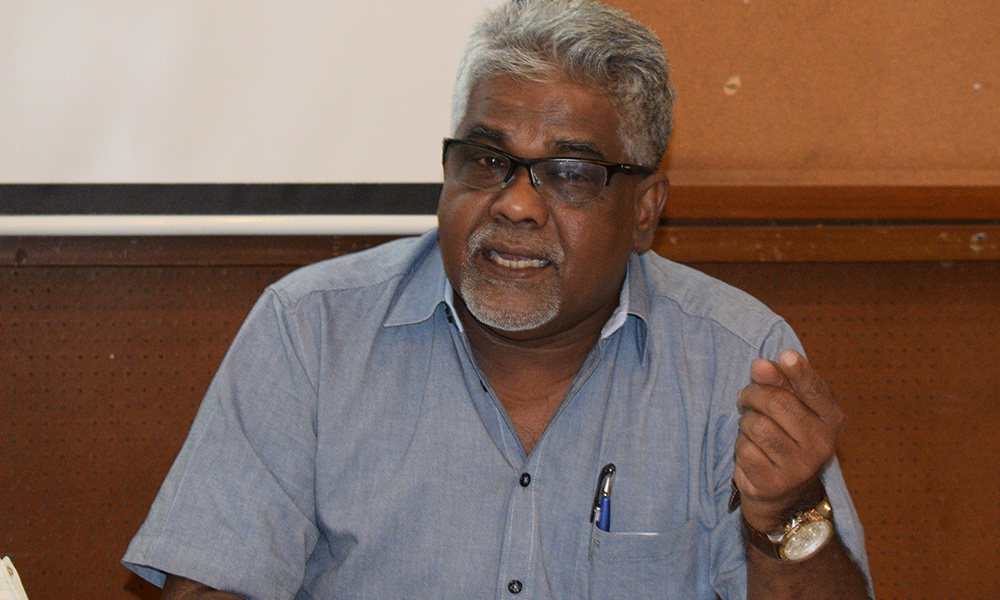
The five members of the National Union of Transport Equipment and Allied Industries Workers (NUTEAIW) were among 110 others who attended a briefing after working hours (5:30pm) outside the company premises, said its general-secretary Gopal Kishnam (above) in a statement.
The International Labour Organization’s (ILO) Committee on Freedom of Association has ruled that the dismissal of five unionists at Hicom Automotive Manufacturers (Malaysia) Sdn Bhd due to their participation in a union meeting had violated their freedom of association and amounted to “intimidation”.
The five members of the National Union of Transport Equipment and Allied Industries Workers (NUTEAIW) were among 110 others who attended a briefing after working hours (5:30pm) outside the company premises, said its general-secretary Gopal Kishnam (above) in a statement.
He added following the meeting that was intended to update members on the collective bargaining deadlock between the trade union and the employer, Hicom Automotive, dismissed 32 union members.
Gopal said the company accused those dismissed of "giving a picture of the existence of inharmonious industrial relations in the company, which could give members of the public a negative perception of the company”.
"Although 27 union members had been reinstated after mediations at the Industrial Relations Department, the company refused to reinstate Muhamad Sukeri Mahudin, Rozaimi Mohammad, Mohamad Yusry Othman, Haikhidil Jamaludin and Nurdin Muda.
"The Industrial Relations Court ruled that Hicom had just cause to dismiss the five union members.
“Subsequently, the High Court, Court of Appeal and the Federal Court upheld the decision of the industrial court,” he pointed out.
Based on the report, Gopal relayed that the ILO committee recommended that the government facilitate discussions between NUTEAIW and HICOM to explore possible solutions concerning the five unionists including reinstatement as a remedial action.
Remedial action needed
“The committee has urged our government to ensure workers and their union leaders were free to organise activities or meetings without retaliation from the company.
“We welcome this decision by ILO and are ready to attend meetings with the government, Hicom Automotive and other stakeholders to facilitate the reinstatement of the five unionists,” he said.
In their report, the ILO committee urged the government to continue to facilitate discussion between the company and union with a view to reinstating the five union members to resolve the matter.
They stated that dismissing trade union members on grounds of having organised a union meeting, which purportedly attracted public attention and resulted in a negative image of the company was not in conformity with freedom of association and can amount to “intimidation”.
The committee explained in the report that such “intimidation” prevented the exercise of members’ trade union functions.
Need laws to protect unions
It concluded by saying whether the meeting could be qualified as a picket was irrelevant, as long as it was peaceful in nature and that management continued to have access to the company premises.
The committee also highlighted that the principles of freedom of association require employers to exercise great restraint in relation to intervention in the internal affairs of trade unions.
Finally, the committee pointed out that the government ensures an adequate and efficient system of protection against acts of anti-union discrimination which should "include sufficiently dissuasive sanctions and prompt means of redress".
It has requested that the government provide detailed information on said sanctions and measures of compensation awarded.






Are you sure you want to delete this comment?
This action cannot be undone.