




Energy policy 'fails on climate change'
The present national energy policy suffers from a myriad of shortcomings and requires nothing less than a complete overhaul to achieve sustainable energy sourcing, generation, and utilisation, a non-governmental organisation said.
The present national energy policy suffers from a myriad of shortcomings and requires nothing less than a complete overhaul to achieve sustainable energy sourcing, generation, and utilisation, a non-governmental organisation said.
The shortcomings range from ad hoc introduction of policy elements on electricity and petroleum and failure to address climate change and eco-system disruptions, to missing information on crucial aspects of energy supply and usage.
What is needed is a single comprehensive integrated energy policy to be adopted after full consultation with all stakeholders, said the Petaling Jaya-based Centre for Environment, Technology and Development Malaysia (Cetdem).
This was the thrust of the recommendations contained in a memorandum presented Feb 5 to the Ministry of Energy, Water and Communications, said Cetdem's executive director Gurmit Singh.
"The approach should be to adequately assess existing energy sources within Malaysia and optimise their use to match final end-use so that conversion efficiencies are maximised," said Gurmit in a press conference at Cetdem yesterday.
"They will also be cost-effective and socially just. Self-sufficiency will be the driving force and reliance on imports will be restricted," he added.
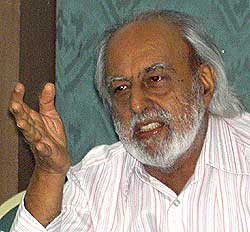 Gurmit also suggested that a dedicated Ministry of Energy be established to coordinate and drive all forms of energy supply and use in the country.
Listing the shortcomings in the existing energy policy, Gurmit said policy elements relating to electricity and petroleum seemed not only ad hoc but appeared to have been introduced at different times and with very little linkages.
The policy also does not account for any figures pertaining to the generation and wastage of energy in the oil palm sector, which Gurmit said was considerable.
"Hence, (the policy's) data collection is not comprehensive enough," he said.
Gurmit also said the policy seemed to regard and go about energy planning as supply-driven, whereas planning should be more demand-driven and efforts made to ensure energy sources are optimally utilised.
For this end, government subsidies that distort energy prices should be done away with in order to force consumers to be more frugal in their consumption, he said.
"The move towards pricing energy at real costs - including environmental and social (costs) cannot be delayed. Distorting subsidies must be systematically removed. The country cannot continue to be profligate with its non-renewable energy sources," said Gurmit.
Actions in place
At the same time, funds should be diverted away from coal power stations and large hydroelectric dams towards implementing 'energy efficiencies' in all major consuming sectors, such as transportation, he added.
Turning to factories and other large industrial users of energy, Gurmit said actions must be put in place to reverse the trend of cheap but inefficient and dirty technologies and processes.
For these reasons, he said, Malaysia compared un-favourably to many countries in terms of energy use counted against per capita gross domestic product (GDP), citing Japan has being only one-fifth of Malaysia's energy intensity.
Gurmit also lamented the 'toe-hold' in Malaysia gained by energy efficiency and renewable energy. Even this, he added, has mostly been funded by foreign sponsors and donors such as the United Nations or the Danish government.
Even just one percent of national oil company Petronas' profits would be a significant boost for investment in renewable energy development, said Gurmit.
He added that government agencies for energy matters are perceived as not exercising their powers adequately and suffer from lack of capable staff.
Many energy decisions, furthermore, are made by technocrats, politicians, and investors to the exclusion of all stakeholders such as the public and civil society.
"Better public consultation with relevant stakeholders should be started so that more effective strategies are implemented," said Gurmit.
"The many vested interests that produce distortions in the energy sector need to be curbed and slowly reduced by ensuring greater public transparency in the award of contracts, procurement of equipment and provision of energy services," he added.


Are you sure you want to delete this comment?
This action cannot be undone.