




Economy: Chinese business group gives its assessment
As the mainstream media trumpets a rosy economic outlook, survey results by a key Chinese business group provides a more down-to-earth assessment.
As the mainstream media trumpets a rosy economic outlook, survey results by a key Chinese business group provides a more down-to-earth assessment.
According the survey by the Associated Chinese Chambers of Commerce and Industry (ACCCIM) - which represents 28,000 Chinese business community and trade associations - the economy had "remained relatively stable" during the second half of 2006.
The bi-annual survey - done in December last year - and its report, in its 15th year running, evaluated questionaries some 257 ACCCIM members which included those from wholesale and retail, manufacturing, professionals and service industry.
 Fifty-six percent of respondents felt that for second half of last year there were "no change" in economic conditions while 32 percent felt that the economy was "deteriorating".
The sentiments appeared to have somewhat improved as in the first half of 2006, 50 percent said there was "no change" in economic conditions, while 40 percent believes it was "deteriorating".
"Based purely on the survey results, it certainly suggest that things are likely to improve in the first half of this year. To some extent, it's in line with the second finance minister on things looking good again," said Dr Peck Boon Soon, deputy chairperson of ACCCIM's economic research committee.
On Feb 9, Second Finance Minister Nor Mohamed Yakcop publicly announced that the government was 'very confident the good times are here', citing expected high 2006 economic growth figures and sustainable stock market rally in the near future.
Optimistic about future
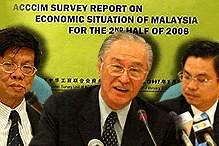
Peck was speaking at a press conference to announce the survey's results at ACCCIM's headquarters in Kuala Lumpur today.
Nonetheless, the report sums up Chinese business community's optimism about what lies ahead for the first half of 2007.
Fifty-five percent of respondents said they were 'somewhat optimistic' about the Malaysian economy over the next two to three years while 19 percent claim they were 'optimistic'.
 Deputy chairperson of ACCCIM commerce committee Chua Tia Guan (
right
) said respondents expect higher local demand and export orders as well as benefits from projects under the Ninth Malaysia Plan (9MP) as their source for optimism.
Deputy chairperson of ACCCIM commerce committee Chua Tia Guan (
right
) said respondents expect higher local demand and export orders as well as benefits from projects under the Ninth Malaysia Plan (9MP) as their source for optimism.
While the 9MP is generating optimism among respondents, 43 percent of respondents claim that government policies were 'adversely affecting' their business performance.
In its report, ACCCIM recommended that the government improve its delivery system and make its policies more transparent and liberal.
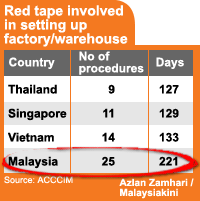 Chua said at present, setting up a factory or warehouse in Malaysia was problematic compared to other regional neighbours.
"So if you look at this, definitely government policies and procedure would affect our national competitiveness in terms of attracting foreign investment," said Chua.
He said the government's recent formation of a high-powered special task force (Pemudah) to facilitate business would be suggesting ways of overcoming such problems. Chua is among the 23 appointed members of Pemudah.
ACCCIM would be submitting its findings to the government soon.
Click below to watch three-minute video


Are you sure you want to delete this comment?
This action cannot be undone.