




Banned book: Author files legal action
The author of March 8 - a book on the 2001 Kampung Medan conflict - has filed a legal action against the Internal Security Ministry challenging the latter's ban on the book.
The author of March 8 - a book on the 2001 Kampung Medan conflict - has filed a legal action against the Internal Security Ministry challenging the latter's ban on the book.
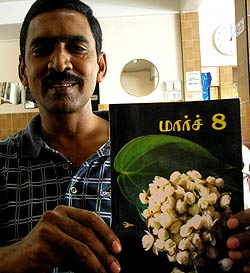 K Arumugam filed an application at the Kuala Lumpur High Court for a judicial review of the internal security minister's decision.
The minister, the deputy minister and the government were named as respondents.
"My lawyer said he couldn't find any precedent for the case. Probably this is the first time someone is taking up the case for a banned book. I intend to give it a try," Arumugam told AFP .
"We are filing for judicial review, calling for the quashing of the order by the Home Ministry and that the ban be lifted to allow me to circulate the book."
Arumugam said in his affidavit the banning of the book was an attempt by the government to shirk from its own culpability over the Kg Medan incident.
"There still remains the perception that the violence committed in the Kampung Medan incident had the support of certain figures in authority," he said.
"Without an investigation or open discussion, that perception will spread," he added, referring to claims by eyewitnesses that some acts of violence took place in front of police officers without any effort by the police to stop the perpetrators.
Arumugam further said that his book - on the 15 days of the conflict that led to six deaths and over 90 casualties - was an attempt to measure the extent to which the government's security agencies were able to contain the violence.
"I criticised the failure of the government machineries to stamp out the violence that (soon after its outbreak) had led to deaths and casualties which could have been avoided had the country's security forces acted more responsibly and speedily," read the affidavit.
Arumugam also said his book highlights the government's inability to bring many of the perpetrators to justice.
"I assert that the banning of my book can be interpreted as the wish of the government to suppress the truth and to exclude itself from any responsibility for the said incident," said Arumugam.
'Without bias'
Arumugam, an engineer-turned-lawyer, denied there were any grounds on the basis of public security or order for the government to have banned his book under the Printing Presses and Publications Act 1984.
"I declare that I have been extremely careful so as not to raise tumult or manipulate information. Adequate scrutiny has been taken to portray the incident as accurately as possible without bias or ethnic prejudice," he said.
"The book was written with the one intention of understanding why and how at a certain point in history, an amicable and civil relationship between two ethnic communities could be shredded to pieces with such tragic consequences.
"This book is thus an attempt to understand a sad episode in the relations between two different ethnic groups. There is no indication on any matter that would be a cause of concern thus necessitating a ban on the said book," he added.
"The book is basically a resource-based document... I (also) tried to explain to the readers that an eye for an eye will make the whole world blind."
Arumugam described the ban as a a violation of his constitutional right to freedom of speech and the public's right to receive information.
Beside a copy of the book and its translation into Bahasa Malaysia, Arumugam submitted as part of the affidavit three malaysiakini reports on the book's ban and the Kampung Medan incident, as well as a PhD thesis containing research on the event.
Activists and rights groups have slammed the government's ban on March 8 and over 50 other books , saying it violated the fundamental rights to freedom of expression and information.


Are you sure you want to delete this comment?
This action cannot be undone.