




Smuggling thrives on Malaysian-Thai border
Medang Hussein, 25, starts the engine of his wooden boat and heads across the narrow Golok River to insurgency-hit southern Thailand, where he will buy rice and smuggle it back.
Driven by poverty and unemployment, Medang, in his tattered white T-shirt, is one of many along the Thai-Malaysian border who engage in a flourishing underground economy to feed their families.
Medang Hussein, 25, starts the engine of his wooden boat and heads across the narrow Golok River to insurgency-hit southern Thailand, where he will buy rice and smuggle it back.
Driven by poverty and unemployment, Medang, in his tattered white T-shirt, is one of many along the Thai-Malaysian border who engage in a flourishing underground economy to feed their families.
Violence in southern Thailand and hard times in northern Malaysia have fuelled the illegal trade, said Kamaruddin Jaffar, a lawmaker for the Islamic PAS party which rules Malaysia's Kelantan state on the border.
"There are no other options for the locals. So many in Kelantan are involved in rice smuggling," he said.
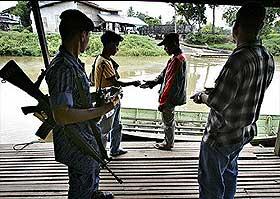 While the black market thrives, merchants across the frontier in Thailand's Narathiwat province complain their legitimate businesses are suffering. They say the Malaysian housewives they relied on as customers stopped coming earlier this month when Malaysia tightened its border.
The clampdown came after Thailand's army-installed Prime Minister Surayud Chulanont and Malaysian counterpart Abdullah Ahmad Badawi agreed to boost cooperation in a bid to end three years of separatist unrest in the south of the majority Buddhist kingdom.
But many like Medang, a Malaysian, still have no trouble crossing back and forth.
He said he turned to smuggling after his usual business, transporting people and goods legally across the river, suffered because of rising violence in Thailand's south.
Border residents often prefer to make illicit frontier crossings using the services of people like Medang which save time. They are often too poor to afford passports.
Despite the stepped-up efforts by Malaysia and Thailand to end the unrest, violence has escalated. About 2,000 people have already died since the insurgency erupted three years ago.
Living in hell
In the latest incident, nine people were shot dead Wednesday in an ambush in Thailand's south.
Militants responded to last month's meeting of the two leaders by staging almost 50 Lunar New Year attacks that left nine dead in the Thai south, where the majority of people are Muslims like their Malaysian neighbours.
"Since the bomb attacks, my income has fallen sharply. Now I have to indulge in rice smuggling to earn some extra money," said Medang.
Under cover of palm trees and thick bushes, buyers place orders for his Thai rice just a few metres from a police base.
An elderly woman, who asked to be known only as Aminah, hands Medang RM60 for a few bags of Thai rice. Without fear of arrest, he takes the money and jumps on his boat to fill her order in Tak Bai town on the Thailand side of the border.
"You can buy anything from across the border," Aminah said.
Ibrahim Nik Mat, a Thai from Pattani province which is also suffering from the insurgency, said violence has made their lives hell.
"The economy is badly affected and jobs are scarce. Even if you get a job, the salary is not enough to feed your family," the labourer, 49, complained.
Running goods across the border can help make ends meet.
"Smuggling is a vibrant economic activity. This is what puts food on the table for many people since the formal economy does not have the capacity to generate jobs," Kamaruddin said.
"Thai rice is cheaper than Malaysia rice and for most locals it is very tasty."
Malaysian officials said Thai rice is about five times cheaper.
It is not the only thing smuggled in.
Ecstasy from across
Mazlan Che Hamid, chief of Kelantan's anti-smuggling unit, said that during an operation in early March, his officers foiled an attempt to sneak liquor into Malaysia aboard a lorry from north of the border.
He said some smugglers earn up to RM500 a trip bringing in goods from Thailand.
Importing of the party drug ecstasy is also "a major problem," said Kamaruddin, who sees peace, security and development as the solution.
"Both the governments must promote growth in this region," he said.
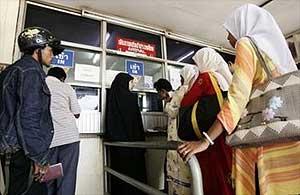 In an interview with Malaysia's state
Bernama
news agency late last month, Surayud urged Malaysians to invest in the south and said there are plans for an industrial zone that could generate jobs at the border.
In an interview with Malaysia's state
Bernama
news agency late last month, Surayud urged Malaysians to invest in the south and said there are plans for an industrial zone that could generate jobs at the border.
The sooner the better for border residents like Kamarudin Mohamad Nor, 48, chairman of the Pengkalan Kubor taxi station, where business has declined as the southern Thai violence intensified.
"Life is difficult in southern Thailand and at the border here. This is pushing people to smuggle goods. It has now become a way of life here," he said.


