




Land woes: Indigenous groups live in fear
Non-Muslim indigenous communities in the largely undeveloped and remote parts of Sabah and Sarawak are living in fear and under constant threat of being pushed away from their ancestral lands.
Non-Muslim indigenous communities in the largely undeveloped and remote parts of Sabah and Sarawak are living in fear and under constant threat of being pushed away from their ancestral lands.
A glaring example is the resettlement down river to Sungai Asap where some 10,000 natives had to make way for the building of a mammoth hydro-electric dam in Bakun.
There are also numerous conflicts between indigenous groups and logging and plantation companies which have encroached into what the natives claim as their customary rights lands.
Other forms of commercial activities have also been reported to be moving into NCR lands.
One of the latest cases affects a village in Togudon - which is located in Sabah's Penampang district - some 45km from the state capital of Kota Kinabalu.
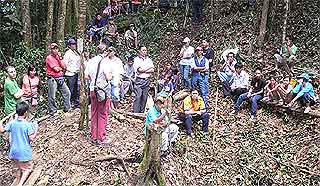 Kampung Togodon is a typical Kadazandusun village, whose population are largely Christian. Its elders claim the village has existed since the turn of the last century. The villagers are mostly subsistence farmers.
Now the serenity of their modest lives are under threat after a Sarawakian-owned company Sabah Juta Sdn Bhd, moved in to stake a claim on the NCR land. The company is said to have three government land grants.
The company has already levelled a nearby site along the main road a short distance from the village which it plans to turn into a highland resort.
At the same time, it has also started jungle clearing works and taken the timber out for, according to reports, planting a type of species of edible bamboo imported from Taiwan.
Despite protests from the villagers, it also demolished a mushroom station - a project initiated by the state Ministry of Rural Development - located at the edge of the village to build an access road leading to the company's land.
Court case
However, the villagers have stopped the company's workmen from moving in any further.
Village chief Gamato Galagub and village development and security committee (JKKK) chairperson Andrew Gosungkit are facing court charges over this.
 "Our kampung has been in existence since 1903 and we have concrete evidence to back it up. Now thecompany tell us they have the grants we don't and that we are squatters on our own land!" Galagub told
malaysiakini
.
"Our kampung has been in existence since 1903 and we have concrete evidence to back it up. Now thecompany tell us they have the grants we don't and that we are squatters on our own land!" Galagub told
malaysiakini
.
According to him, the villagers have applied numerous times for land grants but these have been rejected.
"Recently, we applied again and there is some positive indication at last," he said.
Malaysiakini learnt that the three grants were approved to certain outsiders by the Penampang district officer several years ago and the land was subsequently auctioned off by a bank after the registered proprietors failed to service the loan taken.
That was how the company eventually came into possession of the three pieces of land totalling 45 acres which overlooks the valley and sea.
Moyog's people development leader (PKR) Brian Matasing told malaysiakini the government inherited many such problems due to the action of district officers who had the powers to issue land grants before the land utilisation committee (LUC) was established to consider and approve or reject land applications.
'Passive resistance'
Addressing the villagers at a special gathering, organised by the Partners of Community Organisations (Pacos), Matasing - representing the Moyog state assemblyperson - told the villagers not to despair as there is still some 3,000 acres of state land around the village which they could apply for.
According to him, some of their applications are receiving 'favourable consideration' from the LUC and Matasing advised them not to sell their grants for quick monetary returns.
Sarawak Dayak National Union (SDNU) president Nicholas Bawin, who was specially invited for the occasion, advised the villagers to persevere in their struggle to defend their rights but through peaceful means.
Meanwhile, the villagers erected a memorial plaque at a hillock behind the village to remember those who had fought and died in defending their territorial rights during a tribal feud at the turn of the last century.
According to Gosungkit, the new landmark also symbolised their 'passive resistance ' to the current encroachment.
Despite numerous attempts, malaysiakini could not obtain comments from the company's officials.


