




Orang Asli want vows in black and white
Promises are worth nothing unless they are in black and white, and binding.
Promises are worth nothing unless they are in black and white, and binding.
This the message from the Orang Asli community of Kampung Chang Sungai Gepai in Perak, who have grown weary of unkept vows, to their local leaders.
" Indah kabar dari rupa (Talk is often sweeter than reality)," Tijah Yok Chopil, the Semai villagers spokesperson, told malaysiakini.
Tijah's village - situated about 80 km from Ipoh - is currently haunted by the spectre of marginalisation by another 'development' project on their ancestral land.
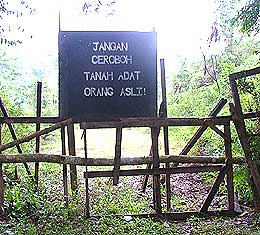 Three years ago, the community of about 800 villagers, who claim to have worked and inhabited the 141-hectare land for countless of generations,
faced eviction
due to a oil palm plantation project under the Perak State Agricultural Development Corporation (PSADC).
Three years ago, the community of about 800 villagers, who claim to have worked and inhabited the 141-hectare land for countless of generations,
faced eviction
due to a oil palm plantation project under the Perak State Agricultural Development Corporation (PSADC).
Following protest and later the submission of a community-drawn map of their customary land, the project was shelved and has not been heard of since.
Despite the earlier 'success' in having the plantation project shelved, Tijah said numerous examples elsewhere in Perak and beyond illustrate the pattern whereby Orang Asli are shortchanged after initial assurances that their interests and concerns will be protected.
This time around, a botanical garden project of PSADC that will take up 93 hectares of the land has villagers concerned that the cost in terms of livelihood and their way of life will far outweigh the benefits that may accrue to a small segment of their community.
State authorities have said the botanical garden project seeks to nurture and protect animal and plant species that are in danger of becoming extinct.
Employment opportunities
Contacted later, Sungkai state assemblyperson R Ganesan said the Orang Asli, who currently earn between RM175 - RM250 monthly from their extraction of rubber and oil palm, can gain employment in the project and increase their income.
He said this can be done by setting up home-stay programmes and building chalets, cultural villages, and stalls within and around the botanical garden for the tourists visiting the nursery.
"They have to look at the long-term benefits that the project will accrue not just to the present generations, but to their children and future generations.
"Concerns of the land being the Orang Asli's ancestral domain will be taken into account. I am concerned about their rights and concerns. But I have to balance these with bringing development to the area," he added.
Ganesan also said he was confident that families in Kampung Chang Sungai Gepai, each owning less than one hectare of farmland, can look forward to gaining about one hectare each after the project.
Tijah said there is no denying the possibilities of promoting the welfare of her village.
However, she said this can only be achieved in reality by guaranteeing Orang Asli's interests as against the possible entry of other parties at the expense of the former.
"Out of the 165 families who live in the village, how many can gain employment in the project? At most, perhaps 30 persons may get work there. What about the others?
"We may be able to build chalets and such things in the beginning. But who is to say that no other company will come in later and build chalets (at our expense)?
"I'm not overly confident with the promises of orang-orang besar (big shots). We want things in black and white, because ultimately, it's the villagers who will lose out when things take a (different) turn from their initial promises," she said.
Tijah said the villagers are discussing among themselves and expressing their worries on a daily basis.
They lack confidence that the authorities will protect their interests, one reason being the absence of consultations between them and the villagers, she noted.
Meeting next week
Perak Menteri Besar Tajol Rosli Ghazali had said the project was approved not only by Prime Minister Abdullah Ahmad Badawi and the Perak crown prince Raja Nazrin Shah but the villagers themselves.
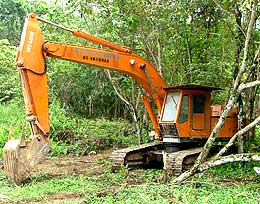 "As far as I know, none of us have given any approval or were even informed of the botanical garden until we ourselves started questioning the sudden appearance of machineries on our land several weeks ago," said Tijah.
"I challenge the MB to tell us the individuals from this village who had given the approval. We are not against development, but if we had the choice, we would not want this project because we were not consulted," she added.
Villagers are also against the idea of being 'compensated' with land elsewhere as the Orang Asli place a lot of meaning and base their identity on the land and forests on which they live.
"We know the 'stories' of these woods than anybody else. We do not want to work and live on someone else's land," she said.
A meeting is in the midst of being arranged between Tajol and the villagers next week.


