




Q&A: 'Let me come into the struggle fresh'
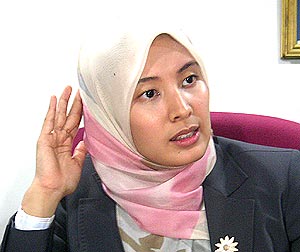
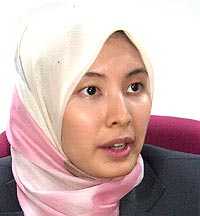
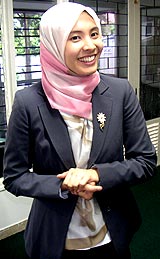
Nurul Izzah Anwar, 26, cannot help being a 'famous daughter' but, as a newcomer to politics, she wants to be judged in her own right, on her efforts and what she can offer to the public.
Nurul Izzah Anwar, 26, cannot help being a 'famous daughter' but, as a newcomer to politics, she wants to be judged in her own right, on her efforts and what she can offer to the public.
She tells malaysiakini her plans and preparations, and gives her views on current issues including the deterioration in race relations, the lack of cooperation among opposition parties, and the spat between ex-premier Dr Mahathir Mohamad and his handpicked successor, Abdullah Ahmad Badawi.
Malaysiakini: What have you been doing while out of the limelight since 2005?
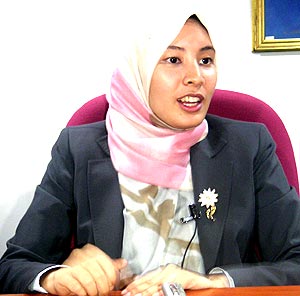 Nurul
Izzah:
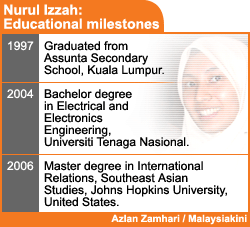
I was in Washington doing my master's programme in
international relations, majoring in Southeast Asian studies. I completed my
degree and am back (in Malaysia) for good. As a temporary respite, this helped
all of us to gather our thoughts and to reflect. Now I am ready to take on the
next level of challenges.
Nurul
Izzah:
I was in Washington doing my master's programme in
international relations, majoring in Southeast Asian studies. I completed my
degree and am back (in Malaysia) for good. As a temporary respite, this helped
all of us to gather our thoughts and to reflect. Now I am ready to take on the
next level of challenges.
What will be the next level for Nurul Izzah?
There are many challenges to tackle. Right now I am based in my father's (Anwar Ibrahim's) office. I help with our main activities in preparing for the general election, working closely with PKR (Parti Keadilan Rakyat, of which Anwar is adviser).
How are you helping your father?
I am co-ordinating his political programmes, of course, working closely with the political outfit. I am also very much involved in the general campaign with the opposition, especially with PKR.
Do you have an actual post?
Political co-ordinator in my father's office.
Is this considered as a political comeback for you?
I don't know how you would term it - 'political comeback' sounds like so much responsibility and expectations. I think I am doing whatever I can to contribute and certainly there is much more that I aim to do. I have to take it step by step.
Any plan to go into active politics, such as running for a seat in the general election?
I strongly believe that I should and if given a chance, certainly (I will do so) because that is the most effective way to actively and constructively engage in politics, to effectively affect the life of the people I represent. Yes, I do feel it is really important.
So Nurul Izzah is going to run for a seat?
I didn't say I will run for a seat. I said, that is what I would like to do, but of course I leave it to the party's decision.
Have you told your parents about your intention?
I think he (Anwar) does know. We have had informal discussions here and there. In the office, I have tried to be as objective as possible. I try to distance myself and try not to call him 'Papa' (laughs), (but it is) not helping at all. I do feel that he understands where I stand, he understands my readiness to embrace politics and he supports me all the way.
How do your parents react to that?
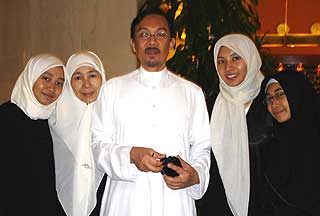 Both my
father and mother (PKR president Dr Wan Azizah Wan Ismail) have been very
supportive of every decision that I've made in life, even though they probably
feel that perhaps taking engineering (in university), for example, was not the
best cause of action. But they have been very supportive of my decision.
Both my
father and mother (PKR president Dr Wan Azizah Wan Ismail) have been very
supportive of every decision that I've made in life, even though they probably
feel that perhaps taking engineering (in university), for example, was not the
best cause of action. But they have been very supportive of my decision.
I have done whatever I can based on my assessment. Of course, I am deeply influenced by their political involvement and my father's plight when he was in prison. These things shaped the events in my life but I do feel that they support me in (any) step I decided to make.
During the 2004 general election, you were completing your studies in university and you cited the university law which barred you from active politics as the main reason for not contesting. What is your consideration now in terms of running or otherwise?
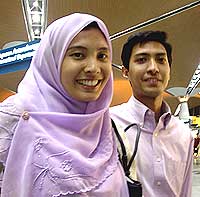
In terms of going through life, I was first a daughter who fought for my father's release from prison (and on) the general issue of political prisoners in Malaysia. Then I became a wife and will soon become a mother. I think there is a lot of considerations that you have to look at and on how you can impact the life of others.
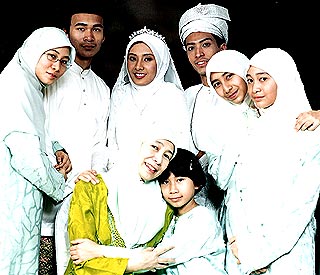 Secondly, what would you leave behind for your children,
the people that you care about? I feel very strongly about taking a stand. It
might not be an easy decision to make but I do not want to leave behind a life
filled with regrets - what I should have done, what path I should have taken -
and that's why I've make this decision. Of course, (the decision is) supported
by my husband (Raja Ahmad Shahrir Iskandar).
Secondly, what would you leave behind for your children,
the people that you care about? I feel very strongly about taking a stand. It
might not be an easy decision to make but I do not want to leave behind a life
filled with regrets - what I should have done, what path I should have taken -
and that's why I've make this decision. Of course, (the decision is) supported
by my husband (Raja Ahmad Shahrir Iskandar).
Are you eyeing any particular seat? The Lembah Pantai parliamentary seat (Bangsar, Kuala Lumpur)?
I have never eyed that seat. (laughs)
You were rumoured to be contesting that seat (in 2004).
Yes. It's very difficult to say because of discussions with DAP, and we had our set of seats in 2004. It doesn't mean we will still have the (same) seats, we might have more. I leave it to the party leadership. Of course, I would definitely give my opinion and thoughts. But to pinpoint at this moment of time, it's very difficult because it's not my decision.
Apart from helping your father, you are not really involved in party activities. How are you going to build a political base and prepare for the general election?
I am already choosing a division and (will) probably work from that. It's important to work with the grassroots as you mentioned. Any politician has to be involved at the higher level of course, but people have to know you (too), know that you are there with them and be accustomed to your activities and who you are. Yes, I am already making moves towards that.
Which division is that?
I don't think I should disclose it right now. You will know (laughs). Somewhere in the Federal Territories. I am not going to go to Penang since I am based here.
We understand you have been nominated by a PKR Malacca division for the deputy Youth chief's post. Are you ready for that?
As a member of PKR, I believe this decision will have to be taken by the members of the party. I am ready to contribute in whatever way I can, in whatever way that the members feel I can strengthen the party, our cause and momentum in gearing up for the election. I leave it to them. This is how I will (make) my decision but I am prepared.
So we can say you are prepared to run if you are qualified?
It's amazing how reporters can change everything (laughs). I have to get another nomination (to qualify for contest). (Since the interview, she has got more than two nominations).
Like it or not, there is criticism out there about you - that you have not taken up a very active role within the party after Anwar's release.
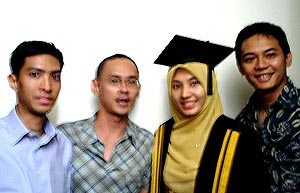 As I
mentioned, the time that I took off for one-and-a-half years was important for
me, my family in terms of reflecting on the very hectic political life we had
before, the turmoil. It (helped) me see things in a different light, (in a)
different way and (rejuvenated) me in term of contributing further to the cause.
There will always be criticism but I would like to focus on the fact that I am
ready to contribute and we have to move on. We have to improve on whatever
weaknesses we have, strengthen whatever strong points we have, and move on.
As I
mentioned, the time that I took off for one-and-a-half years was important for
me, my family in terms of reflecting on the very hectic political life we had
before, the turmoil. It (helped) me see things in a different light, (in a)
different way and (rejuvenated) me in term of contributing further to the cause.
There will always be criticism but I would like to focus on the fact that I am
ready to contribute and we have to move on. We have to improve on whatever
weaknesses we have, strengthen whatever strong points we have, and move on.
People will definitely link me with my father and mother, but it is important to strike a balance between being independent and being so dependent on them. I can't run away from the fact that they are so much a part of my life, they have done so much for me.
My father's incarceration - how can you just pull that apart from who I am? It's just so much of my political awakening, of who I've become, how it shaped me, but okay, I just want to see what I can offer (now), do my best and work with the people. I don't think I want to bring any baggage with me in that sense. I come into the struggle fresh, and we will move on from there.
Before reformasi, were you interested in politics or were you just like any teenager? We've heard that you're interested in (rock group) Radiohead.
 Everything in moderation. Generally I was very much like other
teenagers but I had very close friends who are very much involved in the
debating society in Assunta (Secondary School, Petaling Jaya) and they often
brought up criticism against the government.
Everything in moderation. Generally I was very much like other
teenagers but I had very close friends who are very much involved in the
debating society in Assunta (Secondary School, Petaling Jaya) and they often
brought up criticism against the government.
They mentioned the Bakun dam case at the time, the criticism by Greenpeace (environmental activist group) against the feasibility of the project. I raised this issue with my father and I felt no qualms because if you don't think of something as the counter-plan...
At the time, your father was defending the Bakun dam project.
To be fair, he said, 'Yes, I know about the Greenpeace statement, they are against the project (but) unfortunately there is nothing much I can do. I know my friends do understand I share this reservation'. So to be fair to him, he told me those things.
I wouldn't say it is a completely political awakening and understanding of issues (for me) but there were seeds of that and I did feel in university that one shouldn't just focus 100 percent concentration on studying and leave everything else behind. I felt strongly about that.
By the time you got into university, had reformasi already started?
Yes, during the first semester (during her foundation course in Universiti Teknologi Petronas).
Would you say this period was the awakening of your political understanding?
Yes, that's the right way to put it.
It had a huge impact on you?
Yes, of course. Not just myself but everyone who was there during that period. (Reformasi) affected their lives in different ways, it varied to different degrees, but it was very difficult to divorce yourself from what was happening. It just changed everything for the better, I believe.
You're back in the country right now, what are the issues that you feel strongly about? Is there any particular issue that prompted you to actually come back here?
I was slated to come back (in) December 2006. That was according to my plan when I first left. The issues are many but there are four elements that I feel we should achieve towards a solution that will (help) address the current problem we are facing.
The first, of course, is that we should go back to empowering the people. We should establish local elections again, which were abolished in the 1970s. That will (give) the mayors and local councillors a sense that they are responsible and answerable to the people, not to the political powers-that-be that appointed them.
 Secondly, we need to ensure that (state-owned oil company) Petronas -
there has to be a way - (is) made accountable (for our national treasure).
Probably they could publish their balance of payment, their revenue to the
people through Parliament. This is very important and it is part of the way in
mitigating our problems.
Secondly, we need to ensure that (state-owned oil company) Petronas -
there has to be a way - (is) made accountable (for our national treasure).
Probably they could publish their balance of payment, their revenue to the
people through Parliament. This is very important and it is part of the way in
mitigating our problems.
The third is - just as malaysiakini is a testament to the fourth estate - a free and independent media. I think the only free print media now is The Sun . I would like to see more of that because it is so refreshing and different. There are so many news things that I'm learning (now) because everything has been kept under wraps. Even (Deputy Minister in the Prime Minister's Department, M) Kayveas called the local authorities 'secret authorities' in 2006. It's really absurd. At least The Sun has exposed these issues and more should be done by the other mainstream newspapers.
The fourth is to reform our electoral system to ensure that (as) we reach our 50th year of Merdeka, there should be a move for Malaysia to move to a more mature democracy rather than stay at its infancy - or to say we have our own version of illiberal democracy, so it's fine. I don't think it's fine. The people are mature enough to know their limits when given freedom.
These are the four things that I seriously feel strongly about and would like to highlight.
Race relations have gone backward. How do you feel about where are we heading to and about the divisions not just in terms of race but also now religion?
I do believe that because there is such a clampdown on free discussion and free expression, you are actually blocking the way to create understanding between people of different races and religions. If you don't understand the issue that you are hotly debating about, you wouldn't be able to bridge that gap.
This is a serious concern because if you talk about the NEP (New Economic Policy) now, it's so important for the Malays themselves to see the other side, to see the other viewpoint. You have to separate between intent and practice. Of course, I was supporting the intent of why the NEP was created, as an example, but you have to view the way it has been implemented over the years, how it has benefitted the few... how it has really not benefitted - not only the Malays - but the non-Malays, the Chinese and Indians.
I have friends who wanted to enter university but couldn't because they are Chinese even though they had stellar grades. Similarly, these difficulties are faced by certain Malay families.
As long as there is a clampdown, continuing oppression of free and open discussion, we will not get anywhere. We can't just sweep everything under the carpet, it just won't work. Seriously, when my father first brought up the issue of revamping the NEP, you wouldn't believe (the reaction). People were shocked, because it was not something easy to say.
 I have friends who graduated from overseas who until today see the NEP
as a sacred policy that can never be touched to ensure that Malay rights are
respected, or (treated as) synonymous with Malays' special position. This is not
accurate at all. The Malays' special position was there before, the NEP was
created (later) in 1971.
I have friends who graduated from overseas who until today see the NEP
as a sacred policy that can never be touched to ensure that Malay rights are
respected, or (treated as) synonymous with Malays' special position. This is not
accurate at all. The Malays' special position was there before, the NEP was
created (later) in 1971.
It's important to keep on bringing up contentious issues, (including those involving) religion. Of course, every party should try to discuss it in a very civilised manner, that is important. You have to hear people's grievances. If you just push them aside, it will result in other problems and it will just not solve anything. I probably expect more decisive action by the government and the prime minister (Abdullah Ahmad Badawi), it's really important.
Looking back, (when) I was in Assunta, most of my friends are Chinese and Indians, so it was easier for me because I grew up with them. My best friend is a Catholic, I have no qualm about that. We have discussed contentious religious issues since we were in Form 4. Of course, it has been heated from time to time but we always try to find common areas of interest and work on a belief in basically the same God.
We really have to find serious ways to address this issue. I would say this is probably the most important thing because we are a multiracial nation and a lot of problems can arise if we don't handle things properly. We cannot used the outmoded model of the past in facing challenges of the future.
The upcoming PKR congress next month is being hotly contested. What is your view of that?
 One
thing that differentiates PKR from Umno is that we would like to provide
democratic space for participants and the leadership. That is something we
respect highly. It is not easy because at the end of the day, we are preparing
for the general election (too).
One
thing that differentiates PKR from Umno is that we would like to provide
democratic space for participants and the leadership. That is something we
respect highly. It is not easy because at the end of the day, we are preparing
for the general election (too).
I do think it is important for us to offer a new type of politics. We have to probably come out from this sort of difficult point in time for the opposition as a whole. Of course, we will come (out) with bruises, etc, but at the end of the day, you have to focus on the need to rally people after the candidates are chosen.
Right now, it is free for all, people have a chance to maybe say 'I am the best leader, he is the best leader' and the members will have to choose. Once that process has taken place, it's time to come together to build a more cohesive force.
The opposition hasn't been very much united, particularly because there is a bit of tension between PKR and DAP, partly because of the fact that both parties have similar constituencies. How do you see this being resolved?
One good development is my father has sort of begun a campaign closely with the DAP in Penang. It was launched in late January. That's a good start and of course we have to build on that.
There will be definitely a contest in terms of seat allocation - this is be expected in any party process and any electoral system. But at the end of the day, what most important is the key point we agree on. I believe that no matter how difficult it is, we must try to reach a consensus.
Are you confident there will be a consensus in terms of seat allocation?
I can tell you what I feel - that (consensus) at the bare minimum should be our target in terms of facing the general election.
Now that Anwar is back on full-time politics, is your mother planning to pull back a little or she will just be as active as before?
I do believe she is as active as she has been, (even with) my father running for the PKR presidency. She is now focusing on her duties as MP for Permatang Pauh - she does goes back to the constituency. She will probably be as busy as before but probably in her own way, a different way than before.
But what's important is that she will keep on with her activities because she has her own role and own base. I don't think you can just put her aside. She has this role to play and she will continue to do so.
There is talk about PAS offering Kota Bharu to Anwar. Has there been any discussion of this between you and your father?
My father has discussed it with Tuan Guru Nik (Abdul) Aziz (Nik Mat, Kelantan Menteri Besar) during a visit to Kota Bharu two weeks ago. I think they reached a consensus. But you are asking about my thoughts...
 I was interested by (political commentator)
Ong Kian
Ming's article
(in
malaysiakini
) on PKR's multicultural
image and how it should maintain this image in seat allocation. Of course, it is
very difficult to win in a multiethnic constituency [...] that is a stronghold
of BN. But there is merit to that particular argument because we do want to
project something different.
I was interested by (political commentator)
Ong Kian
Ming's article
(in
malaysiakini
) on PKR's multicultural
image and how it should maintain this image in seat allocation. Of course, it is
very difficult to win in a multiethnic constituency [...] that is a stronghold
of BN. But there is merit to that particular argument because we do want to
project something different.
We are fighting for something that is beyond racial politics, beyond what is always seen as a norm in Malaysia - that would be a strategy incorporated in the upcoming general election. Bear in mind, that just because it is a 90-percent Chinese-based seat does not mean it belongs to DAP per se - we have to discuss this taking into consideration all these other factors. It (Kota Bharu) is probably not exactly the ideal place (for) my father (to contest).
Is there any talk about how many seats PKR will be targeting or will want to win in the coming election?
I am sure the party's election bureau head Azmin Ali will brief you. There is always a political calculation, (but) if you say it, you had really better match it with results. In Malaysian context, it is really very hard to do so.
 Not
because I am not confident of PKR's ability - we have some strengths and
weakness - but I am more cognisant of the fact that the election process is
filled with a lot of flaws and loopholes that really benefit the incumbents. In
any statement, you would have to match it carefully with what you expect and
what will come out in the results.
Not
because I am not confident of PKR's ability - we have some strengths and
weakness - but I am more cognisant of the fact that the election process is
filled with a lot of flaws and loopholes that really benefit the incumbents. In
any statement, you would have to match it carefully with what you expect and
what will come out in the results.
It's not easy, you want to convince the voters, you want to project the image of confidence and that does matter. There are not many underdogs in the world today that still succeed. Ralph Nader (three-time US presidential election candidate) is still going on. People support his policy, but unfortunately being an underdog, there are so many weaknesses and difficulties that you have to fix.
Is there any problem with the party in terms of recruiting young candidate?
We are moving towards that because it is important to project that we are also aiming to get the support from the younger generation - the next generation. We are also aware of the fact that most of our supporters who were in their teenage years in 1998 are now probably in the late 20s, 30s, including myself.
Most of the younger voters have been wooed successfully by the government through the media and various entertainment outlets. We are aware and we have to step up the move to garner young supporters, it's important. You can't move on if you don't get the younger generation to replace you.
Will that be part of the party's main election strategy? DAP did well in the Sarawak elections last year with most of the young candidates they fielded.
Yes, it's true. I think all parties will include this strategy because they (younger generation) represent so many voters. We cannot not include them in our calculation, they are very important part of the upcoming general election.
How do you see the prime minister's leadership?
You ask everyone this? (Laughs) People should separate between character and performance. It doesn't mean criticising his performance is equal to criticising his character. He might be a very nice person, he has a nice manner and is liked by everyone, but we have to be objective in assessing his performance as prime minister.
Most people feel that after the (ex-premier Dr) Mahathir (Mohamad) era, you have a new era and people are excited and relieved in some ways. But I would categorise it as extremely mediocre.
In a lot of issues, perhaps he (Abdullah) as a graduate in Islamic studies should have taken better care of issues related to religiosity. (I will give him a grade of) probably B minus, closer to a C, in terms of performance.
I think there are so many misconceptions, people keep on confusing about the truth. We do admit his strengths, it doesn't mean we reject everything that is linked to what is seen as basically the government. It is more of constructive criticism, wanting him and the administration to improve.
What about the spat between Mahathir and Abdullah? Dr Syed Husin Ali (PKR deputy chief) called it a pot calling the kettle black.
Dr Syed Husin, of course, knows more than me because he lived in that era, he was there. In my short experience under the era of Mahathir, of course it is the pot calling the kettle black. But you have to give it to Mahathir in a sense that he is someone who is very persistent in his attacks, his support. He is extremely persistent. I don't think he is someone who will let go very easily. Abdullah has to expect the attacks to continue.
Of course, Mahathir was part of the legacy, he (is responsible for) so many things that he is blaming Abdullah for. Perhaps I might agree with the criticism but I am very disappointed with the fact that he keeps absolving himself of blame and obscuring the facts. This is probably not responsible at all. People again have to understand that you may support the criticism, but you also have to look at the track record of the person voicing the criticism.
Puteri Reformasi ready for active politics
Part 2
Watch the 17-minute video here. Three more parts to follow.


