




Who's the best PKR candidate?
Now that Machap is over, all eyes will quickly turn to the April 28 by-election in Ijok.
The by-election, called following the death of MIC state assemblyman K Sivalingam last week, will likely see MIC attempting to retain the seat against a resurgent Parti Keadilan Rakyat led by party advisor Anwar Ibrahim.
The former deputy prime minister announced that he will lead PKR into the Ijok campaign, sending shivers down the establishment's spine as they cope with dealing with the former BN superstar.
MIC has not forgotten Lunas.
In the 2000 by-election, PKR's Saifuddin Nasution won by a razor-thin margin of 530 votes. A combination of factors had generated a tidal swing of 5,000-odd votes in the mixed constituency with 44% Malay voters, 31% Chinese and 24% Indian.
Now that Machap is over, all eyes will quickly turn to the April 28 by-election in Ijok.
The by-election, called following the death of MIC state assemblyman K Sivalingam last week, will likely see MIC attempting to retain the seat against a resurgent Parti Keadilan Rakyat led by party advisor Anwar Ibrahim.
The former deputy prime minister announced that he will lead PKR into the Ijok campaign, sending shivers down the establishment's spine as they cope with dealing with the former BN superstar.
MIC has not forgotten Lunas.
In the 2000 by-election, PKR's Saifuddin Nasution won by a razor-thin margin of 530 votes. A combination of factors had generated a tidal swing of 5,000-odd votes in the mixed constituency with 44% Malay voters, 31% Chinese and 24% Indian.
Some suggest that the key factor for PKR's win then was the fielding of a Malay candidate against MIC's S Anthonysamy which brought a crucial swing of Malay votes.
However, as the then deputy president of PKR, Chandra Muzzafar wrote, it was no single factor but several that came together to produce such as dramatic swing.
These included strong dissatisfaction among the Chinese as they watched BN backtracking on 1999 election promises and anger against then prime minister Dr Mahathir Mohamad among the Malays.
However, the victory did have its price , especially among Indian voters. As Chandra noted, " in wake of the squabble over the Lunas seat, a serious mis-perception has developed about PKR's commitment to the interests and aspirations of the Indian minority. As a multiethnic, multireligious party devoted to justice and dignity for each and every community, PKR will have to address this issue".
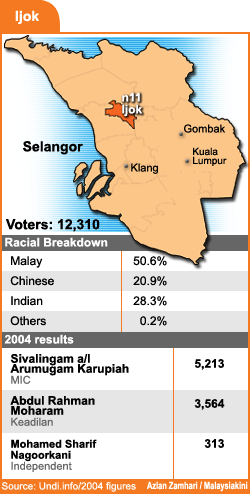 Ijok is similar to Lunas in that it is also an ethically mixed constituency comprising 50% Malays, 28% Indians and 21% Chinese.
PKR may be tempted to repeat the Lunas strategy to overturn MIC's majority of 1,649 votes, garnered against the PKR's 2004 general election candidate Abdul Rahman Moharam.
Come April 28 and allowing for a high turnout of about 75% of the 12,000 voters, PKR will need a swing factor of about 9%.
This will be a tough task, keeping in mind that the BN will be throwing all its political weight (and taxpayer funds) to ensure that PKR does not gain any momentum for the upcoming general election this year.
The wrong signal
I would argue against fielding a Malay candidate in Ijok.
As a multiethnic party, PKR has said that the choice of its candidate would not be based on the voter ethnic demographics. This is true. However, the true test of a multiethnic party is not the ethnic identity of its candidate, but its ability to appeal across Malaysia's vast and ethnically complex society.
BN has proven its strength in this area, capturing close to 100% of electoral seats that do not have a dominant ethnic group.
In order for PKR to burnish its multiethnic political credentials, the test will be whether it can convince voters and secure votes from across the ethnic divides. Ijok will be a major proving ground for this approach, with its minimum target being winning at least 30% of the votes from each major ethnic community.
I would argue that fielding an Indian candidate combined with the mega-force of an Anwar Ibrahim-led campaign and political support from the Chinese social and educationist movements would be the best option to achieve this. Anwar's presence will give PKR great momentum among Malay voters, while the Indian candidate would automatically appeal to the Indian voters who fear losing their political voice.
Gaining 55% of the Malay vote, 65% of the Chinese vote and at least 30% of the Indian vote (if not more) will be sufficient to carry the seat. On the other hand, a Malay candidate will be a political surplus besides essentially putting the 30% Indian voter target out of reach.
If PKR fields a Malay candidate, this move will be fully exploited by BN and the MIC to PKR's detriment. The ruling coalition will pounce on the fact that PKR has ignored the Indian vote in order to gain Malay support. This will send the wrong signal to the Indian community, as well as to the religion-conscious Chinese voters.
Even if the Malay candidate strategy produces a short-term victory, PKR will have a tough time projecting its multiethnic identity. This will translate into a loss of Indian 'swing votes' specifically as well as non-Muslim votes generally - a high cost to pay in the multiethnic constituencies that PKR will be contesting in the next general election.
Be balanced
The ethnic climate in Malaysia today is tenser when compared to Lunas' 2000. The legal cases of M Moorthy and more recently R Subashini, coupled with a series of temple demolitions, have created severe anxiety among Hindus, as well as the non-Muslim community in general.
Non-Muslims will be suspicious of further encroachment into their political space, even if parties such as PKR promise to protect the rights of non-Muslims.
There are also class issues to be considered. Ijok, a working-class area, is more likely to accept a candidate with a background of service to the people, such as a doctor, rather than a business professional who would be more suitable for an urban setting.
The Malay leadership of PKR has to be balanced and show a visible acceptance of the concerns of the minorities on the ground. The high visibility of the Ijok by-election is the best way to present PKR as the best multiethnic party of Malaysia.
This can be done very successfully with a suitable Indian candidate combined with the Anwar Ibrahim-led campaign.


Are you sure you want to delete this comment?
This action cannot be undone.