




Survey: SMEs in sore need of gov't funds
The Associated Chinese Chambers of Commerce and Industry of Malaysia (ACCCIM) has urged the government to boost the small- and medium-scale enterprise (SME) sector.
The Associated Chinese Chambers of Commerce and Industry of Malaysia (ACCCIM) has urged the government to boost the small- and medium-scale enterprise (SME) sector.
 According to findings of the organisation's inaugural survey on SMEs, the lack of adequate funding is a main reason for holding back the development of the sector.
ACCCIM president William Cheng told reporters in Kuala Lumpur that SME banks have failed to provide adequate funding to meet SME requirements.
"From feedback from our members who asked for help from SME banks, they are always told that loans for multi-racial groups are already finished. So they are now waiting for a new allocation from the government," he said.
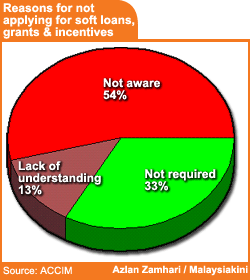 However, the survey also found that 67 percent of the 682 respondents did not understand how to tap into various soft loans, grants and tax incentives available to SMEs from the government.
"Although many people are unaware (about government loans), those who know and apply for it can't get the loan. We appeal to Bank Negara to allocate more loans for the multi-cultural group," Cheng said.
Bank mergers have also affected personalised banking services required by SME businessmen according to Cheng.
"A lot of industries are finding it difficult to get a banker who knows the industries. We're not against mergers, but local banks (should be allowed to) serve to certain industries," he said.
Personal touch gone
Echoing his sentiments was SME committee deputy chairperson Lee Hooi Seng who described the negative impact of bank mergers on SMEs.
"SMEs used to get in touch with the (local bank) branch manager who would know the business prospects and the background of the owner when determining the viability of the business. It's very personal," he explained.
"Now it's more mechanical now, with approval (given) at a regional level. Banks now are using computer systems and a credit scoring system instead."
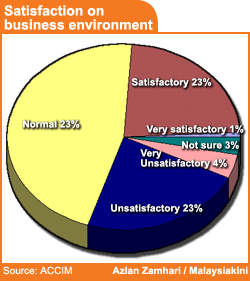 The survey also found that 27 percent of the respondents were unsatisfied with the business environment, compared to 24 percent who were satisfied..
Among those unsatisfied were respondents from the hotel, export, import and construction and property sectors.
External factors were cited by 49 percent of respondents as affecting their businesses most. These include licensing approval, policies, rules and regulations.
SMEs are also hindered by the lack of overseas penetration with only 2 percent having gone beyond the domestic market.
"SMEs need to improve the quality of their products and services and (this requires better) management skills ...with (adoption of) ICT and automation," the survey report concludes.
The survey conducted from Jan 15 to March 20 was aimed at collecting information and statistics on Malaysian SMEs and to understand problems and issues faced by the sector.
Responses were mainly from the northern region (49 percent) and the wholesale and trade sectors (30.8 percent).


