


/file/publisher-c1a3f893382d2b2f8a9aa22a654d9c97/2023/08/87008810c650b3e241975d33e57518be.jpg)

Madani govt retains three states, but at great cost
ANALYSIS | The Pakatan Harapan-BN coalition has managed to keep its three states - Penang, Selangor, and Negeri Sembilan.
However, its victories have come at a great cost.
Malaysiakini breaks down the key outcomes for the six state elections....
ANALYSIS | The Pakatan Harapan-BN coalition has managed to keep its three states - Penang, Selangor, and Negeri Sembilan.
However, its victories have come at a great cost.
Malaysiakini breaks down the key outcomes for the six state elections.
Biggest winner: PN
Despite failing to flip Penang, Negeri Sembilan and Selangor to their side, Perikatan Nasional can still celebrate because it managed to make major gains in the form of vote share in those states.
In a large majority of seats, its candidates picked up between 15 to 30 percent more of the total votes, compared to GE15 last November.
Further, in Selangor, it denied the Madani coalition a two-thirds majority by bagging 22 seats.
Selangor is the only state from the six contested to have a government that does not have a two-thirds majority, with Harapan-BN only winning 34 out of 56 seats.
The most noticeable gains were in northern Selangor, where PN won seven out of nine seats in the Sabak Bernam, Sungai Besar, Tanjong Karang, and Kuala Selangor federal constituencies, save for Sekinchan and Sungai Air Tawar.
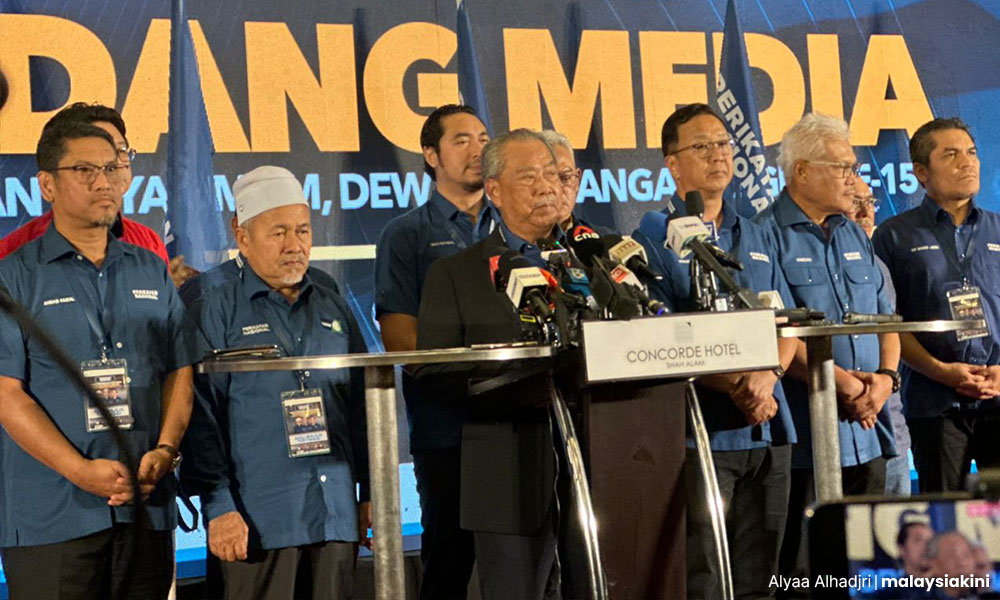
Meanwhile, former Selangor menteri besar Azmin Ali and two of his closest associates - Hilman Idham and Dr Afif Bahardin - are back.
Hilman and Afif, however, got in by the skin of their teeth after winning in Gombak Setia and Taman Medan with razor-thin double-digit majorities.
Over in Penang, PN also won all three state seats in Permatang Pauh - which up until last year was a stronghold for Prime Minister Anwar Ibrahim and his family.
PN’s share of the popular vote in Selangor and Negeri Sembilan is at almost 38 percent, while support for the coalition in Penang is almost 33 percent.
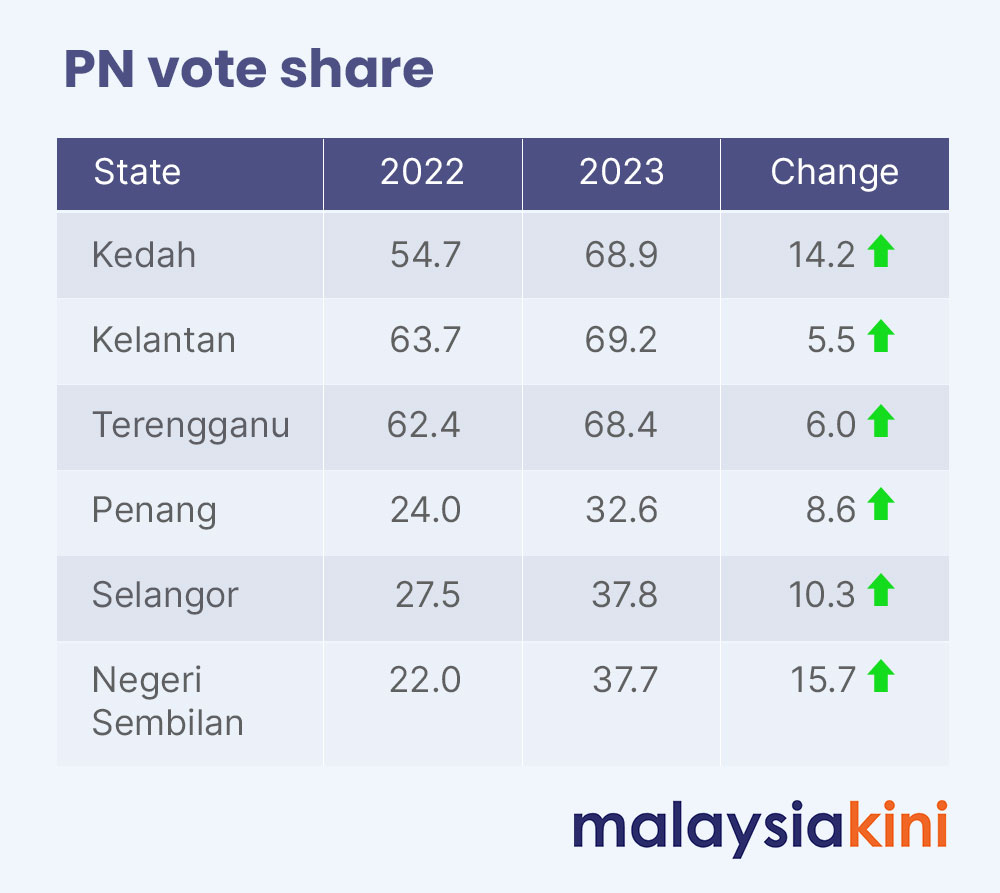
In total, PN gained 56 seats throughout the six states.
Biggest loser: BN
The results showed that the Harapan-BN pact was only successful in Negeri Sembilan, where a two-thirds majority was won with BN contributing 14 out of 31 seats for the state government.
BN failed to contribute more than two seats to the pact in all other states, including the crucial state of Kedah, where they suffered a wipeout.
Coupled with caretaker menteri besar Muhammad Sanusi Md Nor’s stunning popularity among Kedahans, the pact appears to even cost Harapan its stronghold of Derga, which flipped to PN.
This was despite Harapan and BN’s constant efforts to disparage Sanusi in the lead-up to the polls over various issues including alleged sedition against royals, and illegal rare earth mining in the state.
Both Harapan and BN were also wiped out in Terengganu, where PN made a clean sweep.
The results, which are a continuation of BN’s dismal performance since 2018, have major implications for BN, especially Umno.
The poor performance has meant Umno president Ahmad Zahid Hamidi is likely to face a leadership challenge.
One possible challenger might be his deputy Mohamad Hasan, who won his seat in Rantau with a comfortable majority of 11,018 votes.
However, there will also likely be a rebellion from those who were against BN aligning itself with Harapan.
What will happen to the Madani govt?
BN’s backslide in support is also a blow to the Madani government, and calls to question the sustainability of the Harapan-BN pact at the national level.
With Putrajaya at stake, Harapan may surrender the menteri besar position in Negeri Sembilan to BN in order to placate the latter and thank them for winning the state.
However, PN - which has five seats in Negeri Sembilan - may also make the same offer to BN to form the state and federal governments together.
This would require PN to also make an offer to GPS and the Sabah parties in order to form a majority in Parliament.
How can Harapan regain Malay support?
The outcome of the election is indicative of rising Malay support for the PN.
In an attempt to combat this, PKR in particular had moved to pander to conservatives.
This includes an 11th-hour ban on Swatch watches that had LGBT influences.
The results of the election will put PKR and Amanah in a position where they may have to continue pandering to the right in order to win over those who have voted for PN in the next election.
However, this risks PKR and Amanah alienating their non-Malay and liberal supporters, who for now are backing the Madani government likely in a bid to stop a more conservative “Green Wave”.
But analysts like Merdeka Center’s Ibrahim Suffian believe that the so-called “Green Wave” is not just about identity politics, but is an expression of economic anxiety.
As such, simply becoming more conservative may not be enough to win over the Malay votes the Madani pact badly needs, he told BFM.
“Underpinning the so-called ‘Green Wave’ is a sense of economic deprivation and also distress, so if they can make attempts to fix that in the next four years, we'll see this thing be reduced.”
/file/publisher-c1a3f893382d2b2f8a9aa22a654d9c97/2023/08/5c731b87032e7e8cf1844a3be232cc80.jpg)
/file/publisher-c1a3f893382d2b2f8a9aa22a654d9c97/2023/07/e9fb12e3f7a5aa51bdd8943980c0c21c.jpg)
/file/publisher-c1a3f893382d2b2f8a9aa22a654d9c97/2023/08/a3a6f006239a07b46183c62803ac061d.jpg)
/file/publisher-c1a3f893382d2b2f8a9aa22a654d9c97/2023/08/7030abaa2849fe8358d6e73aeea7603e.jpg)
/file/publisher-c1a3f893382d2b2f8a9aa22a654d9c97/2023/08/a42f1981b1e178edda648ea88dddff34.jpg)
/file/publisher-c1a3f893382d2b2f8a9aa22a654d9c97/2023/08/52968d2ee423939cc866fdeecdd766ce.jpg)
/file/publisher-c1a3f893382d2b2f8a9aa22a654d9c97/2023/08/e0a61c245bf9e8fd57bee7bbf37d4191.jpg)
/file/publisher-c1a3f893382d2b2f8a9aa22a654d9c97/2023/08/1220d877ea64ba1e38b0f73a18d625b5.jpg)
/file/publisher-c1a3f893382d2b2f8a9aa22a654d9c97/2021/08/7c985bf627606be1cd2920a9b62da61d.jpg)
/file/publisher-c1a3f893382d2b2f8a9aa22a654d9c97/2023/08/d21af1a5633cfcb4e633840c946c054e.jpg)


The great cost is to our SECLURAISM in the long term. While people such as Suffian may gloss it as economic discontent due to cost of living etc., I believe the Malays are slowly becoming close to PN (Bersatu and PAS). Green wave is HERE TO STAY. There is no denial. In GE15, the wave as created in northern part of Peninsular. Now it gains in central part. Make no mistake, it will MOVE to southern part as well. We will be having Malacca and Johor election in 2/3 years time. Time has change. PN is actually a WINNER in this 6 state elections with higher popular votes. We can call it with whatever name we want, green wave, economy discontent etc but most of the Malays seems having distrust against Madani administration. A vote of PH-BN is a vote for Zahid Hamidi. The Malays seems almost rejected UMNO Baru. How on eratch our PM is going to please the Malays now at the expenses of N0n-Malays. The non-Malays still relay behind PH even though the administration try to win the Malays heart for the last 8 months. The report card for Madani is just a PASS with CAUTION. Is Madani is going to sit on its laurel and pretend as nothing happens to our SECULARISM? A alarm bell had been rung. Wake up and do it fast before it becomes late.
Report this comment
Are you sure you want to delete this comment?
This action cannot be undone.