




Judicial graft: Bar Council wants local survey
The Bar Council wants a local in-depth study on corruption perception, after a global survey revealed that Malaysians felt that the judiciary was not corrupt.
The Bar Council wants a local in-depth study on corruption perception, after a global survey revealed that Malaysians felt that the judiciary was not corrupt.
The council is urging the Malaysian chapter of Transparency International (TI) to carry out the study and issue a country report.
It also wants the Malaysian National Integrity Institute (MNII) to include the state of the judiciary in its national integrity survey, slated for August.
 In a statement yesterday, Bar Council president Ambiga Sreenevasan said the survey contained in TI's 2007 annual global corruption report, "does not, unfortunately, carry an in-depth study."
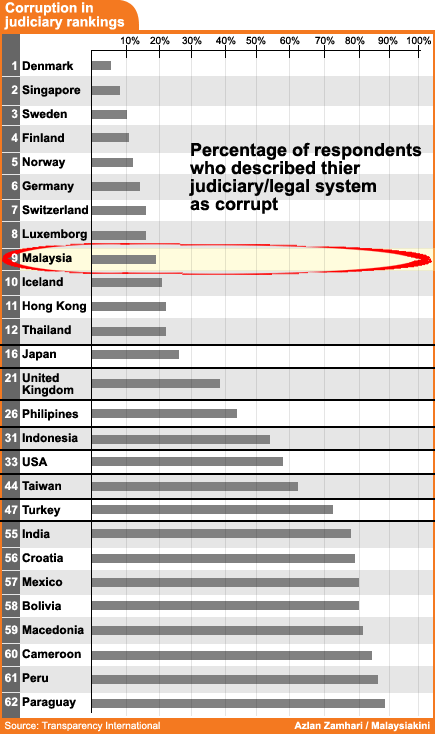
Malaysia ranked ninth of 62 countries surveyed with "relatively low levels" of perceived judicial corruption. It was conducted among some 60,000 people between June and September last year.
The report was officially released on Thursday. TI Malaysia chairperson Ramon Navaratnam expressed surprise at the findings, and encouraged local NGOs to carry out their own surveys.
In the survey, a single question was posed: Does the respondent feel the country's judiciary system is corrupt? For Malaysia, 19 percent felt it was.
No other info or data
"How many and who were actually polled in Malaysia is unclear. It appears that no other reports, data or information were relied on," said Ambiga.
There was no country report on Malaysia, whereas 32 other country reports were presented in this year's report, she said.
"Indeed, the comparative analysis referred to above constitutes a very small part of the entire report consisting of 372 pages," she added.
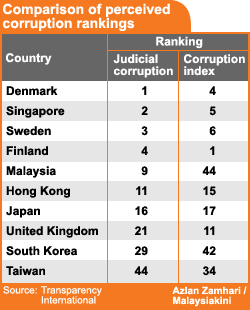 Ambiga said the judiciary corruption perception survey is unlike TI's Corruption Perception Index (CPI). The index ranks countries in terms of the degree to which corruption is perceived to exist among public officials and politicians.
The CPI draws on a variety of sources, including analysts, institutional surveys and World Bank assessments.
"The comparative analysis (judiciary perception survey) on the other hand seems to rely only on the poll conducted," said Ambiga.
She, however, praised the report for "many important" recommendations such as the setting up of a judicial commission for a more transparent promotions process.
Other recommendations include security of tenure for judges, training and the safeguarding of judicial salaries and working conditions.
"Incorruptible and independent institutions are critical to the strength of the nation.
"Of all these institutions, the administration of justice is the most vital and deserves the greatest attention," said Ambiga.


Are you sure you want to delete this comment?
This action cannot be undone.