




Mongolian murder trial seen as test for M'sia
A political analyst with close ties to the deputy premier goes on trial Monday charged with abetting the murder of his Mongolian lover, a case observers see as testing the nation's judicial and political integrity.
A political analyst with close ties to the deputy premier goes on trial Monday charged with abetting the murder of his Mongolian lover, a case observers see as testing the nation's judicial and political integrity.
In a slaying that stunned Malaysia, 28-year-old Altantuya Shaariibuu was killed last October and her body blown up in a jungle clearing south of Kuala Lumpur.
Two members of a police unit that guards Malaysia's top leaders, including the prime minister and his deputy, face murder charges in one of the country's most high-profile trials in years.
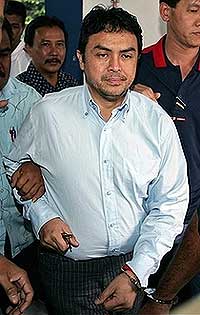 Alongside them, and accused of abetting the murder, is analyst Abdul Razak Baginda, 47, a close associate of Deputy Prime Minister Najib Razak, who has vehemently denied any involvement in the case.
All three accused face the death penalty if convicted.
Ramon Navaratnam, head of Transparency International Malaysia, a branch of the anti-corruption watchdog, said the world would be watching the trial.
"No one can afford to see the case being mishandled or interfered with," he said, "because the whole integrity of the judicial system is under scrutiny."
A loaded trial
Lim Kit Siang, leader of the parliamentary opposition, said it was "a very loaded trial because of the speculation and implications over the involvement of various people, high-profile personalities."
Abdul Razak is a British-educated political and defence analyst who heads the Malaysian Strategic Research Centre think tank.
Married and with a teenage daughter, he was introduced to Altantuya in Hong Kong at the end of 2004, he said in an affidavit and statements to police.
She was a trained teacher and a translator who spoke English, Russian and Chinese, her father has said.
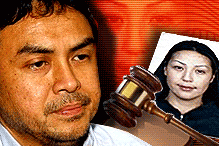 The couple conducted a
jet-setting romance
, meeting in Hong Kong, Shanghai, Singapore, Kuala Lumpur and France. Abdul Razak said they broke up in around August 2005.
The couple conducted a
jet-setting romance
, meeting in Hong Kong, Shanghai, Singapore, Kuala Lumpur and France. Abdul Razak said they broke up in around August 2005.
She began demanding money and blackmailing him, he said in his affidavit, a copy of which was obtained by AFP . He paid several times, but decided to stop in April 2006.
After she turned up at his office and home last October he sought help from a high-ranking police officer, his affidavit said.
That officer in turn put him in touch with another who boasted that he had caused the death of up to 10 people and "could solve my problems", Abdul Razak said, adding though that he asked him not to do anything unlawful.
Altantuya was last seen on Oct 19 as she was being bundled into a car outside Abdul Razak's home.
Police officers Azilah Hadri, 30, and Sirul Azhar Umar, 35, are accused of the murder.
No cover-up
Prime Minister Abdullah Ahmad Badawi has pledged there will be no cover-up, while Mongolia has cautioned against political interference.
Malaysia's judiciary has struggled with a tarnished image since 1988, when the top judge was sacked over alleged misconduct after clashes with then prime minister Dr Mahathir Mohamad.
The judiciary came in for criticism a decade later when Mahathir sacked his deputy Anwar Ibrahim.
International legal groups and rights activists voiced their concern about judicial independence as Anwar was convicted on corruption and sodomy charges.
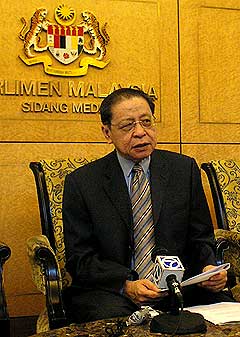 Lim said Malaysia's judiciary had been highly regarded before 1988, and the Altantuya murder case "will be a very important test case as to the degree of recovery of the judiciary."
No evidence has been provided to connect Najib with the killing, and last month he broke months of silence to deny any involvement.
"It's got nothing to do with me at all," he said. "I am not involved at all with Altantuya. Allah is my witness."
Najib is deputy president of Umno, which dominates the ruling coalition.
However Anwar, who now advises the opposition Keadilan party, has demanded an investigation to establish whether Abdul Razak used government connections to organise the crime.


