




Woman released from Islamic rehab camp
A woman who had been forcibly separated from her Hindu husband and 18-month-old baby girl on the grounds of her religion has been released from custody in an Islamic rehabilitation camp yesterday.
A woman who had been forcibly separated from her Hindu husband and 18-month-old baby girl on the grounds of her religion has been released from custody in an Islamic rehabilitation camp yesterday.
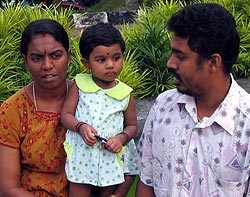 However, the woman - Revathi Masoosai, according to her husband V Suresh, or Siti Fatimah, according to her parents and religious authorities - is prohibited from staying with her husband.
The couple is from Malacca.
Yesterday, Revathi was brought to the Malacca Syariah High Court where she was told that she was freed from the Ulu Yam rehabilitation camp in Selangor.
She had been held there for six months since January.
The court also ruled that she must stay with her Muslim parents, along with her daughter. The baby was seized by the Islamic authorities from her husband and handed over to Revathi's Muslim mother four months ago.
Revathi, 29, was also told by the Islamic court that she could not convert out of Islam.
Suresh had previously claimed that she was not a practising Muslim, but born to Muslim parents and brought up by her Hindu grandmother.
Revathi told reporters that the rehabilitation camp was like a prison and that religious officials tried to force her to pray and wear headscarf.
"Because of their behaviour, I hate ( benci ) Islam even more now," she added.
Case in court
The habeas corpus application today to seek her release was to have been heard this morning at the Shah Alam High Court.
However at the court proceedings, lawyers for the Selangor Islamic Religious Council (Jais) Mohamad Haniff Khatri Abdulla said the matter has been rendered academic and redundant following her release from the rehabilitation camp yesterday.
 Suresh's lawyer Karpal Singh on the other hand told the court that the matter must be heard as it was a matter of public interest as it would set a precedence for similar cases. He wanted the court to declare the detention illegal.
In the end, the court agreed with Haniff and dismissed the application.
Justice Su Geok Yiam said she allowed preliminary objections from Haniff that the Shah Alam High Court had no jurisdiction on grounds that Revathi was no longer in detention.
"The law is clear on this. If the subject of a habeas corpus application is released, then the courts have no jurisdiction to hear the application," said Justice Su after a one-hour recess to make the ruling.
In an immediate response, Karpal said he would file an appeal at the Federal Court on Monday.
A writ of habeas corpus is an application to the court to order the authorities to produce a detainee in court so it can determine whether or not that person is imprisoned lawfully and whether or not he or she should be released from custody.
Representatives from the Bar Council, Malaysian Consultative Council for Buddhism, Christianity, Hinduism and Sikhism and the Melaka Islamic Religious Council (Maim) were also present to observe proceedings.
Related report: 'Revathi, that's my name - forever'
Watch 4-min video of Revathi


Are you sure you want to delete this comment?
This action cannot be undone.