




Apex court stand: Hope for some
While some lawyers welcomed the Federal Court's landmark judgement on Wednesday that family and religious disputes involving both Muslims and non-Muslims be settled in civil courts, others said the ruling is insufficient to indicate how subsequent cases will be decided.
While some lawyers welcomed the Federal Court's landmark judgement on Wednesday that family and religious disputes involving both Muslims and non-Muslims be settled in civil courts, others said the ruling is insufficient to indicate how subsequent cases will be decided.
In making the ruling, Federal Court Justice Abdul Hamid Mohamad had said that legal cases involving non-Muslims cannot be decided by syariah courts.
His decision was received positively by the Bar Council and several lawyers as auguring well for cases involving Muslims and non-Muslims and the question of jurisdiction.
Abdul Hamid's remarks were part of a judgment on a case brought to the court by parties - both Muslims - to a dispute over monies left behind by a deceased person.
The Federal Court said both parties should go to the Syariah Court as both were Muslims but should one party have been non-Muslim, the matter would have to be heard by the civil court foremost.
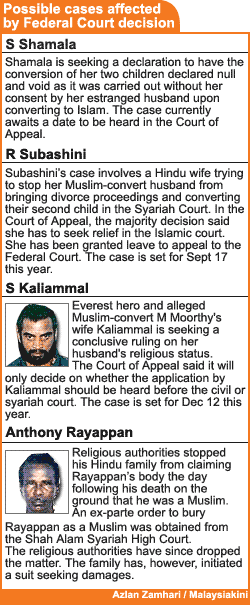
Welcoming the comments, the lawyer acting for R Subashini - who is currently trying to stop her Muslim-convert husband from bringing divorce proceedings and converting their second child in the Syariah courts - said it is 'quite good and encouraging'.
"It reinforces statements that we have made in Subashini's appeal, that the syariah courts have no jurisdiction in cases where one of the parties is non-Muslim," said lawyer K Shanmuga when contacted.
Provide a boost
 Similarly, lawyer M Manoharan said his efforts on behalf of S Kaliammal to seek a conclusive ruling on her deceased husband's (Mt Everest hero M Moorthy) religious status - Islamic religious authorities claim he had converted to Islam - would receive a boost of sorts by Abdul Hamid's judgment.
"The judge is brave enough to come out openly to make it clear. We must thank Justice Abdul Hamid for taking the opportunity to make such a clarification," said Manoharan.
 "When one party is a non-Muslim, whether the issue is one of child custody, land matter, or any other issue, they are subject to and can only be tried in the civil courts," he added.
Other lawyers, however, declined to accord Abdul Hamid's remarks as having any concrete significance to their cases.
Pawancheek Merican, who acted for Rosmawati and Roslinawati Sharibun in whose favour the Federal Court had made its ruling on Wednesday, said the judgment's ratio decidendi (specific grounds of the decision on that particular case) was "definitely binding on similar cases at the lower courts".
Other remarks, however, "which contain his views on such as cases involving Muslims and non-Muslims are persuasive only to the extent they are relevant to the cases currently pending in the lower courts."
"Whether his remarks are binding on other cases depend on how the courts look at the cases concerned, and the specific facts of such a case," said the senior lawyer.
'In passing'
Zainul Rijal Abu Bakar, meanwhile, who is representing Subashini's husband Abdullah Muhammad Shafi Abdullah, said the judge's remarks were made as if in passing and were 'not binding on the lower courts.''
"We have to wait until Sept 17 (when Subashini's case is due to be heard at the Court of Appeal) - if they make a decision then - because it cannot be said we have conclusive determination of the Federal Court on this case," said Zainul Rijal, who is also the president Syariah Lawyers of Malaysia.
However, the landmark judgment is not expected to affect cases involving Muslims seeking to leave Islam such as Lina Joy. Civil court judges are likely to continue referring these cases to the syariah courts.


