




Only right incentives ensure development
The Regent of Perak Raja Nazrin Shah today stressed on the importance of the role played by the state in ensuring sustainable and equitable development.
The Regent of Perak Raja Nazrin Shah today stressed on the importance of the role played by the state in ensuring sustainable and equitable development.
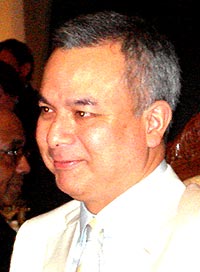 In speech delivered at a book-launching event in Kuala Lumpur, he pointed out, "the state has an important role in ensuring an equitable distribution of income between people, groups of peoples and regions."
Emphasising on the role of the state, he noted that "when it has worked well, the result has been a stimulated economic development".
However he also pointed out that "when it has not worked well, state intervention has verged on the predatory, extracting resources and providing nothing much of a value in return."
"Create the right incentives for efficient market behaviour and people will respond accordingly," he said.
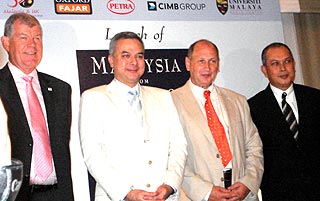
Raja Nazrin was launching a book entitled From Kampung to Twin Towers , authored by Dr Richard Leete, the resident representative of the United Nations development Program of Malaysia.
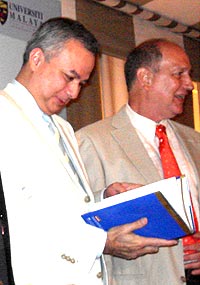 The book looked into 50 years of economic and social development of Malaysia. Raja Nazrin was the guest of honor.
In his speech, the regent, who in the recent past has been a vocal proponent of open and transparent governance, cited China and India's restructural incentives programme as examples of sustainable growth.
"When China in the late 70s and India in the late 90s reformed their incentive structure, they were able to achieve high growth rates," he said.
"However, for growth to be sustainable, these incentives must be embodied in institutions," added the prince.
A success story
At the same time, he said that for markets to flourish, the government must provide appropriate institutional environment.
"Countries that have failed in this respect have experienced stagnating or falling incomes and persistent poverty," he warned.
He continued to emphasize on the need for incentives for governments to provide good governance.
 "This can be achieved through mechanisms such as the separation of powers, readily available avenues for the public to monitor power and rules that inhibit corruption."
"They all contribute toward the effective and efficient functioning of a modern economy," he stressed.
In any event, Raja Nazrin said Malaysia was a success story, emerging as one of Southeast Asia's most developed and prosperous countries.
He said that three factors were pivotal in ensuring Malaysia being able to prosper in the past 50 years political resolve, economic pragmatism and effective implementation of policies.
 He also congratulated Leete (
photo
) for "undertaking this much-needed study", stating that the author was "eminently qualified" to write such a book.
He also congratulated Leete (
photo
) for "undertaking this much-needed study", stating that the author was "eminently qualified" to write such a book.


